
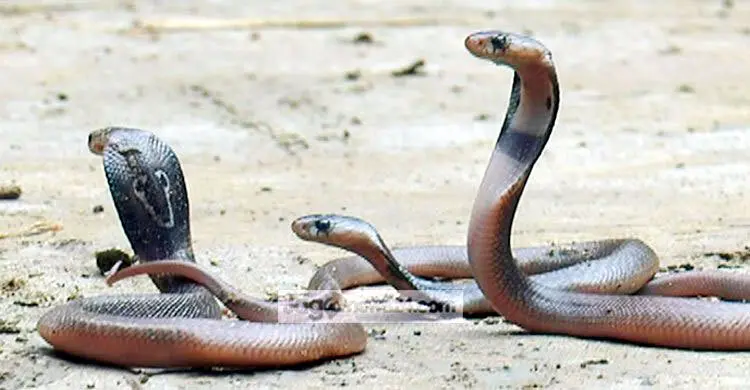
Snakes have become more of a menace in Chuadanga. Last month 48 people injured by snakebites were treated at Chuadanga Sadar Hospital alone, four of whom died under treatment. In the same period at least 20 more snakebite patients reportedly received first aid at the district's other three upazila health complexes.
According to Chuadanga Sadar Hospital, 48 people came for treatment for snakebites from 1 to 31 July: 25 men and 23 women. Four of them died. More than 20 snakebite patients received first aid at the health complexes in Alamdanga, Jibannagar and Damurhuda upazilas, with no deaths there, because the upazila health complexes usually refer high-risk patients to Chuadanga Sadar Hospital.
The four deaths
On 4 July, Halim, son of Shawkat of Kushodanga village in Maheshpur, was bitten by a snake. He died under treatment in the male medicine ward of Chuadanga Sadar Hospital. On 8 July, a snake bit Nazmul, son of Chandu Fakir of Nurnagar village in the municipal area. He was taken to a kabiraj (traditional healer) in Alamdanga and died there.
On 24 July a snake bit Josna Begum (45) of Naolamari village in Khaskorra union, Alamdanga upazila. When her condition worsened, family members took her to the emergency department of Chuadanga Sadar Hospital, where the doctor on duty declared her dead. Most recently, on 28 July, a snake bit Abdur Razzak, son of the late Abul Hossain of Akondobaria village in Damurhuda upazila. His family took him not to hospital but to a kabiraj in Alamdanga upazila. The kabiraj wasted time in the name of treatment and his condition worsened. He was then admitted to Chuadanga Sadar Hospital, where Razzak died under treatment.
Get to hospital in the first hour
Bakhtiar Hamid, founding president of Pankouri, an organisation working on wildlife and the environment, told Jago News that Chuadanga and Jhenaidah have more snakes than anywhere else in the country. People are bitten most from July to August, when monsoon water fills the surroundings and snakes look for higher, warmer places and enter settlements. Scrub and bushes are also being cleared day by day, destroying their habitat, which is another reason they come into settlements, meet people and bite them.
He said the biggest mistake after a snakebite is taking the victim to an ojha or kabiraj instead of hospital. Ojhas can never cure a patient; a snakebite victim must reach hospital within the first hour. Many patients die of heart attacks from fear after being bitten, so the patient must be reassured. People should use a torch when walking at night and sleep under a mosquito net, he said.
Chuadanga civil surgeon Dr Sajjat Hasan told Jago News that there is no alternative to public awareness to reduce snakebite deaths. After a bite the patient must come quickly to the local hospital. If the doctor thinks the snake was venomous, all local hospitals have enough antivenom vaccine, which must be given to the patient, he said.
Source: Jagonews24. First published in Bengali on The Agro News.
Comments
(0)