
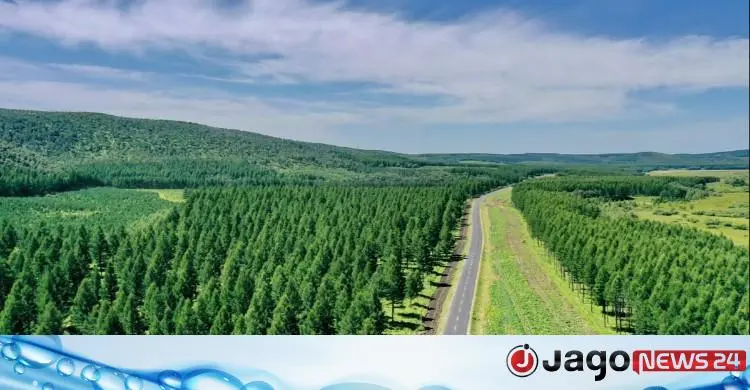
When we picture the changing face of the Earth from satellites, we usually think of shrinking forests or climate disaster. For centuries, rebuilding a forest was thought to be a slow process, and many believe planted forests grow far more slowly than natural ones. A vast environmental project in East Asia has overturned that idea.
Over the past few decades China has turned millions of acres of desert into a living ecosystem. A recent study found that leaf growth in the country's man-made forests is much faster than in natural forests, according to a paper in the scientific journal Geophysical Research Letters.
Satellite images show a 66 per cent lead
A team of researchers led by climate scientist Yuhang Luo analysed several decades of satellite images, comparing forest growth patterns in different regions of China. They found that China's huge planted forests are about 66 per cent ahead of nearby natural forests in leaf production.
China launched a mega-project in 1978 to halt the spread of deserts, planting billions of trees in its northern and western regions.
The researchers first thought that growth in monoculture or planted forests might stall for lack of soil nutrients, but the satellite data show the opposite. These planted forests have adapted remarkably well to rising carbon dioxide in the atmosphere.
The study says the rapid growth is driven by the rising level of carbon in the atmosphere. Because fast-growing species were planted, they can absorb carbon dioxide quickly. Being young and sensitive to carbon, the trees are putting on leaves quickly and the forest is becoming denser.
Natural forests still store more carbon
A study published in another environmental journal, Communications Earth and Environment, by Kai Cheng and his team gives more detail. It found that although planted forests can put out leaves quickly, natural forests are more effective at storing carbon in the long term. Because natural forests have diverse tree species and uneven density, carbon stays there longer.
Analysing data from China's national forestry department, the researchers found that although planted forests are denser, natural forests of the same age hold more carbon. Planted forests, however, contribute much more to preventing soil erosion and reducing dust storms.
The findings of the two studies point to new paths in the fight against climate change. These man-made forests can spread green leaves very quickly, which helps hold desert sand in place, and they play a major early role in absorbing atmospheric carbon.
But experts say one should not look only at how many trees were planted. As these planted forests age, their growth may slow. For their long-term protection, native species need to be added and forest density managed.
Based on a report in the Times of India.
Source: Jagonews24. First published in Bengali on The Agro News.
Comments
(0)