
China's agrochemical industry has moved out of the trough into what analyst Xiaoyu (David) Li calls "a mild bottom-level recovery with sharp structural divergence": prices have stopped falling, but profits have not followed. In the first three quarters of 2026, the 24 listed Chinese pesticide companies he covers raised combined revenue 2.26% to USD 20.177 billion while their recurring net profit fell 8.02% to USD 754 million, with a median weighted return on equity of 2.76%.
Prices are still far below their peak. In November 2026 the median price of 131 comparable technical-grade active ingredients was 51.4% below its 2020-2023 high, and 51.9% of them were more than 50% below. Li, marketing director of SPM Biosciences and author of AgriBusiness Global's China price index, set out the figures in a 2027 outlook that AgriBusiness Global summarised on 27 November.
The obstacle, he argues, is not farmers' demand but cash, credit and rules. He cites 23% of Brazil's farm loan book classed as troubled, North American distributors buying just in time, US anti-dumping and countervailing duty cases on Chinese glyphosate, a proposal by Sindiveg in Brazil to raise import tariffs to 35% on six formulation lines, and the EU's planned zero-residue limits for unapproved high-risk actives. Demand peaks are becoming shorter and sharper, with longer quiet seasons in between.
With home demand flat, growth depends on exports, and those are shifting from volume to value. Formulations overtook technical material in export value for the first time in 2024, at 54.12%. From January to September 2026 pesticide exports under HS code 3808 reached USD 7.839 billion, up 9.6%, and 2.6205 million tonnes, up 4.7%, although the third quarter brought the first simultaneous fall in both volume and price.
Policy is pushing the same way. The National Plan for the Development of the Pesticide Industry (2026-2030), issued on 19 October 2026, lists 76 restricted products, among them glyphosate, glufosinate, 2,4-D, atrazine and imidacloprid. Li stresses that the restriction applies to new licences and registrations, not to use or existing plants. Biopesticides such as RNA and peptide products are the favoured growth track, and export VAT rebates on selected technical materials were removed from 1 April 2026. The share of the top 10 firms rose from 34% in 2024 to 45% in 2025, and Li thinks it will very likely pass 60% by 2030.
New investment is going into newer off-patent chemistry rather than commodity actives such as glyphosate, 2,4-D and atrazine, and about 46% of announced capacity has not broken ground. Li names five questions for 2027: whether price rises turn into profit, the US duty and Brazilian tariff rulings, the final EU Omnibus X text, the path of the yuan and when new capacity arrives. The analysis and its forecasts are Li's own; the AgriBusiness Global summary was written by Matt Hopkins.
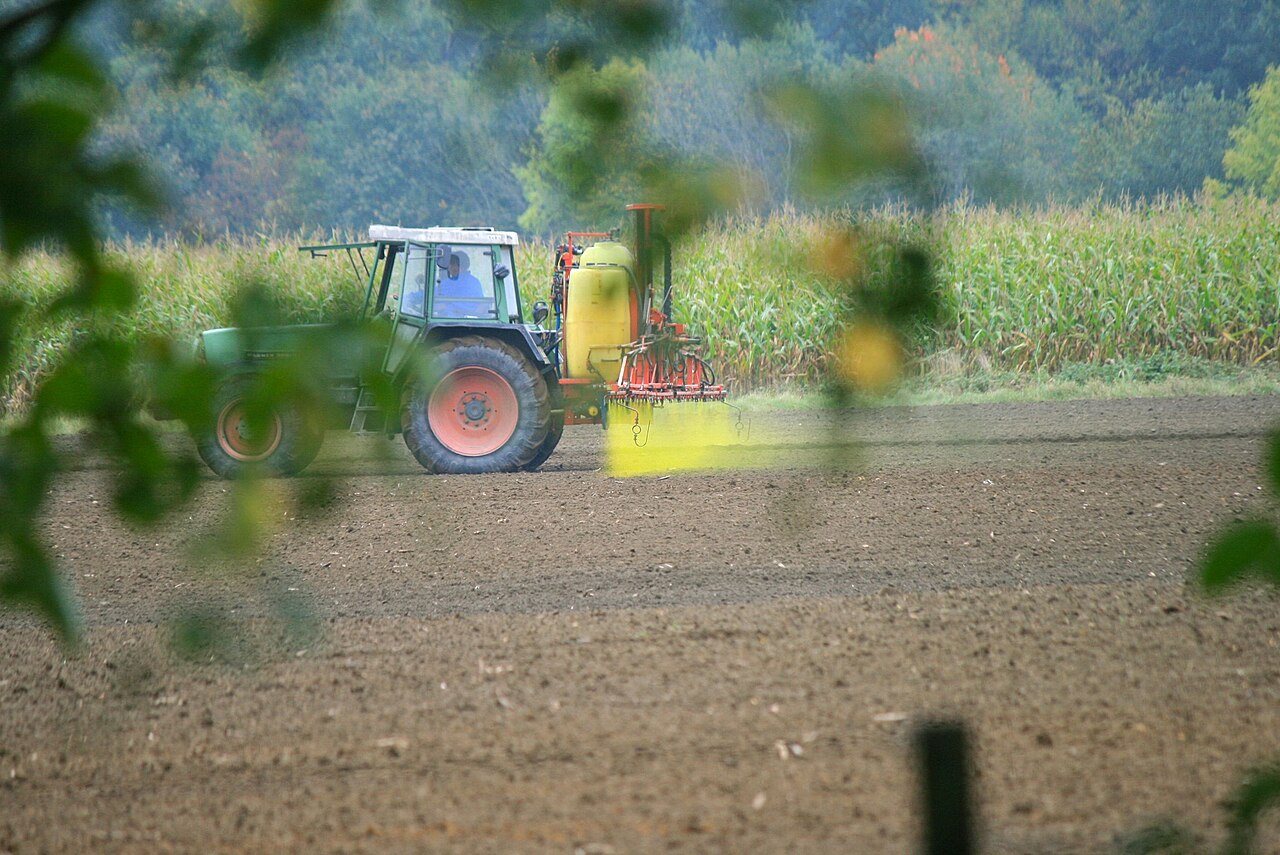
Photo: Stefan Thiesen / Wikimedia Commons (CC BY-SA 3.0)
Source: AgriBusiness Global

Comments
(0)