
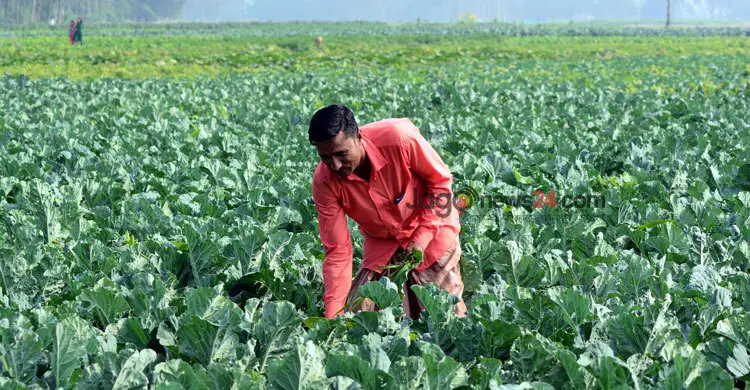
Watered by the Karnaphuli, Halda, Sangu, Ichhakhali, Chandkhali, Murari and Dolu rivers, Chattogram has always been fertile farming country. For several years the area under early vegetables has been growing, as market demand rises and the crop is comparatively more profitable. Young agri-entrepreneurs in particular are leading the way.
From 23 acres to 40
One of them is Shahidul Islam Babar of south Chattogram. Owner of Sunmoon Agro and Fisheries, Babar has built a large farm on about 40 acres in Satkania and Lohagara upazilas, where many kinds of vegetables are grown with the early-season demand in mind.
Shahidul Islam Babar told Jagonews24: "Normally our crops are harvested from December to January. But at that time farmers do not get a fair price. On the other hand, there is a shortage of vegetables in the market at the end of the monsoon, and prices are high. With all this in mind, for several years we have been focusing on early vegetables."
He said: "In 2020 I started by growing vegetables on 23 acres. Now I have built up cultivation on about 40 acres. This was possible by making proper use of every season." On his farm in Satkania, cucumbers are grown under mulch, which raises yields and keeps weeds down.
It is not only Shahidul Islam Babar. Early vegetables are now being grown along the Sangu river in areas of Chandanaish including Dhopachhari, Dohazari, Barma, Bailtali, Basrat Nagar, Hazaribazar, Barotkhana, Chagachar, Jamirjuri, Laltia, Diakul, Raijoara, Killapara, Laliar Char, Laltiar Char, Puranagar and Shilghata, and in Kaliaish, Khagaria, Nalua, Amilaish and Charati in Satkania.
Across wide areas there, farmers are growing winter vegetables such as cauliflower, cabbage, radish, aubergine, bitter gourd, spiny gourd, tomato, bottle gourd, red amaranth, radish greens and coriander leaves.
Lohagara upazila agriculture officer Kazi Shafiul Islam said: "For several years we have been encouraging farmers to grow early vegetables. This year early winter vegetables are being grown on 50 hectares. Many farmers have already started to harvest."
Sitakunda, Saidpur and Fatikchhari
Farmers in Sitakunda are busy bringing winter vegetables to market early. According to the upazila agriculture office, winter vegetables have been grown on a total of 5,400 hectares in Sitakunda, of which 2,650 hectares are beans and 2,750 hectares other crops.
Nazmul Islam, a young agri-entrepreneur from Saidpur, said: "If any vegetable can be brought to market at the start of the season, it fetches a higher price. Radish, red amaranth, bitter gourd and spinach have already started coming to market, and we are getting good prices."
Two young agri-entrepreneurs in Fatikchhari, Abdul Halim and Osman Gani, have through their joint efforts turned Rupai Valley Agro Farm, in a remote hilly part of Fatikchhari, into a hands-on training centre for local farmers. Early vegetables have already started to be harvested on the farm.
They said any crop grown early meets higher market demand, so the profit is much greater. Using modern methods, it is now possible to grow pesticide-free vegetables.
Abdul Halim said: "At Rupai Valley Agro Farm we use yellow sticky traps, pheromone-based organic methods and organic fertiliser to produce safe crops. These two pest control methods make it easier to control insects without pesticides. Organic methods also cost less."
Output nearly doubled
Four or five years ago most of Chattogram's vegetable demand was met with vegetables supplied from the north of the country. Young agri-entrepreneurs have changed that picture. Thanks to timely decisions, most of the demand is now met with vegetables grown locally.
According to the agriculture department, Chattogram's growth in vegetable production is 20 per cent, almost three times the national growth rate. In 2010-11 Chattogram produced 2.75 lakh tonnes. Over a dozen years, vegetable production has nearly doubled and now stands at more than 6 lakh tonnes. Use of high-yielding seed is raising output, and farmers are turning to vegetables because they earn more than from rice.
Rain and late floods
Prolonged rain and late floods linked to climate change are becoming a major obstacle to vegetable farming.
Chandanaish upazila agriculture officer Azad Hossain said a target of 700 hectares had been set for early winter vegetables under Kharif-2 this rabi season, but because of the rain farmers had managed to plant only about 400 hectares so far.
He said: "Because of the rain, farmers have been in some difficulty with early winter vegetables this season. Farmers hit by prolonged rain and floods will be helped quickly through incentives and rehabilitation programmes."
Source: Jagonews24. First published in Bengali on The Agro News.

Comments
(0)