
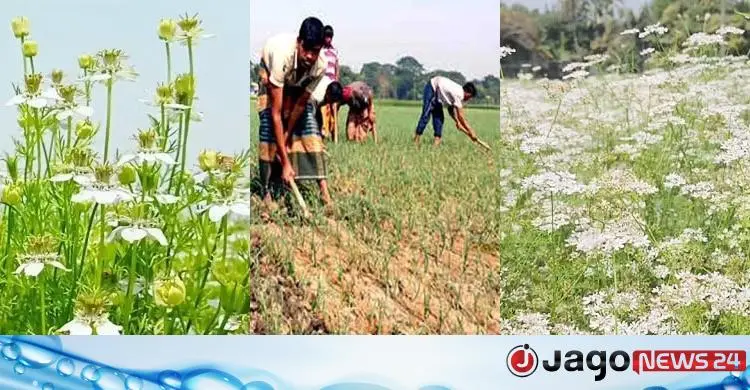
Bangladesh has about 8.3 lakh hectares of char land along the banks of the Padma, Meghna, Jamuna, Brahmaputra, Teesta, Dhaleshwari and other rivers, of which about 5.2 to 7.9 lakh hectares are cultivable. About 65 lakh people live on the chars. Char soils are short of nutrients and organic matter. The salinity-free char areas are in Kurigram, Lalmonirhat, Sirajganj, Bogura, Pabna, Rajshahi, Jamalpur, Manikganj, Tangail, Faridpur, Kushtia, Shariatpur, Madaripur and Chandpur. Crops are grown on the chars after floodwater recedes, and char farmers usually grow various local varieties in their own way.
Spice crops are very popular in Bangladesh, but the shortage of cultivable land on the mainland means the area under spices cannot be expanded. Onion, garlic, chilli, coriander and black cumin are the most important spice crops, and there is a considerable shortfall in all of them. In an era of climate change, there is ample scope to raise both yield and production of these spices in the harsh char ecosystem to feed a growing population. For sustainable production and national food security, improved varieties and modern methods, along with sole and mixed cropping, are needed on the chars.
Two kinds of char
Attached chars are high, with relatively more sand and weeds and less silt. Early-sown or early-planted crops and crops with a long field duration are chosen here. Garlic, onion, murikata onion (grown from small bulbs) and chilli are usually grown as sole or mixed crops.
Island chars are low, with few weeds but more silt. Late-sown crops and crops with a short field duration are chosen. Here onion is usually grown alone, or with black cumin and coriander as mixed crops.
Growing two or more crop species together on the same land is called mixed cropping. By making the fullest use of land, labour, nutrients, water and light, it raises total output, income and cropping intensity per unit of land compared with a single crop. It also reduces pest and disease attack and improves the success of cultivation. Cropping intensity on the chars is currently 145-162 per cent and can be raised considerably with planned mixed cropping. Growing two crops on the same land in a set pattern is called intercropping, which can be done on the chars in rows or strips.
Onion with black cumin and coriander
On island chars, black cumin or coriander, or both, are grown as mixed crops with direct-seeded onion. The land is prepared with two passes of a power tiller and laddering. At the final ploughing, rotted cow dung is applied where available, along with 35 kg TSP, 25 kg MoP, 20 kg gypsum, 2-3 kg zinc and 1-2 kg boron fertiliser per bigha. If the soil lacks moisture, fertiliser should be applied with water.
Three onion varieties suit the chars: BARI onion-1, BARI onion-4 and BARI onion-6, of which BARI onion-4 is a much improved variety. The improved varieties of black cumin and coriander are BARI kalozira-1 and BARI dhonia-2 respectively.
- In December, onion (800-1,000 g a bigha), coriander (1.0-1.5 kg a bigha) and black cumin (800-1,000 g a bigha) seeds are sown together. If both coriander and black cumin are mixed with onion, their seed rates are halved. The seed is then covered with sand.
- Before sowing, onion seed should be treated with 2 g of Provax fungicide per kg of seed. Coriander seed should be soaked in water for 24-48 hours and dried before sowing.
- Black cumin seed should be sun-dried for at least two days, cooled, soaked in water for 10-12 hours, treated with 2 g of Provax per kg, then dried until free-flowing and sown. On many chars farmers sow without ploughing.
- 20-25 days after sowing, irrigate and apply 15-20 kg urea a bigha. At 40-45 days, weed, irrigate and apply another 15-20 kg urea. At 60-70 days, weed and irrigate again and apply 15-20 kg urea.
- For disease control, spray Luna Sensation (1 ml a litre of water), Rovral (2 g a litre) or Amistar Top (1 ml a litre) in rotation every 15 days. For thrips, spray Success or Imitaf (1 ml a litre).
Harvest and yields
Many farmers keep about 25-30 per cent of the coriander in the field and pull up the rest for sale. Others sow a third of the usual coriander and black cumin seed rate. Many grow garlic, coriander and black cumin along field boundaries.
Onion is harvested from the end of March to the first week of April. Coriander and black cumin seed is harvested 15-20 days before the onion, while coriander leaves are harvested within 1.0-1.5 months of sowing. Onion yields 2.0-2.5 tonnes a bigha depending on variety; black cumin 120-140 kg a bigha; and coriander 150-200 kg of seed and 500-700 kg of fresh leaves a bigha.
Making the fullest use of nature through mixed cropping in this way raises total output, income and cropping intensity per unit of land compared with a single crop, so there is ample scope to increase both the yield and production of these spice crops in the char ecosystem.
Source: Jagonews24. First published in Bengali on The Agro News.

Comments
(0)