
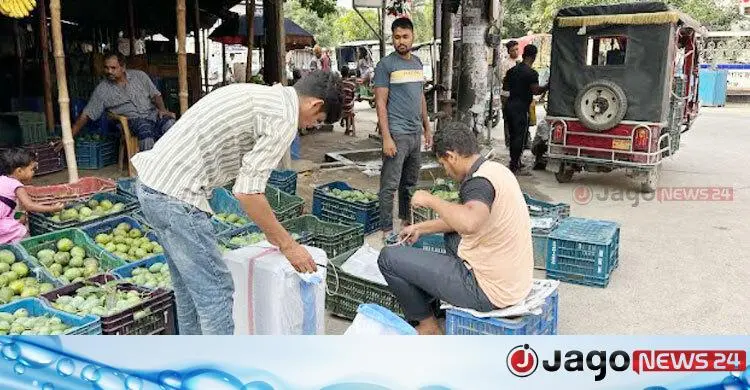
Chapainawabganj's mangoes have won a reputation beyond the country's borders, but this season they are bringing growers worry rather than smiles. Production costs are rising but the expected prices are not coming. Growers and traders complain that oversupply, the influence of middlemen, a shortage of crates and rising transport and courier costs are denying them a fair price throughout the season, and many are counting losses instead of profits.
Growers said they have been losing money for several years because mango prices are not fair. While production costs rise day by day, market prices are not stable and in many cases are falling. People in the sector believe interest in mango farming is declining somewhat as a result.
Talking to growers and traders, the reasons for falling prices include heavy pressure of supply, higher transport and packaging costs, the influence of middlemen, and huge quantities of mangoes reaching the market at the same point in the season. The shortage and high price of crates used for packing are also affecting overall prices, and courier charges are hitting growers directly.
Where the money goes
A maund of mangoes at Kansat market costs about Tk 2,000. Transporting it needs at least three crates, because a maund there is counted as 60 kg and each crate holds about 20 kg. Three crates now cost about Tk 900, so with packaging alone the total reaches about Tk 2,900. A significant share of sale income thus goes on crates, cutting deeply into profit. And there are more costs to market the fruit.
Then there is labour. Extra workers are needed in the season to pick, sort and fill crates, and shortages and demand push wages up. Filling three crates, including labour and paper, costs at least Tk 300. Courier charges then add Tk 16 to Tk 20 a kg. By the time the mangoes are loaded for transport from the market, the cost is about Tk 4,400 — meaning about Tk 2,400 is spent on other items for Tk 2,000 worth of mangoes. Buyers set their prices with these costs in mind.
According to people in the trade, sending a kilogram of mangoes by courier costs up to about Tk 16 on average, and more for distant districts or the capital's markets.
Local traders say that with packaging, labour and transport costs all rising at once, the whole mango marketing system is under pressure. There are complaints that middlemen often use these extra costs as an excuse to buy mangoes cheaply from growers. Farmers lose out, and the balance of fair prices in the market is upset.
A long wait at Kansat
Atikur Rahman of Shyampur union set out at dawn with high hopes, bringing Lakshmanbhog mangoes from his orchard to Kansat market by van. He reached the market at around 9am and waited for buyers, but with supply high and buyers few, he had not sold his vanload by 1pm.
Expressing frustration, he told Jago News that besides not getting a fair price, waiting for hours without a sale adds to transport and other costs.
Mango trader Hamidur Rahman Sujan told Jago News that mangoes were once carried and sold in bamboo baskets, but plastic crates came into use gradually from 2016. A crate initially cost Tk 60-70, but the price has risen several times over and one now costs Tk 300. Over the same period mango prices have fallen relatively, so growers' and traders' costs are rising while profits shrink.
Mango prices may be falling, he said, but packaging, transport and labour costs keep rising, putting extra pressure on traders.
Mango grower Rafiqul Islam said a syndicate is involved in the plastic crate business. After the mango season ends, these traders buy up large numbers of crates and stockpile them, then sell them at much higher prices when demand rises at the start of the new season. Growers and traders thus bear extra costs from the very start of the season.
When crate prices are driven up by creating an artificial shortage, he said, it directly affects the cost of producing and marketing mangoes, and in the end the growers carry the burden.
Co-operative and officials speak
Ismail Khan Shamim, general secretary of the Shibganj Mango Producer Co-operative Society Limited, said the main costs of mango farming were once orchard care, fertiliser, irrigation and labour. Now, besides production costs, marketing costs have risen alarmingly, and higher prices for packaging materials in particular have put heavy new pressure on growers and traders. Crates, cartons, paper, tape and other packaging are needed to send mangoes around the country, and courier and transport charges rise every year.
"There is no alternative to good packaging to get mangoes safely to their destination. But the way these materials are getting more expensive, growers' share of the profit keeps shrinking. Even when mango prices are relatively stable, or in many cases falling, production and marketing costs keep rising," he said.
Pesticides, disease control, labour, transport and courier charges are all ultimately borne by growers, he said. Mangoes that usually sell for Tk 50 a kg at Kansat market are selling online for Tk 150.
Things have reached a point where packaging and transport often cost more than the mangoes themselves, he said, and small and medium growers are hit hardest. With costs rising and prices not keeping pace, many growers are losing heart. He believes that without closer monitoring of the packaging market and special support for growers, mango farming will become even more expensive, hurting one of the country's most promising farm sectors.
Md Mominul Haque, Chapainawabganj district marketing officer, said various initiatives are under way to curb the dominance of middlemen in mango marketing and ensure fair prices for growers. Emphasis is also being placed on transparency in market management and on narrowing the gap between producers and consumers.
He said the market situation this season, growers' problems and the rise in packaging costs have been reported to higher authorities. The complaints of farmers and traders are being taken seriously, and efforts are under way to take the necessary steps in co-ordination with the relevant offices.
Mango is an important cash fruit for the country, Mominul Haque said, so the government is working to protect growers' interests and ensure proper market management. The authorities are keeping watch so that there is no artificial shortage, unreasonable price rise or middlemen's influence in the market.
This season Chapainawabganj has set a target of producing 458,912 tonnes of mangoes on 37,000 hectares.
Source: Jagonews24. First published in Bengali on The Agro News.
Comments
(0)