
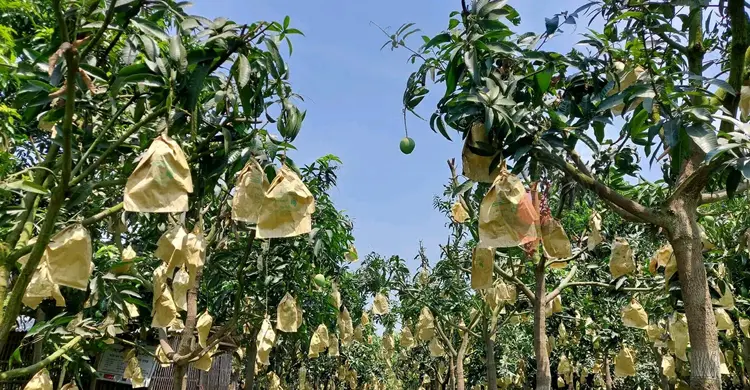
A huge amount of work has been going on around mangoes in Chapainawabganj for the past two months. Recently growers have been using fruit bags, a kind of jacket that covers the mango, to keep the sweet fruit poison-free and fit for export. The agriculture department says fruit bagging can produce mangoes completely free of disease and pest attack without pesticides, and cuts pesticide use by 70-80 percent.
In Sundarpur union and Baroghoria in Sadar upazila and in Monakosha, Shyampur, Khasherhat and other areas of Shibganj upazila, orchards were busy with work. Some workers stood on ladders and others on tables to fit fruit bags on the mangoes. The work has created jobs for many, including schoolboys, who are covering their school costs with it.
Growers weigh cost and profit
Sajib Ali, a grower from Shibtala neighbourhood of Chapainawabganj, said: "This year I have more than about four maunds of mangoes on 200 trees of Ashwina, Khirshapati, Lakshmanbhog, Fazli and other varieties in the Dhorbona area of Ranihati. Of these, I have used fruit bags on about 200 maunds of Ashwina, because last year I lost money bagging other mangoes. A fruit bag costs more than about Tk 4, so the cost is high. But bagging Ashwina mangoes was profitable, so this year again I have bagged about 20,000 mangoes, which should come to about 200 maunds."
Nayan, a grower living at Kansat Bazar in Shibganj upazila, told Jagonews: "I have been in the mango business for 10 years. The first few years were profitable, but for the past three or four years I have been losing. This year all the trees are full of mangoes, and I hope to make a profit. So I am using fruit bags on the Ashwina mangoes. It means less pesticide."
Bhulu Rahman of Shyampur union told Jagonews: "I have about 1,200 maunds of Ashwina mangoes on 300 trees, my own and ones I bought. So far about 50,000 mangoes have been bagged, and work on the rest is going on."
He said: "About 20 labourers work in the orchard every day at Tk 300 a day. But I am worried about mango prices. If I get a good price I may make a profit; otherwise everything is gone, because I spent all the money I had buying orchards."
Shariful Islam, a grower from Babpur, said: "I have about 100 mango trees, all Ashwina. But 10-15 kinds of fruit bags are on sale in the market now, and I cannot tell which to take or which is good or bad. The agriculture department is not really helping either. It has caused me trouble."
Ibrahim, 15, who was up an Ashwina tree bagging mangoes in an orchard in Shyampur union, told Jagonews: "Adults can't do this fruit bagging. That's why children are in demand for the work, because if adults climb the trees the branches may break."
Concerns over bag quality
Ismail Khan Shamim, general secretary of the Shibganj Mango Producer Co-operative Society, said fruit bags have been used in Chapainawabganj since 2015, but their quality is not controlled. People are supplying them however they can, and because they are poor quality, mango traders are losing out. They are also very cheap. The agriculture department needs to monitor this.
He said: "People in other districts think bagged mangoes are less sweet, but that is not so. Bagged mangoes are sweeter than others. Mangoes from this district will reach the market in the first week of June, but mangoes are already being sold in the market under the Chapainawabganj name. That is sad. None of our growers has picked mangoes yet."
Fruit bags do not spoil when wet with rain and do not block light and air from reaching the mango. About 100-150 million mangoes are bagged in Chapainawabganj each year, because the method gives fruit completely free of disease and pests without pesticides, and growers benefit.
Palash Sarkar, deputy director of the Department of Agricultural Extension (DAE) in the district, said fruit bagging is very popular in Chapainawabganj, with growers using bags mostly on Ashwina mangoes. The yield is very good this year and he hopes growers will profit. The department is always giving growers good advice, he said.
Mango orchards cover 37,855 hectares in Chapainawabganj district, and this year's production target is 425,000 tonnes.
Source: Jagonews24. First published in Bengali on The Agro News.
Comments
(0)