
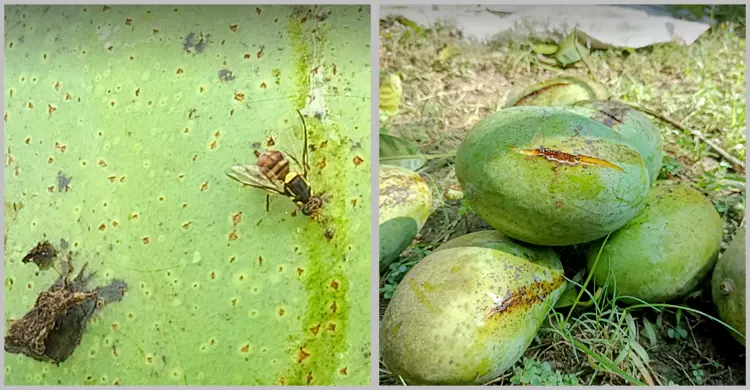
Heavy rain has been falling for more than ten days in Chapainawabganj, known as the capital of mangoes. It has brought an infestation of fruit flies in the mango orchards. Mangoes are splitting where the flies bite them, thousands of growers are suffering, and Fazli mangoes worth crores of taka are rotting on the trees.
People involved say the fruit fly appears whenever there is very heavy rain, but so far orchard owners have not been able to control it.
Visits to orchards across the district found rows of trees hung with Fazli mangoes, but fruit flies had bitten most of them, leaving the fruit to split and rot. Growers are finding no remedy from anyone and are worried.
Half the crop lost
Shibganj produces the most mangoes in the district. Enamul Haque, a grower in Shyampur union of the upazila, said the heavy rain started about 10 days ago. A few days ago he saw fruit flies in his Fazli orchard. He sprayed pesticide but it did no good. The flies keep piercing the mangoes, and a pierced mango splits, spoils and rots.
He has 14 Fazli trees on two bighas, which he estimated carried about 100 maunds of mangoes. More than half have been ruined. He is feeding them to his cows and throwing many away in the orchard, because there are more split mangoes than the cows can eat. He cannot pick and sell them either, because mango prices are now very low.
Riyal Uddin, a grower near Kansat bazar, said he had been picking since morning, and for every good mango he had found a split one. "In a word, if you pick two baskets of mangoes, one basket is split," he said.
He said the mango market is so slack that the Kansat bazar is not taking mangoes, and when it does, prices are very low. Meanwhile, the mangoes are all splitting and spoiling.
Pheromones or fruit bagging
Ismail Khan Shamim, general secretary of the Shibganj Mango Producers' Co-operative Society, said Shibganj upazila produces the most Fazli mangoes in the district, but the problem here is the fruit fly. Whenever it rains, fruit flies bite the mangoes, and this year they have attacked almost every Fazli orchard. When the fly attacks, more than 30 percent of the mangoes are ruined; by that reckoning, the pest has destroyed mangoes worth more than a crore taka.
He said the pest could be controlled if the government took steps, but it cannot be controlled by spraying any pesticide. He called on the government to use sex pheromones in the area, which he said would stop the pest breeding; otherwise mangoes worth crores of taka would be ruined every year.
He said the agriculture department advises using fruit bagging to protect against the pest. "But the problem is that bagged mangoes fetch much lower prices in the market. So what do I gain by spending money on bagging?"
Dr Md Mokhlesur Rahman, chief scientific officer at the Regional Horticulture Research Station in Chapainawabganj, said Fazli growers live in fear of the fruit fly whenever it rains. The pest destroys 20-30 percent of mangoes. Spraying pesticide does not solve the problem; the solution is fruit bagging.
Asked about it, Palash Sarkar, deputy director of the district Department of Agricultural Extension (DAE), said fruit fly attacks increase when it rains. He said Fazli growers had been advised to use fruit bagging. Those who used it were protected, while the orchards of those who did not were attacked. The sky is now clear, and he hoped there would be no more attacks.
Source: Jagonews24. First published in Bengali on The Agro News.
Comments
(0)