
Chapainawabganj is known at home and abroad as the mango capital, and for decades the district's farming and economy have revolved around mango. In recent years, however, farmers have suffered heavy losses on mango because of climate change, irregular rain, disease, rising production costs and failure to get fair prices. As a result, hundreds of farmers in the district are turning to jujube (boroi) as an alternative, profitable crop.
The district now grows many jujube varieties, including China, Ball Sundari, Bombai Fuli, Diamond, Baukul, Thai, Baby Sundari and Bharat Sundari. Relatively little care, low costs and quick yields have given farmers new hope. Many have started planting jujube between the trees in their mango orchards or on land that had lain fallow for a long time.
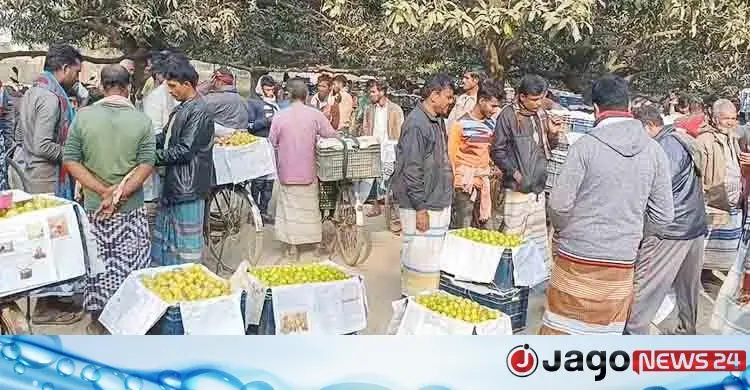
Mirzapur jujube market
The jujube market at Mirzapur in Daipukuria union of Shibganj upazila has become the centre of the trade. Every day from early afternoon, farmers from the district's upazilas and from the neighbouring district bring crates of jujube to the market in vans and pick-ups.
Local resident and trader Ali Asraf said: "From 12 noon every day the crowd of farmers starts to grow. Wholesalers sort and buy the jujube. From here it is sent to Dhaka, Chattogram, Sylhet, Cox's Bazar and other districts. At present a maund of jujube sells for Tk 3,500 to Tk 4,000."
From mango losses to new hope
Many farmers now hope to get back on their feet financially through jujube. One of them is Tarek Rahman, a jujube grower in Shibganj upazila. "I have been involved in the mango business since birth. For a long time mango was our family's main source of income. But for the past few years we have been making losses on mango year after year because of bad weather, rising production costs and not getting fair prices. That put us in severe financial difficulty," he said.
"Looking for another source of income, I first started growing jujube on a small plot. Because the yield was good and the market price was good, I am now quite hopeful. Jujube costs less, takes less time and pays quickly. I plan to expand it to more land in future."
According to the agriculture department, about 560 hectares in Chapainawabganj district are under jujube this season, significantly more than the previous year.
Dr Md Yasin Ali, deputy director of the Department of Agricultural Extension (DAE) in Chapainawabganj, said: "Because of losses on mango, many farmers are turning to jujube. The Mirzapur market sells about Tk 1 crore worth of jujube a day. Jujube is a profitable crop and is becoming a major alternative source of income for growers."
He said that if modern cultivation methods, training and market management can be ensured, jujube will play an important role in Chapainawabganj's farm economy in future.
People involved in the sector believe that with more government support, storage facilities and export initiatives, jujube could not only change farmers' fortunes but also open a new agricultural opportunity for Chapainawabganj beyond its mango-dependent economy.
Source: Jagonews24. First published in Bengali on The Agro News.
Comments
(0)