
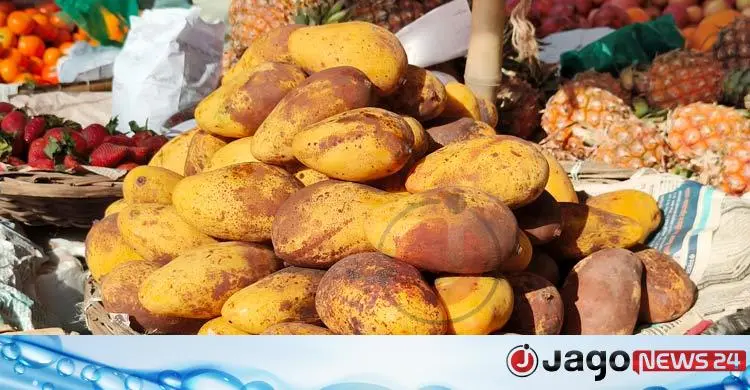
In Chapainawabganj, known as the "mango capital", spring means trees covered in blossom. Golden blossoms and tender leaves are everywhere and the sweet scent of mango hangs in the air. Farmers are busy tending their orchards: protecting blossoms, spraying regularly, irrigating and keeping orchards clean. Meanwhile, in a few exceptional orchards in the district, early Katimon mangoes are already on the trees.
Before the season has even started, green and ripe Katimon mangoes are hanging on the trees and have already drawn a strong response in the market. Demand for these early mangoes has multiplied, especially with Ramadan.
A 40-bigha orchard
Habibur Rahman, a resident of Shibganj upazila, has set up a Katimon orchard on 40 bighas of leased land in Ghion village of Nachole upazila. Thanks to proper pruning, timely fertiliser, disease control and regular supervision, his orchard is already bearing fruit, with large green Katimon mangoes hanging in clusters.
He said he hopes to sell about Tk 30 lakh worth of mangoes this season, and that with demand for early mangoes around Ramadan, prices are relatively high. "If you can catch the early market, the profit is higher. The yield is good this year and I am getting good prices too. I hope to exceed my target," he told Jagonews.
Habibur Rahman is not alone: many other farmers in the district are turning to Katimon. They say the variety bears fruit relatively quickly, tree height can be kept under control and it suffers less disease. Sweet, low in fibre and attractive to look at, it is widely accepted in the market. With demand for fruit at iftar rising during Ramadan, Katimon sales have grown further.
Buyers and sellers
At the New Market fruit bazaar in Chapainawabganj, Katimon mangoes had taken their place beside other fruits, and consumers were buying them along with other fruit for iftar.
Faruk Ahmed Chowdhury, a resident of West Pathanpara in the town, said: "Mango is a wonderful gift of nature. Its juicy taste soothes not only the palate but also the mind. When you eat a cold mango first at iftar after a hot afternoon, the taste is truly unique. So I bought a kilogram of mangoes for Tk 300."
Ruhul Ali, a fruit seller in the New Market area, said: "Since the start of Ramadan, demand for Katimon mangoes has risen noticeably. Buyers come every day to buy these juicy mangoes, and for iftar especially they are giving Katimon priority alongside other fruit."
The general secretary of Shibganj Mango Producer Co-operative Society Limited said: "Early in the season the market used to depend on foreign mangoes. Now that Katimon is produced in the country, the need for imports has fallen considerably. This saves foreign currency, and local farmers and traders are benefiting too."
Dr Yasin Ali, deputy director of the Department of Agricultural Extension (DAE) in Chapainawabganj, said farmers are receiving technical support, training and advice to expand Katimon cultivation, and awareness is being raised about modern orchard management, safe pesticide use and methods of harvesting and storing fruit. According to them, if cultivation is expanded in a planned way, Katimon mangoes can make an important contribution to the country's economy.
Source: Jagonews24. First published in Bengali on The Agro News.

Comments
(0)