
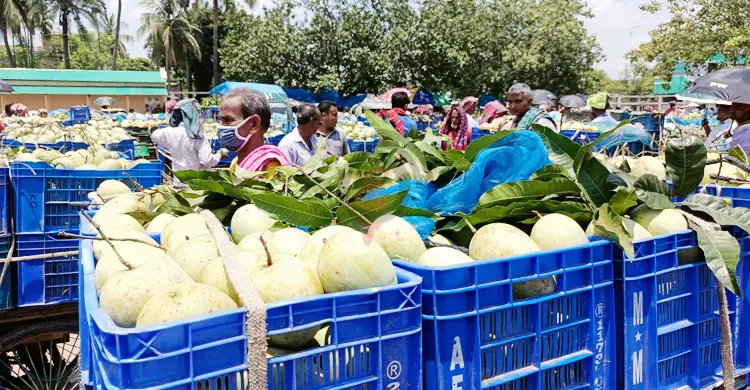
Chapainawabganj's Ashwina mango recently received a GI certificate (recognition as a geographical indication product). Yet this very year, farmers cannot recover their production costs from selling Ashwina mangoes, and they are worried. People in the trade say Ashwina prices have fallen because of the dominance of Amrapali and other late varieties.
Visits to Ashwina orchards across the district found hundreds of maunds of Ashwina mangoes still hanging in bunches. But with no price, traders are not picking and selling them, because the sales would not cover production costs.
At Kansat, the country's biggest mango market, farmers sat with Ashwina mangoes laid out in baskets on rows of vans. The market was slow, with Ashwina selling at Tk 900-1,000 a maund. Farmers say that does not even cover production costs.
Costs above price
Shafiqul Islam of the Pukuria area had come to Kansat market with two vans of fruit-bagged Ashwina mangoes, but buyers were not offering the price he wanted, and he looked worried.
"I have about 300 maunds of Ashwina mangoes in my orchard," he told Jago News. "I picked two vans' worth to sell, but there are no buyers. Some buyers are offering Tk 1,000 a maund, but production costs alone are Tk 1,300-1,400 a maund. At this price, selling mangoes won't even cover production costs, let alone make a profit."
Shahidul Islam, a mango farmer in Shyampur union, said: "This mango season has been the costliest year for farmers. Because of drought we needed far more irrigation, and fertiliser, pesticide and labour costs have also risen. Yet in this season of endless costs we are not getting the price we hoped for."
"My production cost was more than Tk 1,200 a maund, yet I have to sell at Tk 1,000-1,100 a maund," he said. "I took a loan to do the fruit bagging. Where will I repay it from?"
"I have more than 400 maunds of Ashwina mangoes in my orchard," Shahidul Islam said. "I spent more than a lakh taka on pesticide and Tk 2 lakh on fruit bagging, besides other costs. I had bought the mangoes from the orchard owner at about Tk 500 a maund. But now, doing the sums, I see selling the mangoes won't cover production costs. We will make heavy losses this year."
Tofajul Islam, a mango farmer in the Abbas Bazar area, said: "I can't recover production costs by selling mangoes. The pesticide shopkeepers keep asking for money, but where will I get it? I can't sleep at night for worry."
"Amrapali and various other varieties are available now, so Ashwina is selling less," he said. "Ashwina prices have fallen because of Amrapali and other varieties."
Late varieties crowd the market
Ismail Khan, general secretary of the Shibganj Mango Producer Co-operative Society, told Jago News: "A few years ago there were no mangoes other than Ashwina in August, so farmers got a good price for it. This year, though, Amrapali, BARI-4, Gourmati and other varieties are on the market even at this time. These mangoes are much sweeter, which is why Ashwina prices have fallen."
Shibganj upazila agriculture officer Shariful Islam said about 40 percent of Ashwina mangoes are produced in Chapainawabganj, and 30 percent of these are fruit-bagged. The prices of fruit bags, pesticides and other farm inputs have risen, and farmers will lose money if they sell mangoes below Tk 1,500, he said.
Mangoes were grown on 37,855 hectares in Chapainawabganj district this year, with a production target of 4 lakh 25 thousand tonnes.
Source: Jagonews24. First published in Bengali on The Agro News.
Comments
(0)