
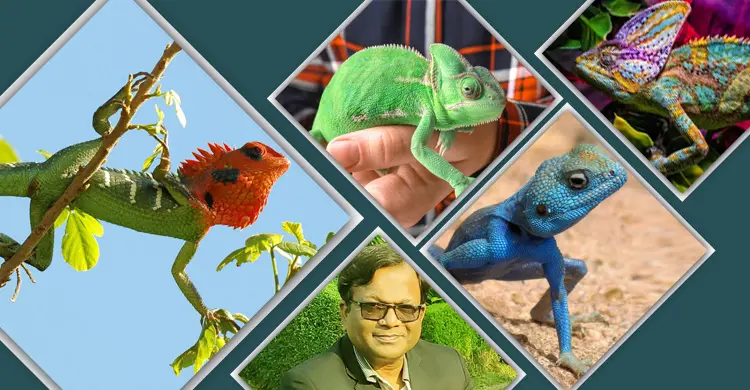
Many of us often see strange-looking lizards in the corners of our home gardens, and many of us are afraid of them. Some think they are venomous snakes; others say they drink blood. In fact this creature is quite harmless. It does not suck human blood, and only takes on a frightening, grotesque look now and then to defend itself.
A creature of many forms
Some of these lizards are covered in spines, and some have several horns on their heads. They are shape-shifters that move slowly: even when badly frightened they cannot cover more than twenty to twenty-five feet a minute. When in danger or cornered, one rises on its two front legs, lifts its head, puffs out its mouth and makes a hissing sound. This works well: researchers say a single lizard can drive off a pack of hunting dogs.
They do not use force, do not bite, do not suck blood and do not bother anyone; there is hardly a more peace-loving creature on earth. These snake-like animals are seen most in Bangladesh, India, Sri Lanka, Spain and Australia. Another kind lives mainly in trees; scientists call them arboreal. They dig tunnels in the ground only when it is time to lay eggs.
What do they eat?
Most of these lizards quench their thirst with rainwater or morning dew clinging to leaves. Researchers who put bowls of water in front of pet lizards found they would not touch them. Their food has to be varied from time to time: bees one week, crickets the next, and perhaps spiders the month after.
They love their freedom, and even when tamed they are hard to keep alive in a cage. Without sunlight they develop rickets, and they need a strong range of temperatures to survive. Just as fish need an aquarium and spiders a vivarium, these creatures need a medium-sized glass box called a terrarium. Its top is covered with wire mesh, and moss, ferns, grass or small plants are set in soil inside. Snakes, frogs and tortoises can also be kept in a terrarium.
What kind of home do they need?
Different kinds prefer different weather, though most like to live in dry conditions. The Carolina anole, or American lizard, is an exception and needs a shaded greenhouse-type set-up. Spiny desert lizards need several inches of sand and some cacti. Almost all of them sleep through the winter like Kumbhakarna; this is called hibernation.
Catching one is not easy. They are as nimble as seasoned circus performers, leaping from branch to branch on their toes and tails. Even while asleep on a branch, the slightest touch sends them dropping to the ground. If you grab the tail it comes off, though it later grows back. Most interesting of all, they change colour with their surroundings and mood, which is why they are called shape-shifters.
Why and how they change colour
The layers of the lizard's skin hold special cells made of particular pigments. Just below the outer skin are cells producing yellow and green pigment; beneath them are red, blue, orange and purple cells. The deepest layer holds melanin, from light brown to deep black, the same pigment responsible for human skin colour.
These coloured cells change in size. When the yellow cells swell larger than the blue ones, the lizard turns light green. When it is angry or stressed, the melanin cells extend branches into the outer layer and spread dark colour, so an angry lizard gradually looks black or deep red. Researchers know how the colour change works, but have still not properly worked out how the command to change colour reaches the skin cells from the brain.
The blue-tailed lizard
Lizards with green, brown and blue tails are most common in Bangladesh. They usually grow no longer than seven or eight inches. Young ones have dark or deep brown bodies with five white or yellow stripes running lengthwise, and a deep green or blue tail. With age the body colour fades, the stripes darken, the neck thickens and the bright green and blue of the tail turns grey. The country's lizards generally like rocky ground, and a dry terrarium made with round pebbles and moss suits them.
Another lizard here is the fence lizard, named because it hangs by its toes from wire mesh or fences. Because of its speed many also call it the swift lizard. About seven inches long, it has very rough scales. The female swift has wavy deep green and yellow markings on its back; the male has blue and yellow stripes along its sides and black patches under its chin.
The fearsome spiny lizard
Bangladesh also has the snake-like Carolina anole and a spiny kind of lizard. They are thin and slender with no legs, and are easily mistaken for snakes. But a snake's tail does not come off, while theirs does and grows back. They can grow to about three feet long, two-thirds of it tail.
The spiny lizard is a desert dweller that lives in harsh conditions. It has horns on its head, and some have countless spines on their bodies. Its tail does not come off, so it has a different defence: by bursting capillaries in its eyes it can squirt out a fifth of its body's blood and soak an attacker. The predator drops its prey to wipe its face, and in that moment the lizard runs away.
However frightening they look, these lizards do us no harm. Instead they protect crops by eating insects and keep the environment clean. So there is no reason to hate them or, out of fear, try to kill them when we see them on garden trees, in fields, or on fences and walls. Lizards are our great friends.
The writer is a science writer and researcher and an MPhil scholar in the Faculty of Social Sciences, University of Dhaka.
Source: Jagonews24. First published in Bengali on The Agro News.
Comments
(0)