
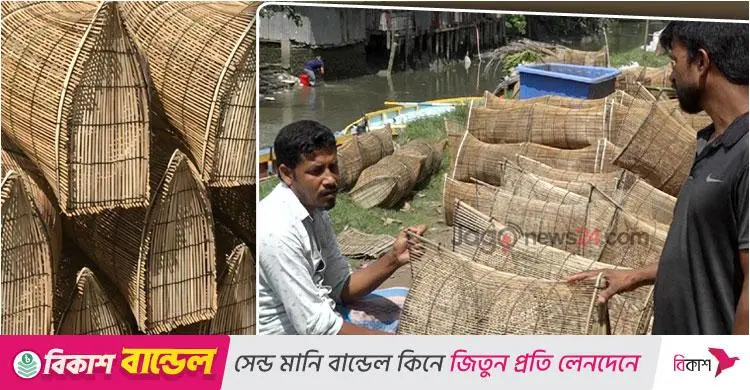
When the monsoon arrives, clouds cover the sky and fields and ghats flood, a thousand features of rural life come alive. One living example is the chai, a bamboo fish trap that becomes a companion of village life in the monsoon waters.
The chai is not just a tool for catching fish but also a symbol of the relationship between people and nature. Set in canals, beels, paddy fields or on riverbanks, the trap catches the taste of aquatic life. With patience, skill and waiting, the chai makes a unique rural picture.
Many names, many shapes
The chai has different names and shapes in different parts of the country. In the Sylhet region it is called "kui"; elsewhere it is called "boichna", a larger trap suited to catching prawns. It is set by cutting a gap in a field ridge or tied to a bamboo stake on a riverbank. Koi, shing, baim and large prawns carried in on the new monsoon water are easily trapped in it.
Making a chai is not merely craftwork but a kind of creative art. More than a hundred families in the villages of Sonargaon, Sahapur, Satbhaiyapara and Ramganj in Narayanganj are involved in it. Village women make chais at home after their household work, which gives them self-reliance and extra family income.
One muli bamboo usually yields four small chais, while a thick bamboo can make about 25. The bamboo is split, dried and finely bound to form the trap. Inside, one or more chambers are made so that a fish that enters cannot get out.
There are many kinds of chai, such as the ghuni chai, koiya chai, big-fish chai, jihba chai and guti chai. Each is made to a particular size, shape and structure so that particular species of fish are easily caught. Cooked rice, rice bran or crushed pieces of mussel and snail shell are put inside as bait, so the smell of food draws fish into the trap, where they are caught.
A monsoon tradition
With the monsoon begins the festival of setting chais. Young and old, boys and girls of the village, go in groups to set them in canals and beels. Pulling up a chai in the misty early morning, the glint of trapped fish inside brings joy. It is not just about catching fish but an example of people's direct bond with nature.
Though the chai has faded somewhat in a mechanised life, it still survives as a tradition in many parts of the country. With state training, easy access to raw materials and marketing opportunities, it could grow into a promising small industry. Women's participation in particular could establish it as a suitable field for women's development.
Source: Jagonews24. First published in Bengali on The Agro News.

Comments
(0)