
Of all pets, the cat is perhaps the most pampered and best loved. The friendship between people and cats is not new; cats have been part of human history for a very long time. But the relationship has been long and sometimes complicated. From being worshipped in ancient Egypt to being feared in the Middle Ages, cats have been bound up with people for thousands of years.
People once believed cats were ill-omened; today we see them as a symbol of love. That contradiction is the most dramatic side of their history. On one side, the devil's messenger; on the other, a talisman for sea voyages. The stories of medieval Europe and of the sea meet in a mysterious chapter in which one small animal both frightened people and saved them.
Feared as the devil's messenger
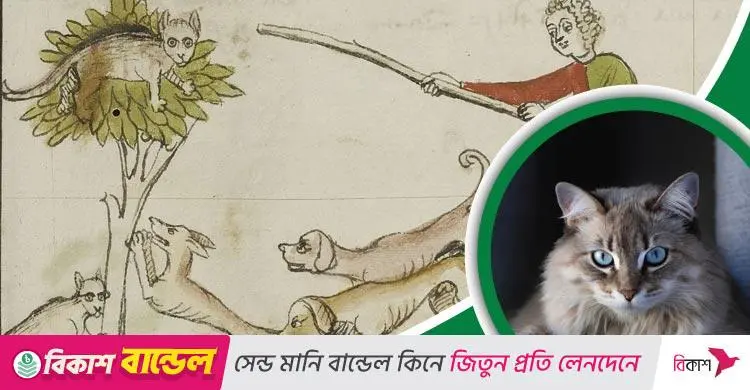
The Middle Ages were a time of religious superstition and terrible false beliefs. In Europe cats were thought to be the helpers of witches, even messengers of the devil. Black cats in particular were a symbol of fear, and people took a cat staring with shining eyes in the dark to be something supernatural.
In the 14th century, when the church's influence was at its height, many clergy believed evil spirits lived in cats, so killing them was regarded as a "holy act". Thousands of cats were burned to death at churches and in village and town streets on mere suspicion.
The result of this superstition was dreadful. As cats declined, rats multiplied, and rats were the main carriers of the Black Death, the plague. Between 1347 and 1351 about a third of Europe's people died in the epidemic. The very cats branded "cursed animals" could in fact have protected people from it, which the writer calls one of history's grim ironies.
Another legend held that witches turned into cats at night. If a cat suddenly appeared in front of someone after dark, people feared an evil spirit was abroad. The superstition ran so deep that in many villages in England and France, seeing a cat was taken as a sign of coming misfortune.
Even King Henry VIII of England disliked cats, and in his reign seeing a black cat was considered a royal ill omen. Yet amid this fear some royal households kept cats as guardians, because they caught rats and saved food stores. That double view best sums up European society's confused attitude to cats.
Good fortune on the ships
While cats' fortunes were dark on land, they found a new life at sea. In the late Middle Ages European sailors began making long voyages in the age of discovery. Rats ruined ships' food, cloth and even timber, so cats were taken aboard as the solution.
At first they were kept only to catch rats. But sailors gradually came to feel that voyages with a cat aboard went smoothly, with fewer storms and safer passage, and so the cat became a symbol of good luck.
European sailors believed that if a cat sat calmly on deck, the weather would stay fair, but if it grew restless or hissed while looking over the side, a storm was coming. Many forecast the weather by watching the cat.
On English ships the cat was called the "ship's cat". These cats were not just pets but members of the crew. Many captains had special sleeping places, food and even small uniforms made for their cats. The most famous ship's cat was Unsinkable Sam, from the Second World War, who survived three sinkings and was rescued by another ship each time. After that Sam became a "symbol of indomitable luck".
From the sea to the home
From the sea, the cat became a symbol of good luck on land too. The sailors' belief gradually spread among ordinary people, who began to believe that a cat in the house brings good fortune and keeps evil spirits away. So the animal once hated as the "devil's messenger" became a "symbol of luck".
In the coastal villages of England, Scotland and Norway many families still see a black cat as lucky. They say that if a cat washes its face on the veranda, someone is coming with good news. Over time people have understood that the cat is no curse but a symbol of nature's perfect balance. Its silent tread, concentration and independent nature have made it a lasting companion of human civilisation.
Today, as cats sleep in royal comfort in European homes, the shadow of their dark past remains in the pages of history. The same societies that once burned them now mark special days for them, build shelters and pass laws for them.
The article draws on the World History Encyclopedia.
Source: Jagonews24. First published in Bengali on The Agro News.



Comments
(0)