
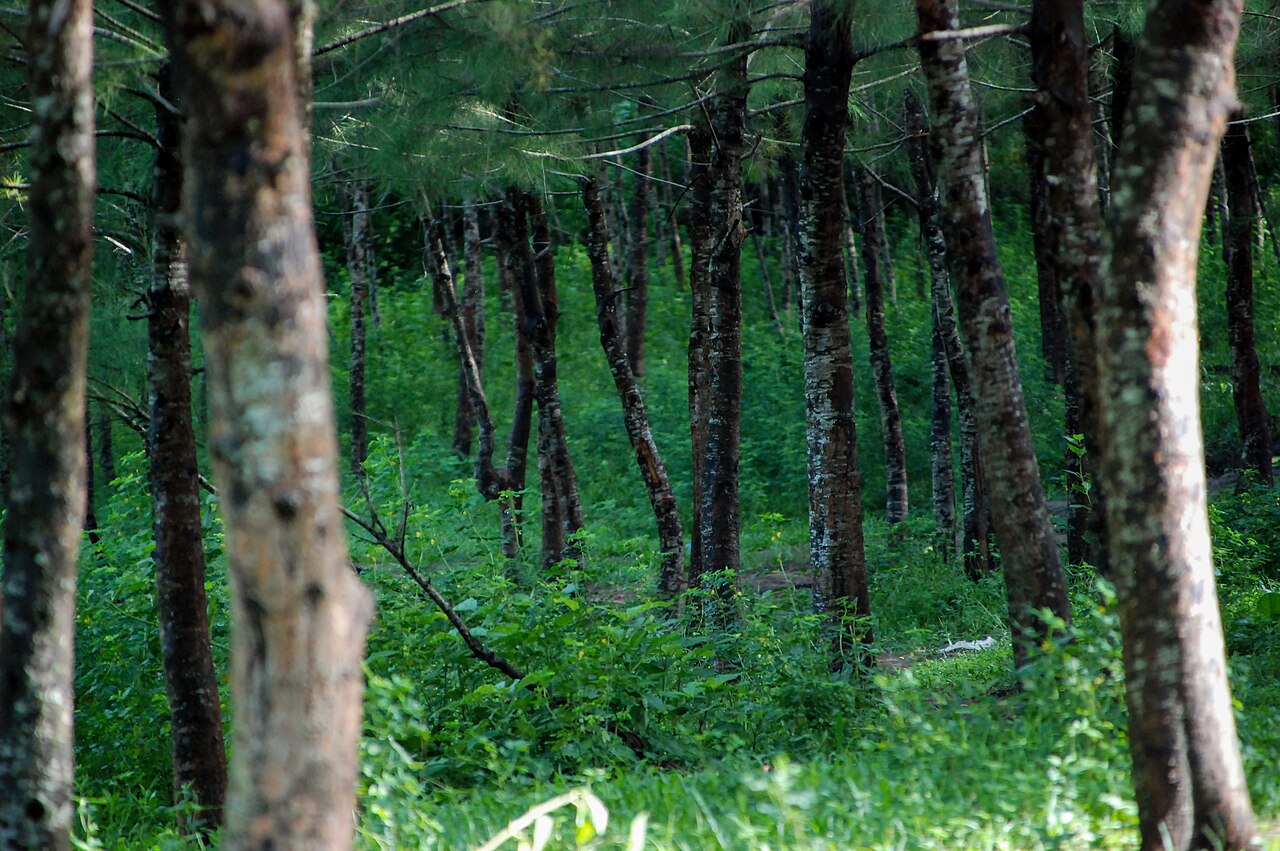
The pabon jhau, a tree Bangladeshis know mainly as a planted one, has been found growing in a natural habitat at Mirsharai in Chattogram. Nature and environment writer Mokarram Hossain writes in Prothom Alo that in 2025 he saw large numbers of the trees at Ichhakhali, beside the boundary wall of BEPZA (the Bangladesh Export Processing Zones Authority), where they had grown from seed and, despite the tidal water, formed a wild stand.
The tree was once known as bilati jhau. Villagers call it the pobon tree, from pabon, the wind, because even a light breeze makes its branches whoosh. From that name the writer proposed pabon jhau to Professor Dwijen Sharma, who adopted it and used it in the latest edition of his book Shyamoli Nisorgo.
Despite looking like a pine, it is not related to pines. As Dwijen Sharma explained, pines are gymnosperms, while the casuarina is a flowering plant (an angiosperm) like the mango or the bakul.
A mature pabon jhau (Casuarina equisetifolia) is a tall, straight tree that can reach 6 to 35 metres. Young trees are pyramid-shaped and the trunk is grey and rough. The leaves are reduced to almost invisible brown scales. The flowers are tiny, with male and female flowers in separate clusters, and it flowers twice a year, in early summer and late autumn. The seeds are light and brown.
It is most common in coastal districts and along the sea, and is scattered across the rest of the country. Its wood can be used as fuel, belts of casuarina are very effective at stopping sand from spreading, and it suits roadsides, parks and home yards as an ornamental tree.
The writer recalls that about 30 casuarinas were planted along the road to his family home around 1985 and grew fast in the new soil.
Photo: Moheen Reeyad / Wikimedia Commons (CC BY-SA 4.0)
Source: Prothom Alo


Comments
(0)