
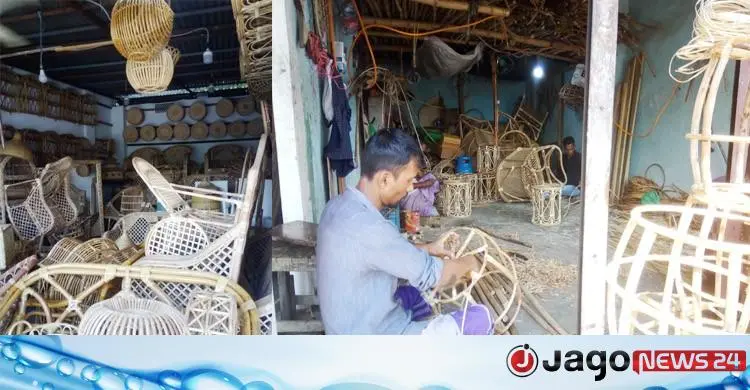
Among Bangladesh's visible forest resources, cane is one of the most notable. This neglected resource has long played an important part in people's livelihoods. Beautiful cane goods are a key element in decorating drawing rooms and bedrooms, and finely crafted cane furniture is truly dazzling. For people of taste it is a priceless asset, and in elite households at home and abroad cane crafts still proudly show off their beauty.
It is deeply unfortunate that the traditional cane industry, once famous around the world, is going through hard times. Despite its considerable potential, it has still not grown into a large industry. Properly managed, it could open a way for poor people to earn a living and play a notable part in building the country's economy. Neglect and short-sightedness alone have left a promising industry barely surviving. If cane craft is brought to the fore with its potential in mind, it will not only bring foreign exchange but will undoubtedly show a way to earn to a sizeable share of the country's unemployed. This is not possible without the government's sincere commitment.
Where cane grows
Cane generally grows well in most forests of tropical Asia. It would be no exaggeration to call it a plant of Bangladesh, Bhutan, Cambodia, Laos, Myanmar, Thailand, Vietnam, India, Java and Sumatra. Cane also grows abundantly on wet, marshy lowland in tropical and subtropical regions. In Malay an important subgroup of cane is called rattan, and in many parts of Bangladesh it is also known as ratan. Cane grows as a thorny, tangled bush. In Bangladesh it is seen mostly in the low-lying and hilly areas, as well as beside village roads, behind homesteads, on fallow land and in damp places in forests.
In Bangladesh cane grows abundantly in the hills and lowlands of Chattogram, Cox's Bazar, the Chittagong Hill Tracts and Sylhet. Cane plants are usually slender, long, thorny and very tough. They can be propagated both vegetatively and from seed. Vegetative propagation uses suckers. From seed, seedlings are raised in a nursery bed and later transplanted. If the seed's flesh is removed before sowing, seedlings emerge within a few weeks, and they must be moved once they are 0.75 to 1 metre tall. Within two to three years the cane forms a large clump and can be cut at seven to eight years. Cane needs little care, though irrigation and a little fertiliser can be given as needed some time after planting.
Beyond natural forest, cane also grows in the fairly damp conditions along the edges of haors. Like bamboo, it grows in clumps, and a single seedling soon becomes a dense clump. The plant matures very quickly, and the evergreen cane reaches 45 to 55 feet, sometimes more, when fully grown.
At one time planting cane around every home in rural Bengal was almost essential. These thorny canes served as boundary walls. To protect homesteads from thieves, robbers and surprise attacks by enemies, large ditches were dug around them and filled with water, and thorny cane was planted around the ditches. This gave considerable protection from thieves, robbers, enemies and wild animals.
Species and uses
Several species of cane are found in Bangladesh, notably jayat, kerak, sanchi, pati, jali and golla cane. The thorny kind is called jayat cane and is used for building materials, though it is now scarce. Pati cane is used to make the shital pati, the cool mat famous around the world. It grows in moist places near water and is often planted on pond banks, canal banks and riverbanks; because its roots run deep, it helps prevent bank and river erosion. Golla cane usually grows in hilly areas and is used to make cane furniture. At one time police and law enforcers used this cane to discipline wrongdoers, and many people used to grow it commercially in the hills.
It can be said, then, that most of the supply behind the worldwide reputation of Bangladesh's cottage industries comes from cane. Different kinds are used for different work, and cane craft needs jali and golla cane most, mainly for weaving and binding. Thin and thick strips are taken from the cane depending on the design. Jali cane is used for chairs, tables, swings, baskets, women's bags and many other useful items, while golla cane forms the frames of everyday furniture and other goods. Depending on the job, golla cane is split lengthwise into several pieces or cut in various ways.
Demand abroad
There is wide demand for cane goods in the world, especially in Asia and Europe. Bangladesh exports significant quantities of cane products to Russia, Germany, Singapore and the Middle East. By taking part in several international craft fairs in Germany, Canada, Japan and other countries, Bangladesh has earned a special reputation for its cane craft.
Source: Jagonews24. First published in Bengali on The Agro News.
Comments
(0)