
Jiangxi province lies in central China and occupies a very important geographical position. With its climate, rainfall and four distinct seasons, it belongs to the subtropical humid monsoon climate zone. It borders Zhejiang and Fujian provinces to the east, Guangdong to the south, Hunan to the west, and Hubei and Anhui to the north.
Stretching from the banks of the Yangtze river in the north to hilly areas in the south and east, the province has ample water and warmth. Winters are mild and summers hot. The average annual temperature is about 16.3 to 19.5 degrees Celsius, annual rainfall is 1,341 to 1,943 millimetres, annual sunshine is 1,600 to 2,100 hours and the frost-free period lasts 240 to 307 days.
Both urban and rural areas of the province are very suitable for camphor trees, because the camphor likes warmth and humidity and is not cold-resistant. Under the dual influence of the natural environment and literary tradition, camphor trees with well-developed roots have been in Jiangxi since ancient times.
The provincial tree
The province's good environmental conditions and its fine tradition of planting and protecting camphor trees combine with the tree's 'longevity'. Jiangxi even has ancient camphor forests thousands of years old, which reflect the province's ancient culture.
With 63.1 per cent forest cover, Jiangxi is known as one of China's 'green provinces', and the camphor is the most distinctive evergreen species in its forests. Its evergreen colour makes the most beautiful scenery.
The camphor is Jiangxi's provincial tree. A saying goes: 'No village without camphor trees; there can be no village without camphor trees.' The camphor is closely linked with Jiangxi, and because of its indomitable nature it became known as Jiangxi's 'provincial tree' in the 1980s.
With its strong vitality, the camphor has become popular as a symbol of good fortune, longevity, happiness and harmony. No part of the tree goes to waste; its branches, leaves, seeds and wood all have a unique scent.
According to statistics from the camphor engineering technology research centre of the National Forestry and Grassland Administration at the Jiangxi Academy of Forestry, Jiangxi has more than 300 ancient camphor forests. These are increasingly valued for their unique ecological, scientific research, humanistic and tourism value.
Anfu, the hometown of camphor
Anfu County, one of the 18 ancient civilised counties of Jiangxi, is known as 'the blessed land of central Jiangxi'. It lies in the middle of the Luoxiao mountains and is surrounded on three sides by hills, with a mild climate, ample sunlight and a long frost-free period, making it very suitable for evergreens such as camphor.
Overall, camphor trees in Anfu County are widely distributed and numerous, with strange shapes, varied customs, great age and deep heritage. In 2017 the Chinese Forestry Society recognised Anfu County as the 'hometown of camphor trees in China', and it is regarded as the country's true camphor town.
According to statistics, Anfu County has more than 120,000 camphor trees, including more than 10,000 ancient camphor trees over 400 years old and more than 200 over 1,000 years old.
Camphor trees in Anfu County have a long history and deep cultural heritage. The people of the county have a tradition of cherishing camphor trees in daily life, and many places use the name 'camphor'. A census of place names found more than 100 villages in the county with the word 'camphor' in their names, and countless roads, hills, rivers, bridges, ponds and bays are named after the camphor tree.
Many ancient camphor trees are scattered through Anfu's villages, casting their colourful shade. Each tree is a scene, and each ancient camphor tree has a story. Local people often name camphor trees after their characteristics, appearance and associations. The three main good deeds in the local people's belief are building roads, building bridges and planting camphor trees.
There is also a custom among local people of worshipping the camphor tree as a deity. Every year on the 15th day of the first Chinese lunar month, village elders lead villagers in various activities beneath ancient camphor trees. They bow to the trees and pray to the camphor god, asking it to bless the village with good weather, plentiful harvests, prosperity and good health.
The 'Five-Claw Camphor'
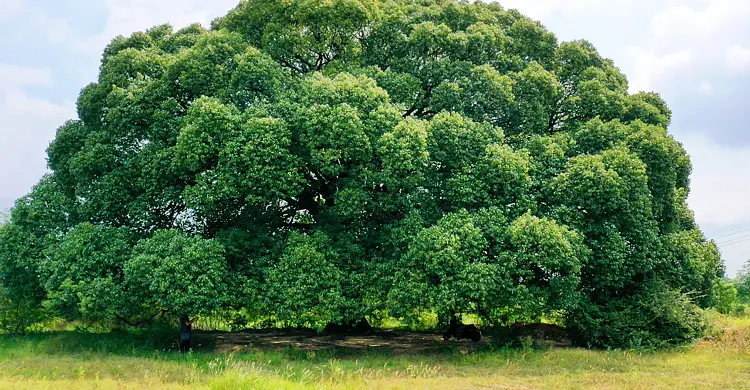
The 'Five-Claw Camphor' is an ancient camphor tree from the Han dynasty and is regarded as a symbol of Anfu County's ancient civilisation. More than 2,000 years old, it is the 'longest-lived' camphor tree in Jiangxi and was named the 'King of Jiangxi Camphor Trees' in 2019. The tree is 35 metres tall, with a trunk girth of 13.9 metres and a crown covering about 2,400 square metres.
The tree begins to branch about 5 metres above the ground. Its five huge branches look like the five claws of a dragon holding the trunk, so local people call it the 'Five-Claw Camphor', also known as 'Kuisho camphor'. Although its trunk is hollow and rotten, the tree keeps a fine shape and looks like an umbrella in the sun.
Around the villages of Anfu County there are not only large natural camphor forests and green trees but also a national scenic area, a national natural heritage protection area and a national geological park, as well as a thousand-year-old Confucian temple.
The county can be described as a place of beautiful scenery, beautiful places, long history and outstanding people, and it is gradually becoming a popular spot for tourists and photographers. The scent of camphor now fills Anfu County, which stays green through all four seasons every year, adding to the beauty of its scenery.
Medicinal value and conservation
The camphor tree not only has ornamental value but also beautifies the environment, and it has very high medicinal and economic value. It is used as medicine: its branches, leaves, seeds, bark, wood and roots are very important ingredients in Chinese medicine. It is a plant that benefits the whole human body and a Chinese herbal medicine of excellent effectiveness.
To maintain ancient trees well, Jiangxi province has taken steps to strengthen protection in three ways:
- First, re-listing all the ancient and famous trees in the province for protection.
- Second, rescuing and rejuvenating endangered and weak ancient and famous trees under a 'one tree, one policy' approach to effectively restore their growth.
- Third, selecting counties for improved management and protection of ancient and famous trees, running pilot projects on their management and protection, and actively promoting initiatives to maintain ancient and famous trees.
In Jiangxi, 'it is desirable to increase tree planting and forbid felling' is a clan rule set by village ancestors. These ancient and famous trees are not only important natural resources but also history: a valuable heritage and wealth left by those who came before.
Written by Mohammad Saiyedul Islam, a doctoral fellow at the School of International Trade and Economics, Jiangxi University of Finance and Economics.
Source: Jagonews24. First published in Bengali on The Agro News.
Comments
(0)