
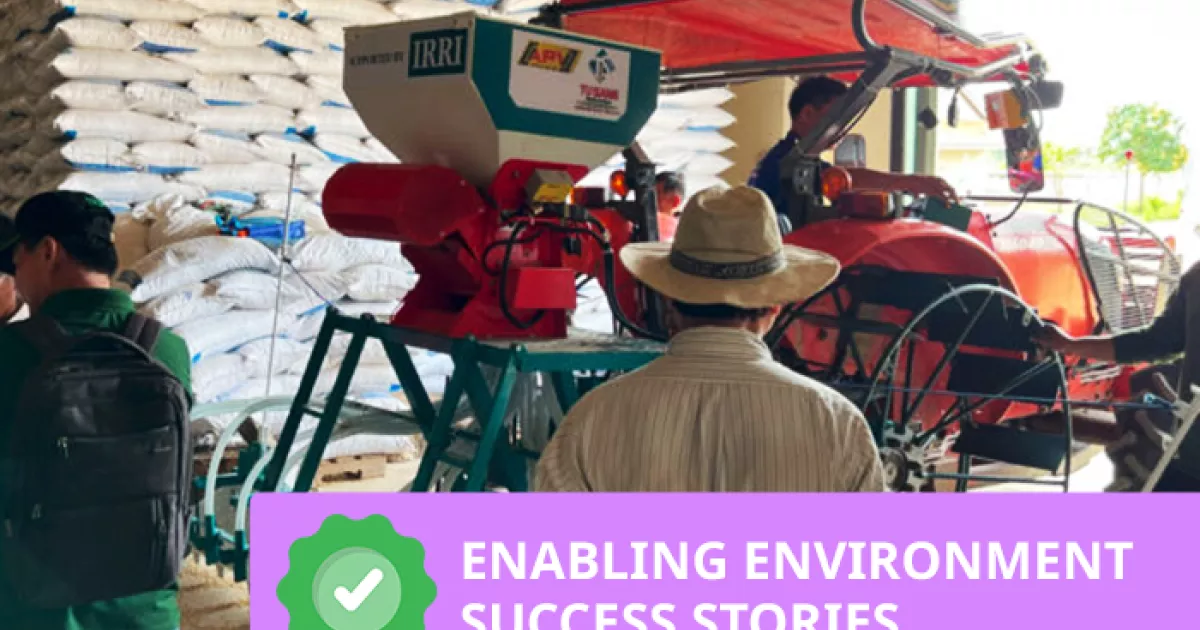
Cambodian rice farmers who replaced hand broadcasting with mechanised direct seeding harvested an average of 0.9 tonnes more paddy a hectare and earned more than USD 200 extra per hectare, according to an assessment of 200 pilot farmers by the International Rice Research Institute (IRRI).
Broadcasting seed by hand is still the common practice across much of Cambodia. It demands a great deal of labour, wastes seed and spreads fertiliser unevenly. Machinery that could replace it has been scarce: imported seeders are expensive, locally built prototypes are still being developed, and a whole province may have only a handful of service providers, so the few machines that exist cannot cover the narrow window when the crop must go in.
IRRI worked on the problem from three sides at once through the CGIAR Initiative on Excellence in Agronomy and, later, the Sustainable Farming programme. Training-of-trainers workshops, farmer field schools and field demonstrations built the technical skill of extension officers and lead farmers. One-stop service centres and custom-hire businesses, set up through Modern Agricultural Cooperatives, gave farmers access to machines they could not buy, with maintenance tied back to the manufacturers. Baseline surveys in four provinces fixed a starting point against which the change could be measured.
The seeder places each seed at a measured depth and spacing instead of scattering it. In the pilots that cut the seed rate by half, made nitrogen use more efficient, lowered labour costs by as much as 40 per cent and reduced methane coming off the paddy field.
One finding changed how the service was run. Where machines were scarce and the planting window tight, men were getting to them first. When the service protocol was altered to give women farmers priority, women producers in Takeo Province recorded yields 17 per cent higher than before.
The practice has also been written into national policy. Mechanised direct seeded rice is now part of Cambodia's Nationally Determined Contributions 3.0 under the Paris Agreement, with a target of 100,000 hectares by 2035, and it has been folded into the USD 240 million Climate Adaptive Irrigation and Sustainable Agriculture for Resilience project. Local service providers, meanwhile, have shown that custom hiring can pay for itself, and climate funds have helped buy machines in the target provinces.
For a Bangladeshi reader the arithmetic is familiar: the cost of farm labour is rising, seed is expensive, and a machine that sows a precise line uses less of both. The Cambodian case is a reminder that the machine alone is not the answer — it worked because someone organised the hiring, trained the operators and made room for women in the queue.
Source: CGIAR

Comments
(0)