
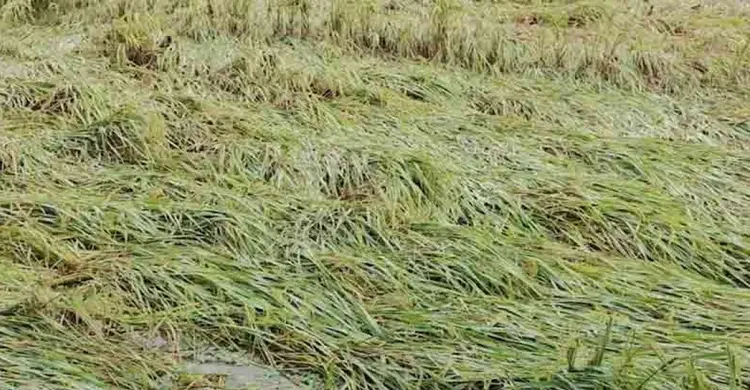
The Bangladesh Rice Research Institute (BRRI) has issued farming advice for the period after Cyclone Sitrang.
In a notice on Tuesday, 25 October, the institute said that, according to forecasts from the Weather Research and Forecasting (WRF) model, there is almost no chance of moderate or heavy rain in any district of Bangladesh over the five days from 25 to 29 October. However, some districts of Barishal and Khulna divisions may get very light rain.
Water, weeds and lodged plants
In this situation there is no need to apply fertiliser or irrigation to rice fields. If the paddy is half-ripe or close to ripening, water must be drained from the field very quickly. Irrigation channels should be kept clear so that excess water does not stand in rice fields.
Shama or fulka weeds flower at this time, so they should be pulled out.
If the cyclone has flattened the rice, where possible five or six hills should be tied together to keep the plants upright. This reduces the chance of yield loss and helps the grain fill properly.
Disease control
At the current growth stage, neck blast may appear in aromatic varieties and false smut in susceptible varieties such as BRRI dhan49, BRRI dhan75 and BRRI dhan79. Once these two diseases take hold they cannot be controlled. So as soon as the rain eases, against neck blast farmers should spray a tricyclazole-group fungicide such as Trooper at 8g per 10 litres of water, or a bin-group fungicide such as Nativo at 6g per 10 litres of water, mixed well, on 5 decimals of land, twice at an interval of seven days (in the afternoon). Care must be taken that rain does not wash the chemical off right after spraying. Likewise, a propiconazole fungicide should be applied against false smut.
Storms and rain may also bring bacterial leaf blight. If the disease appears after the rice has flowered, it does not cause much yield loss.
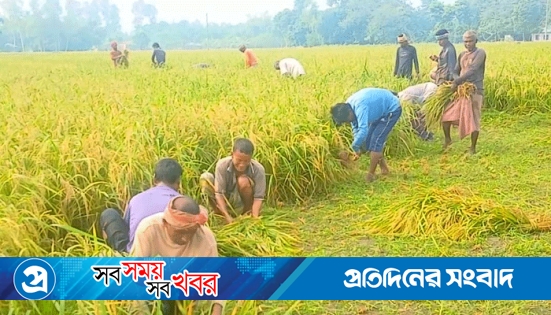
BRRI also advised farmers to store harvested crops in a safe place and to thresh them quickly.
Source: Jagonews24. First published in Bengali on The Agro News.

Comments
(0)