
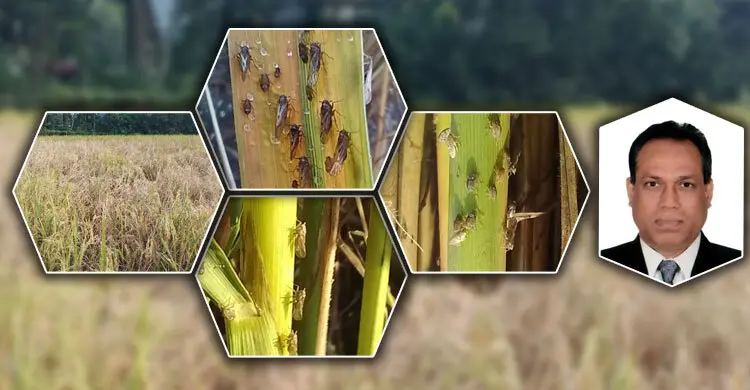
Brown planthopper is one of the main enemies of green rice. Also known as the current poka, it breeds very quickly, and its numbers can grow so large that affected fields develop hopper burn, a scorched look like a lightning strike.
What it looks like and its life cycle
Its body is brown or dark brown and very soft. Adults come in long-winged and short-winged forms. The female's abdomen is much larger than the male's, and females are bigger than males. Adults are 3.5-5.0 mm long.
The brown planthopper's life cycle has three stages: egg, nymph and adult. The adult female lays 8-16 eggs in clusters inside the leaf sheath. The eggs hatch in 4-9 days. Nymphs moult five times; they are white at first and later turn brown. Nymphs can develop into both short-winged and long-winged adults. Long-winged adults are usually seen when the rice ripens.
Adults are brown and about 4 mm long. It takes 14-26 days, depending on the weather, for a nymph to become an adult. Adults can live for about three weeks. One life cycle takes 21-33 days depending on the weather, and in favourable weather the insect can breed 10-11 times a year. Thousands of insects can be born from one pair (male and female) within a month or two.
Conditions that favour it
It needs damp, shady places to survive and breed. Fields that are always wet or have some standing water are attacked more. Dense planting and more nitrogen fertiliser than needed can increase attacks, as can failing to weed regularly and not planting in rows. The insect breeds most at 12-31 degrees Celsius. It does not like light and air and lives near wet, damp places. Both nymphs and adults sit at the base of the rice plant and suck its sap, making the plant weak. When numbers are high, the affected crop can look as if burnt by lightning (hopper burn).
The damage it does
Brown planthopper is currently one of the most harmful pests of rice in Bangladesh. It attacks high-yielding varieties of Boro, Aus and transplanted Aman most. Nymphs and adults suck sap from the stems and leaf sheaths at the base of the plant. When many insects feed together, the plants first turn yellow, then dry up and die, looking burnt from a distance. This is called "hopper burn" in English. If hopper burn happens at or before heading, no yield at all is obtained; if it happens after the grain has hardened, losses are 20-40%. It can attack from tillering to ripening, but attacks are heaviest from the booting stage to the milk stage.
Control measures
- Grow varieties tolerant to brown planthopper.
- Depending on the seedlings, leave 10-12 inches between rows and plant 8-10 inches apart.
- Follow the lag method, leaving one row empty after every 10 rows. This lets plenty of light and air into the field, reducing planthopper attacks without lowering yield.
- Inspect and survey the rice field at least once a week to check for the insect.
- To detect brown planthopper, set a light trap beside the field for three hours after dusk.
- Use fertiliser in balanced doses. Too much urea makes seedlings very green and succulent, which increases attacks, so use a leaf colour chart (LCC) and apply moderate doses of urea in 2-3 splits.
- Clear weeds, dead leaves, sheaths and the like from affected fields so more light and air can circulate.
- Do not keep water standing in the rice field all the time; dry the field from time to time. This will reduce attacks and breeding.
- Destroy finger grass, an alternative host of this insect.
- If brown planthopper is seen in the field, part the plants every two arm-lengths to let in light and air.
- Grow short-duration rice varieties.
- When brown planthopper attacks, the whole village should take urgent action together to control it.
- When 80% of the rice in the field has ripened, harvest without delay.
If the pest cannot be controlled by these methods, as a last resort spray an insecticide such as pymetrozine plus dinotefuran (Ebu) or nitenpyram (Sega) at the correct dose at the base of affected plants. Seek advice from the nearest agriculture office.
Source: Jagonews24. First published in Bengali on The Agro News.
Comments
(0)