
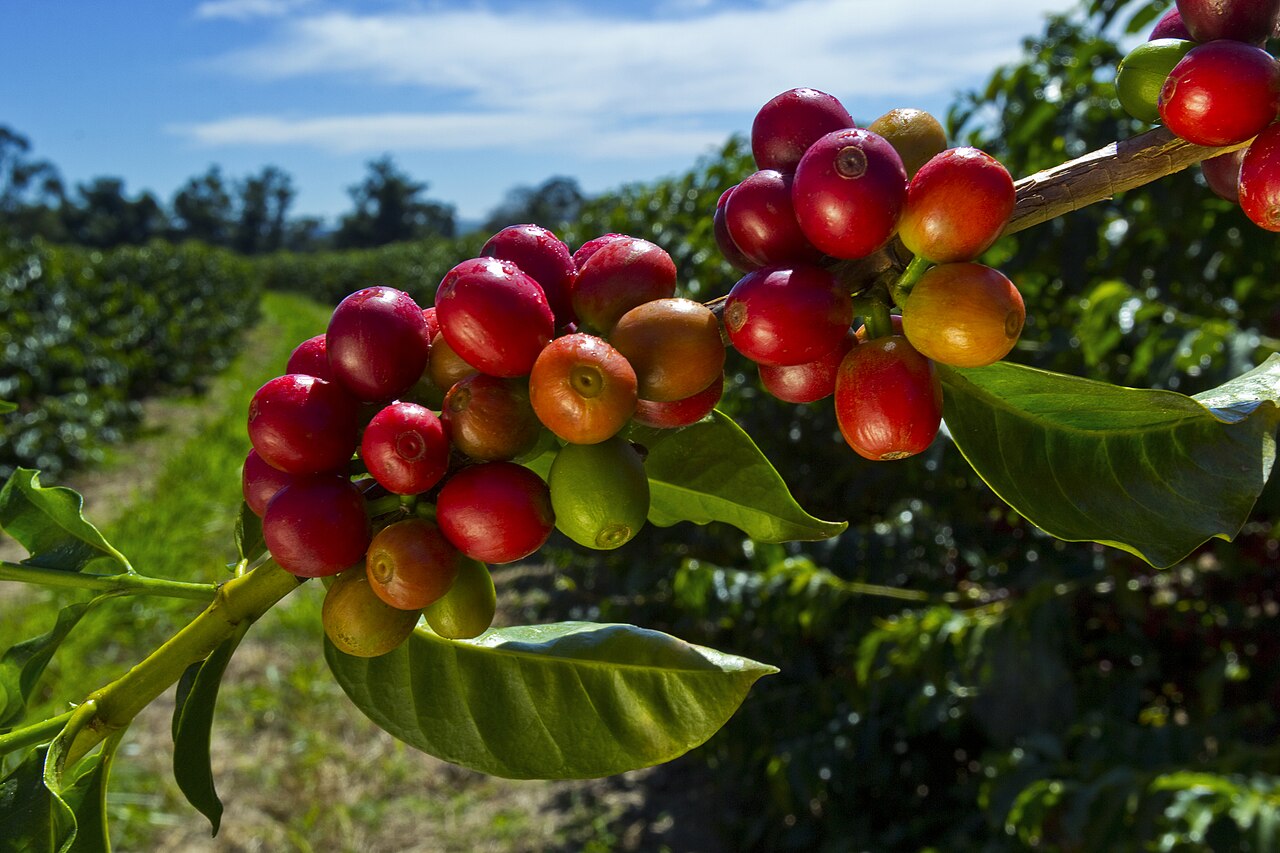
Brazil's coffee crop for the 2026/27 season is forecast at a record 72.5 million 60-kilogram bags, up 15.1 percent from the season before, according to the US Department of Agriculture's Foreign Agricultural Service (FAS) office in Brasília. The whole gain comes from arabica, while late-season rain has raised doubts about bean quality and left exportable stocks unusually tight.
The FAS puts arabica output at 49.2 million bags, up 29.5 percent on 2025/26 and 1.7 million bags above its June estimate. Robusta was revised down by 1.1 million bags to 23.3 million, 6.8 percent lower than last season, as yields fell in the robusta states of Espírito Santo and Bahia. Robusta goes mainly into instant coffee and blends, arabica into the specialty and mainstream roasts.
Heavy rain late in the season delayed harvesting and drying in the main arabica regions, including Minas Gerais, the largest producing state, and knocked ripe cherries off the trees before they could be picked. That usually lowers the share of beans in the top grades. The report flags the quality problem but does not put a number on it.
With those conditions and strong demand, ending stocks for 2026/27 are forecast at 3.42 million bags, 22.7 percent below the 4.425 million bags the FAS projected in June. The agency calls that tight for a harvest and an export programme of this size: even a record crop is not expected to rebuild the carryover stocks buyers rely on between seasons.
Exports for 2026/27 are forecast at a record 49.07 million bags, up 25.8 percent, made up of about 45 million bags of green coffee, 4 million of soluble and about 70,000 of roasted coffee. The FAS also raised its export estimate for 2025/26 to 39.02 million bags from 37.87 million. The National Coffee Exporters Council (Cecafé) separately reported shipments of 5.33 million bags in October 2026, the highest monthly volume since its records began in 1990 and 28.4 percent above October 2025.
Prices inside Brazil have not followed the tighter stocks. University of São Paulo data cited by the FAS show arabica and robusta both averaging about 29 percent below year-earlier levels in September 2026. Domestic consumption is forecast almost flat at 22.39 million bags, so nearly all the extra supply goes to export.
The FAS also warned about the following crop. Citing a 12 November outlook from the US National Oceanic and Atmospheric Administration that put the chance of a strong to very strong El Niño at more than 79 percent through January to March 2027, it said water stress and heat in that window could cut both output and quality in the 2027/28 season.
Photo: Jonathan Wilkins / Wikimedia Commons (CC BY-SA 3.0)
Source: Global Agriculture

Comments
(0)