
Corn ethanol is expected to make up a third of Brazil's ethanol production as early as the 2027/28 crop year, two years ahead of earlier projections, according to an estimate by the consultancy StoneX reported by Global Agriculture. Corn now accounts for 27% of the country's ethanol; StoneX expects that share to reach 33.6% in 2027/28, with corn ethanol output rising 29.7% to 13.6 billion litres.
The growth is led by companies such as Inpasa, already the world's second-largest ethanol producer. It produced 6.7 billion litres in 2026 and projects 8.6 billion litres in 2027, while the grain it processes is expected to rise from 15 million to 19 million tonnes.
Inpasa processes corn, sorghum and biomass into several products. Alongside anhydrous, hydrated and neutral ethanol it makes DDGS, a protein-rich feed ingredient for cattle, pigs and poultry, of which it projects 3.5 million tonnes in 2026. Its technical corn oil capacity is expected to reach 340,000 tonnes a year in 2026 and 436,000 tonnes in 2027, an oil that can feed biodiesel, renewable diesel and aviation fuel production. It also generates electricity.
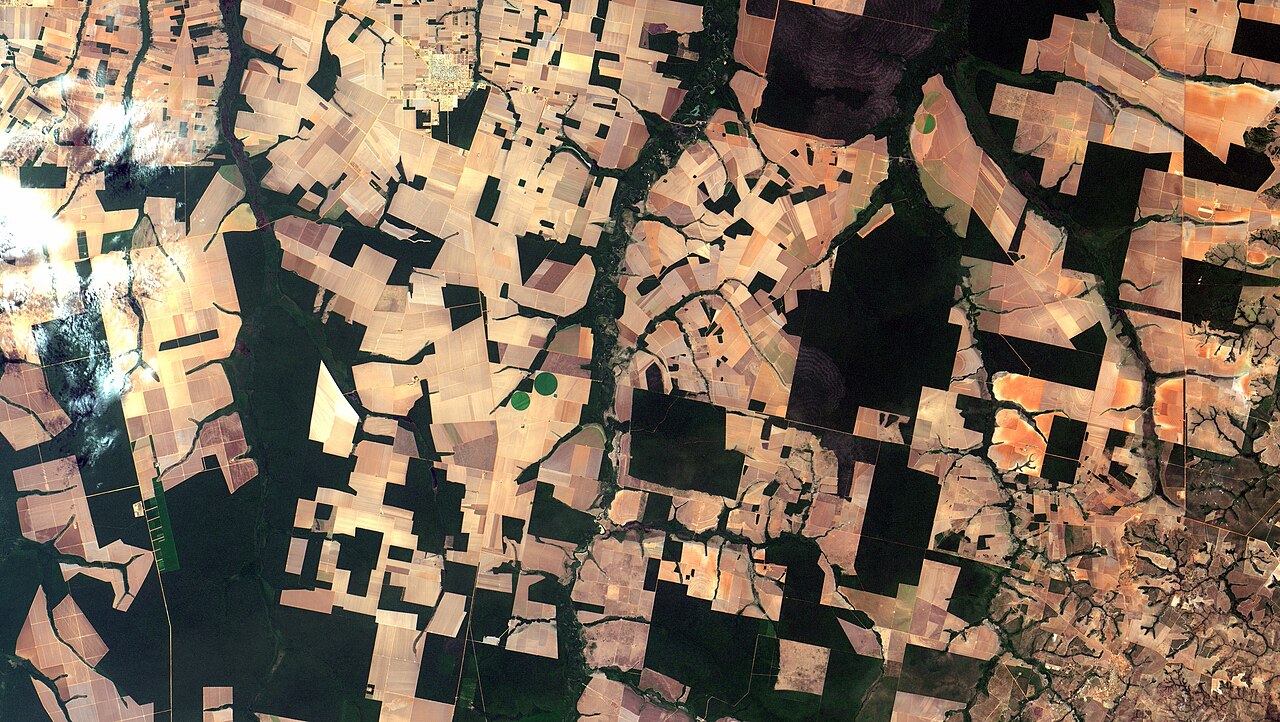
The company says Brazil's second-crop system is central to its model: corn is planted after the soybean harvest on the same land, which, according to the company, avoids clearing new areas. "Unlike the European model, which often fuels the debate over competition between 'food versus fuel,' the Brazilian multi-cropping system offers an integrated solution for food and energy security," said Bruno Maier, Inpasa's institutional relations manager.
Inpasa has also tested ethanol in shipping. The Laura Maersk vessel ran a 10% blend in October 2025 and a 50% blend in December, and in May 2026 a dual-fuel vessel completed its first voyage on 100% ethanol. The International Maritime Organization has recognised the Brazilian second-crop corn ethanol route as cutting greenhouse gas emissions by almost 78% compared with conventional bunker fuel.
For farmers, the expansion means more industrial demand for corn and more protein feed and vegetable oil coming out of the same grain.
Photo: INPE / Wikimedia Commons (CC BY-SA 2.0)
Source: Global Agriculture

Comments
(0)