
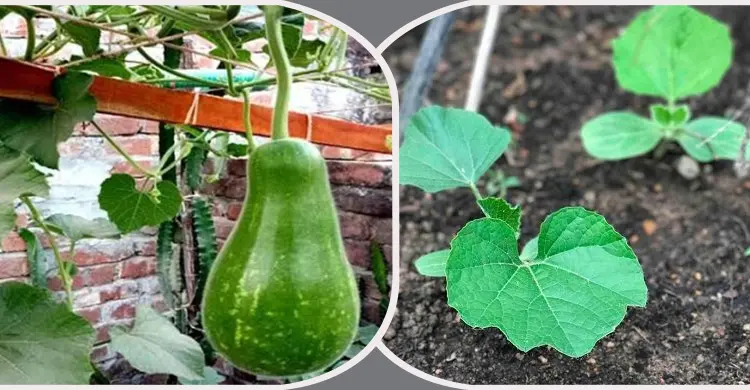
Bottle gourd (lau) is a very popular winter vegetable, though it is now grown all year round. It is usually grown around homesteads in winter. Its leaves and tender shoots are eaten as greens, and they are as nutritious as the gourd itself.
There are many bottle gourd varieties in the country. They can be told apart by the size and shape of the fruit and by how much the vine spreads.
Varieties
Some improved local varieties have plants ranging from dark to light green. BARI Lau-1 was developed through selection and approved for cultivation throughout the country in 1996. Its leaves are green and soft. Male and female flowers open 40-45 days and 60-65 days after transplanting respectively. The fruit is light green and 40-50 cm long, each weighing 1.5-2.0 kg, and each plant bears 10-12 fruits. The variety can be grown all year.
There are also hybrid bottle gourds, round or long in shape. Bottle gourd grows in almost all soils, but loam to clay loam is best. As it is a climbing plant, the crop can be produced by planting seedlings for most of the year.
Raising seedlings and planting
It is best to raise seedlings in polythene bags, which keeps seed costs down. Transplanting polybag seedlings needs 800-1,000 grams of seed per hectare. Seedlings can also be raised directly in soil pits: sow 4-5 seeds per pit, and they will germinate within 4-5 days.
In Bangladesh, two or three plants are usually grown around the homestead, beside the cowshed or on a pond bank. For larger plots, the land should first be well ploughed and levelled with a ladder. Sow 4-5 seeds per pit at a spacing of 2 x 2 metres. In the rabi season bottle gourd can be grown without a trellis, but yields are higher on a trellis. It can also be grown by sowing seeds in soil placed on heaps of floating water hyacinth.
When the seedlings grow a little, keep two per pit and pull out the rest. Loosen the soil with a weeder until it is crumbly, and water the plants as needed every day.
When the plants are 15-20 cm tall, a bamboo tip with its side twigs should be pushed into the ground beside the base of each plant.
Pests and harvest
The crop can be attacked by the red pumpkin beetle, which should be picked off and killed as soon as it appears. Mosaic virus disease can also be spread to bottle gourd through some species of grass.
The first fruit of BARI Lau-1 is harvested within 60-70 days of transplanting. A fruit is ready for picking when it is covered in plenty of fine hairs and a fingernail pressed into the skin sinks in easily; fruit becomes ready 12-15 days after pollination.
Source: Jagonews24. First published in Bengali on The Agro News.


Comments
(0)