
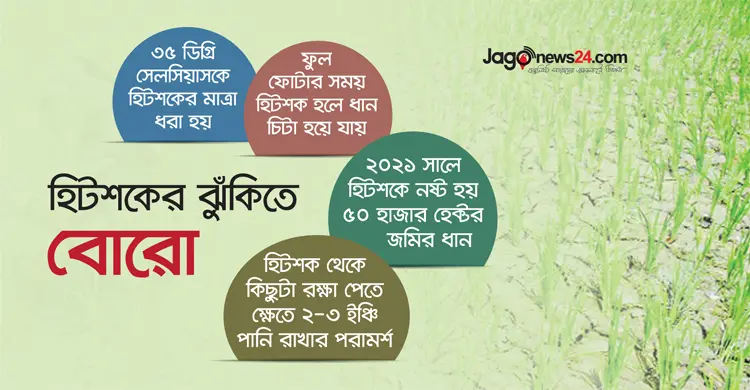
Just as people suffer heatstroke in extreme heat, rice plants are also damaged by intense heat. This is called heat shock or heat injury. When it strikes, the rice flowers burn and the grains turn chaff. The damage mainly happens at flowering, and the boro crop, the country's main crop, is now at this risk.
Rice researchers say heat shock can result from temperatures rising or falling too far. A temperature of 35 degrees Celsius is taken as the heat-shock threshold.
The boro season begins in the winter month of November (Kartik–Agrahayan) and ends in the extreme heat of April–May (Baishakh–Jyaishtha). A temperature of 35°C or more is unbearable for rice, and if it persists for one or two hours during flowering, excessive chaff forms. Such a heat shock occurred in the country in 2021, when paddy on nearly half a lakh hectares was destroyed.
Warnings from DAE
Badal Chandra Biswas, director general of the Department of Agricultural Extension (DAE), told Jagonews that heat shock is a risk this year because of the intense heat. "We have sent warnings to farmers and agriculture officials across the country," he said.
"Heat shock happens at the flowering stage. Most of our paddy has now passed that stage and reached maturity, so even if heat shock occurs, the damage will not be great. Still, we are asking people to stay alert," he said.
Experts say heatwaves also bring nor'westers (Kalbaishakhi). But whenever there is a heatwave without rain, it causes heat shock in rice: if paddy flowers during a rainless heatwave, the flowers dry up. That is the situation now.
Such events are not new in the country but are not well known to the public. It is a new challenge of climate change in agriculture.
Scientists' view
Dr Md Nazmul Bari, chief scientific officer and head of the entomology division at the rice research institute (BRRI) in Gazipur, told Jagonews: "Heat shock or heat injury happens when temperatures rise or fall too far. A temperature of 35°C is taken as the threshold. Temperatures have been rising steadily in various parts of the country since the second week of April. This could happen. There is a risk."
"It does the most damage at the flowering stage of rice, which we consider the most vulnerable stage. At that time hot wind draws water out of the panicle, the flowers dry up and the grain turns to chaff. It is a new challenge of climate change in agriculture. It has happened before, but not across such a wide area," he said.
Saying heat shock is not new in Bangladesh, Sajjadur Rahman of the plant physiology division of the institute in Gazipur told Jagonews: "We have kept records of heat shock since 2012. It has occurred at various times in Jashore Sadar, Tarash in Sirajganj, Kaliakair in Gazipur and Shambhuganj in Mymensingh, but only in one or two fields of a village or in the fields of one area. The first big heat shock was in 2021. On 4 April that year it struck the haor areas of Netrokona and Kishoreganj at once, as well as parts of Gopalganj, Kushtia, Rajshahi and Mymensingh districts."
He said that with no rain even in Baishakh this year, that risk remains. Hot Baishakhi winds cause damage. Usually rain follows a nor'wester and the temperature falls, so this does not happen, but this year that is not happening.
What to do
The heatwave is now sweeping the whole country, and DAE has issued several precautionary recommendations to protect field crops. The risk of heat shock is higher where paddy is now at the flowering stage, so farmers are being advised to hold enough water in boro fields to protect the crop from the heat. Two to three inches of water must be kept in the field until the grains in the panicle harden.
Boro cultivation
More than 55 percent of the rice produced in the country against annual demand comes from the boro season, so the government gives this season special importance for food security.
This season the boro cultivation target was set at 49 lakh 77 thousand 600 hectares and the rice production target at 2 crore 10 lakh tonnes. Hybrid, high-yielding and local varieties are being grown.
In the 2021–22 fiscal year the boro target was stated as 48 lakh 72 hectares, and cultivation reached 49 lakh 51 thousand hectares. Last year's rice production target was 2 crore 9 lakh tonnes, and production was 2 crore 10 lakh tonnes.
Preliminary DAE data show boro cultivation rose by about four percent this season, with a total of 49.99 lakh hectares planted.
Those involved say bringing home the boro crop successfully is very challenging every year, because farmers live in fear every year of flash floods and heavy rain in the haors.
Source: Jagonews24. First published in Bengali on The Agro News.
Comments
(0)