
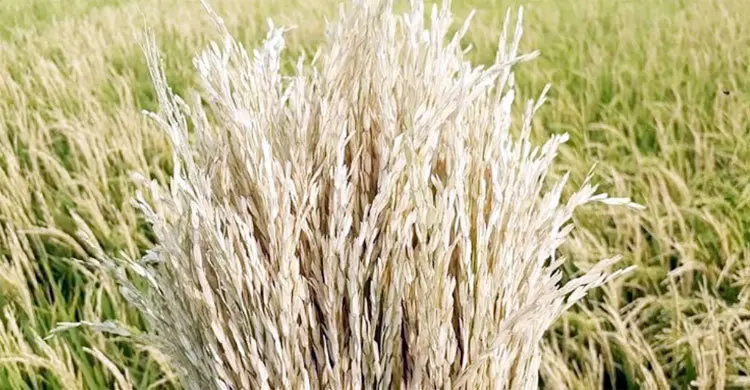
Mild to severe heatwaves are sweeping the country, affecting crops as well as people. In the current boro season, heatstroke, or heat shock, in paddy has become a worry. The last major heat shock in the country was in 2021, when paddy on nearly half a lakh hectares turned to chaff (empty grain) in the heat, with losses of several hundred crore taka. Agriculture experts fear similar losses this year if the heatwave does not ease soon.
A heatwave also struck in April 2021, when boro paddy across the country was at the flowering stage. The maximum temperature then reached 39 degrees Celsius, well above the 35 degrees Celsius that is critical for paddy. The open flowers dried up, causing heavy losses.
This year the country faces similar hostile weather, and temperatures are even higher than then. Outside the haor areas, boro paddy across the country is at the flowering stage, with about two-thirds of the crop passing through it now. Experts therefore see a high risk of heat shock again.
What causes heat shock
Heat shock, or heat injury, is caused by temperatures rising or falling excessively; 35 degrees Celsius is taken as the heat shock threshold. Mild to severe heatwaves are currently affecting parts of more than 40 districts. On Saturday the year's highest temperature so far, 42.6 degrees Celsius, was recorded in Jashore. The Bangladesh Meteorological Department classes a maximum of 36 to 37.9 degrees as a mild heatwave, 38 to 39.9 degrees as moderate, 40 to 41.9 degrees as severe and 42 degrees or more as very severe. A severe heatwave is under way and a "heat alert" is in force across the country.
Dr Md Sajjadur Rahman, chief scientific officer (plant physiology division) at the Bangladesh Rice Research Institute (BRRI), told Jagonews24: "This hostile weather has created a risk for boro paddy. Everywhere except the haor areas the crop is at the flowering stage, which is a very fragile condition for paddy. Pollination is not happening properly, because normal pollination takes place between about 9.30am and 11.30am, and the temperature is going above 35 degrees then."
"We have also been out in the field," he said. "The temperature is causing another problem: grain formation is not happening properly. The plant makes food during the day, which is broken down at night to form the grain. That is being disrupted because night temperatures are also high, so grain filling is poor. In other words, the carbohydrate kernel inside the husk is getting smaller. That will affect overall production; it will fall."
A new climate challenge
Rice researchers see this kind of heat shock as a new challenge of climate change for agriculture. The risk is not well known to the public, and there is no remedy other than a fall in temperature. Although the boro season begins in November (Kartik–Agrahayan), it ends in the extreme heat of April–May (Baishakh–Jyoishtho), and severe heatwaves have struck at this time in recent years. If a severe heatwave lasts even one or two hours during flowering, an excessive share of the grain turns to chaff. Heatwaves are also interspersed with Kalbaishakhi storms. Heat shock occurs whenever there is a heatwave with no rain; if paddy flowers during a rainless heatwave, the flowers dry up.
"We have kept records of heat shock since 2012," Sajjadur Rahman said. "There was a heat shock once in 2007. Apart from that, there have been small-scale heat shocks in some areas in some years. So far heat shock has occurred before in Jashore Sadar, Tarash in Sirajganj, Kaliakair in Gazipur and Shambhuganj in Mymensingh, but only in one or two fields of a village or the fields of one area. The first large heat shock came in 2021."
Dr Md Nazmul Bari, chief scientific officer at BRRI, said: "If it does not rain, we will be badly hit. We are in the most vulnerable position. Farmers are being advised on how to make up their losses, but there is little farmers can do in this situation."
"This is a new challenge of climate change for agriculture," he said. "Besides heat shock, diseases are increasing at such temperatures. Blast, BLB and BLS are being seen."
BRRI's advice to farmers
BRRI recently issued a warning to farmers about the heatwave. It said that during flowering and pollination the panicles in flower are in a highly active state. To protect them from hot winds (lu), the plant releases large amounts of water through transpiration, which works much like a cooling system in the plant's physiology.
The way to protect paddy from heat shock during intense heat, therefore, is to hold enough water in boro fields, and to keep two to three inches of water in the field until the grains in the panicle harden. Measured use of some chemical fertilisers can also help protect the plants in these adverse conditions.
There is no alternative to holding water in the field to protect paddy from a heatwave, and fields must not run short of water at this time. At least two to three inches of water must be kept in the paddy field at all times, so that even when temperatures are high the water acts as a cooling system. If the temperature can be kept below 35 degrees Celsius, the problem will not occur.
Neck blast may also strike in these conditions. As a preventive measure before symptoms appear, farmers should spray Trooper at 8 grams in 10 litres of water, or Nativo at 6 grams in 10 litres of water, per 5 decimals of land, twice at five-day intervals, in the afternoon.
BLB and BLS are also being seen widely. For these, 60 grams of Thiovit, 60 grams of potash and 20 grams of zinc should be mixed evenly in 10 litres of water and sprayed on five decimals of land.
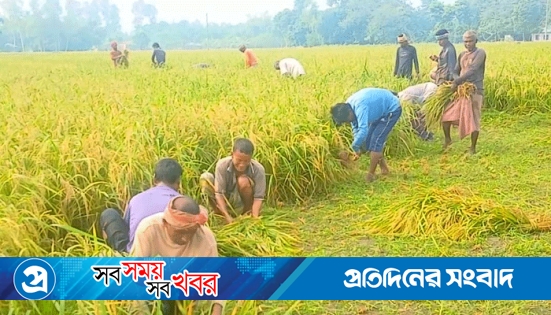
According to the Department of Agricultural Extension (DAE), boro was grown on 50 lakh 58 thousand hectares across the country in the 2023-24 financial year, with a production target of 2 crore 22 lakh 564 tonnes. So far boro has been harvested only in the haor areas, where cutting has been going on for three days; paddy on 77,000 hectares was cut in the first two days.
Source: Jagonews24. First published in Bengali on The Agro News.
Comments
(0)