
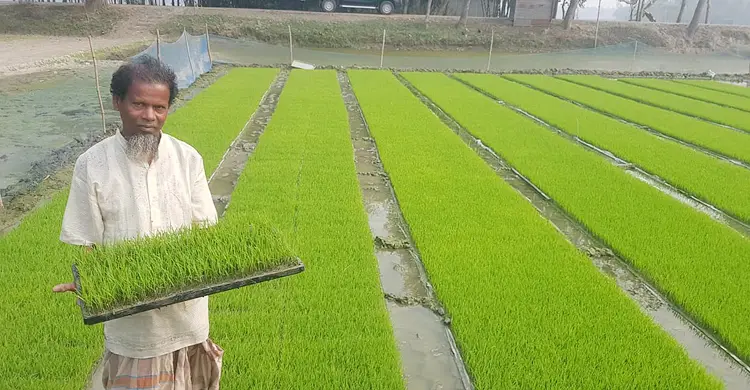
The ideal seedbed is becoming more popular every boro season. Seedlings raised in these beds can withstand any adverse weather. Raising seedlings this way saves money and even raises yields, so farmers are turning to it. The upazila agriculture office has been giving regular advice on making ideal seedbeds.
Compared with a traditional seedbed, seedlings from an ideal seedbed are healthier and at lower risk of cold injury. Because soil does not cling to the roots when they are pulled, the seedlings are not damaged, and almost all of them survive after transplanting. Lower costs and better yields have made the ideal seedbed more attractive to farmers.
How the beds are made
In an ideal seedbed, a bed is made on a strip two and a half haat (cubits) wide, with drains on both sides. This makes it easier to broadcast seed, and to care for the bed if disease or insects strike. Less seed is wasted than with the old method.
According to the Department of Agricultural Extension (DAE), to raise seedlings by the ideal method, dry land is first ploughed well and organic and chemical fertiliser applied. Once the land is ready, beds two haat wide are made. Quality seed is soaked in water for 24 hours and then broadcast on the bed. The seedlings are ready for transplanting 25 to 35 days after sowing.
Less seed, lower cost
According to agriculturist Abdul Wadud, farmers are being given proper advice and guidance on caring for community (ideal) seedbeds. Weeding, fertilising, irrigation and pest control become easier, and healthy, strong seedlings are produced. The method needs less seed than the local method, so costs are lower too. By his calculation, the seedlings from one decimal of seedbed can plant about 20 decimals of paddy land.
The writer, Ziaul Haque, is a diploma agriculturist and editor of Chashisheba.com.
Source: Jagonews24. First published in Bengali on The Agro News.

Comments
(0)