
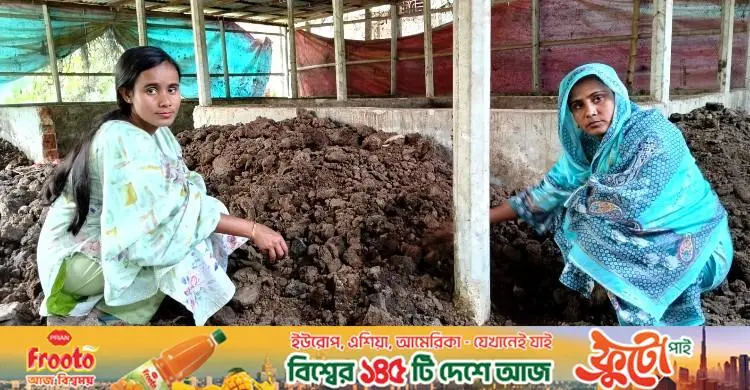
Even with a Dhaka University master's degree at home, Rajia Sultana Sumi was laughed at in her village. Some said, "All that study, and in the end earthworm farming?" Others sneered, "She didn't get a job, so now she's stuck with cow dung." Many relatives asked her family what good had come of sending her to Dhaka University. A few years later the picture in the same village has changed. Farmers now come to her farm in Goriarpara, Shibganj upazila, Bogura, every day: some to buy organic fertiliser, some to learn, and some to show their own children that education can lead to work like this.
The young woman who left the Dhaka job market to return to the village is now not only an entrepreneur; to local people she stands for a changed reality. Her Shamima Agro Farm produces organic fertiliser and has become a source of work for young people and women in the village, and the centre of a small movement to create rural entrepreneurs.
From Dhaka University back to the village
At an age when most young people are busy with BCS coaching, corporate jobs or dreams of going abroad, Sumi, who finished her master's at Dhaka University, chose the village soil. She began with a small organic fertiliser project. Sumi was born into a farming family in Goriarpara village in Shibganj upazila and grew up watching her father toil in the fields, familiar with paddy, wheat and vegetables. Her family's dream was to see their daughter highly educated, and she enrolled in the Department of Social Welfare at Dhaka University, completing her honours and master's in 2020.
At university she too dreamed of a good job. Like her friends, she prepared and sat for job exams. But she came to realise that the job market in the city is not only fiercely competitive but uncertain. Long waits, limited opportunities and growing frustration made her think again. "At one point I felt I could do something for the very village I came from," Sumi told Jagonews. "Agriculture is tied to our lives, yet many people still think of it as a backward profession."
While working on environment and social development during her studies, she learned about the harmful effects of chemical fertiliser. Going through agricultural research material, she saw that years of excessive chemical fertiliser use were destroying the organic quality of much farmland: soil fertility was falling, production costs were rising and in many cases the land was holding less water. That was where the idea of producing organic fertiliser came from.
Taunts, dead worms and doubtful buyers
After her master's, instead of chasing jobs in Dhaka she came back to the village. In a corner of her father's land, together with her elder sister Shamima Begum, she began producing vermicompost, or earthworm fertiliser. The start was very small: a few concrete rings, some earthworms and a little capital. Social pressure began as soon as the work did. Many villagers were astonished to see a Dhaka University student working in a field. Some jeered, "She couldn't get a job, so now she does this." Others criticised the family: "What was the point of spending so much money educating the girl?"
"It was very hard at first," Sumi said. "Even relatives said all sorts of things. But I thought, if agriculture keeps the people of the country alive, there is nothing to look down on in this profession. There were plenty of technical problems at the beginning too. Sometimes the worms died, sometimes production did not go right. Building a market was not easy either. At first farmers doubted whether organic fertiliser worked. Many believed you could not get a harvest without chemical fertiliser."
Gradually things changed. A few local farmers tried their fertiliser, and when others saw the results, interest grew. Abdul Kuddus, a farmer in Goriarpara, said: "I used to use only urea and chemical fertiliser. Then I took organic fertiliser from Sumi and used it on my land. I saw the soil getting softer and the plants doing better. Now I use it regularly."
Jobs for young people and women
Shamima Agro Farm now produces organic fertiliser regularly in several beds. Beyond the local market, farmers come for it from neighbouring upazilas, and the entrepreneurs say many farmers get in touch after seeing videos of the farm on social media. But Sumi did not stop at fertiliser. Realising that change would not last unless jobs were created for village youth, she began training local young people and later formed an organisation with them called Chetonayon. Through it, several young people now produce their own organic fertiliser on a small scale, and some have gone into marketing.
Rafiqul Islam, a young man who started work after the training, told Jagonews: "I used to have to go to the city for work. Now I have found a way to earn in the village. After training with Sumi I produce earthworm fertiliser on a small scale myself. The initiative has opened new possibilities for village women too. Many women now take part in small-scale organic fertiliser production between household chores."
Rashida Begum, a local housewife, told Jagonews: "I used to do only housework. Now a few of us make fertiliser together, and it brings extra income to the family." Another woman, Nasima Khatun, said: "There are few chances of work for women in the village. This work can be done near home, so many women are interested."
Soil health and the capital problem
People involved in agriculture say educated young people joining farming sends an important message for Bangladesh's agriculture sector, because modern farming needs not only labour but technology, planning and knowledge of market management. Abdul Hannan, Shibganj upazila agriculture officer, said: "Using organic fertiliser is the need of the hour. To protect soil health we must reduce dependence on chemical fertiliser. When educated entrepreneurs like Sumi come into agriculture, new thinking and technology come with them."
Various studies related to agricultural development in Bangladesh have also found that organic fertiliser plays an important role in maintaining the organic quality of soil over the long term, the report says. Keeping soil fertile has become a major challenge, especially in the farming areas of the north. Agriculture officials say that unless the use of organic fertiliser is increased, production costs may rise further. But although the opportunity is there, the big obstacle for small entrepreneurs is a shortage of capital: demand is growing, but without enough investment production cannot be expanded.
"Fertiliser is wanted from many places," Sumi said. "But with limited capital I cannot increase production. With loans on easy terms or government support, it would be possible to work on a much bigger scale." She said she plans to build a full training centre in future. Teaching young men and women organic fertiliser production, modern farming and small-business management is one of her dreams, along with plans to raise awareness about environment-friendly farming.
KGM Faruk, Bogura district secretary of the Campaign for Good Governance (SUPRO), said: "Sumi's story is not just the story of one entrepreneur; it is a story of a changing social outlook. Society still often sees agriculture as the last option. But when a Dhaka University student chooses agriculture as a field for enterprise, it sends a big message. Sumi has shown that education does not only mean a job; education can also create new jobs. Standing on village soil, Sumi is now an example of a new reality. Amid a youth heading for the cities, she is walking the other way. That road was hard and still is, but on it she has found her own identity."
Source: Jagonews24. First published in Bengali on The Agro News.

Comments
(0)