
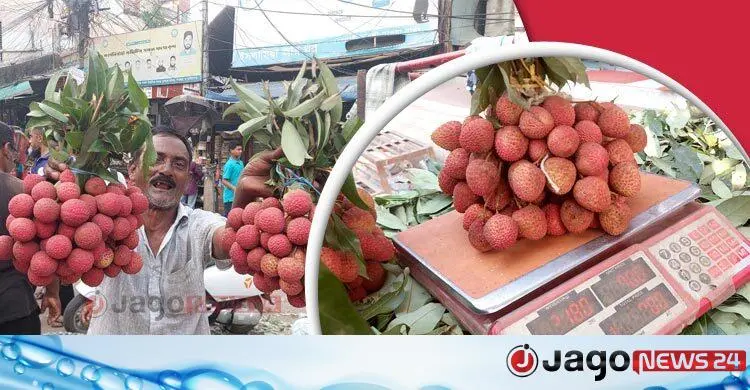
Jyoishtha is the honey month, and lychee is one of its most longed-for fruits. People wait all year for this juicy, fragrant and uniquely tasty fruit, but its reign in the market is short. In just two to three weeks, trade worth crores of taka takes place. And in that market a new trend has appeared: lychees are sold sometimes by count and sometimes by the kilo, sparking a new debate among buyers and sellers. Who really gains from selling by weight?
Visits to fruit shops in Station Road, Kataltala, Chelopara, the Court area and the Press Club area of Bogura town showed that where lychees used to be sold by the hundred or by the piece, most shops now increasingly sell them by the kilo. Some shops use both methods.
Buyers have mixed reactions. Some find buying by the kilo convenient, while many others think it causes them a loss.
Buyers who feel short-changed
Anisur Rahman, who had come to Station Road to buy lychees, said: "I have bought lychees a few times, both by the kilo and by the hundred. I felt buying by the kilo is a loss."
Asked why, he said: "A kilo holds 30 to 40 lychees. They are bigger, too. But you get more when you buy by the hundred. To me, buying by the hundred seems more profitable."
In his view, buying by the hundred also makes it easier to check freshness and quality, and there is less chance of rotten or worm-eaten lychees.
Many other buyers make the same complaint. They say selling by weight creates the chance to mix small and large lychees to add weight, so there is no knowing in advance how many lychees a kilo will contain. Nor can the risk of cheating on weight be ruled out.
Buyers say that when buying by the kilo they pay for the weight of the skin and stone as well as the flesh, although what they really want is the flesh. In many cases they pay more than the edible part is worth.
Besides, large improved varieties such as Bombai or China-3 give fewer fruits per kilo, so a buyer gets fewer lychees for the same weight. Smaller lychees, on the other hand, give more per kilo.
Golam Azam, who was buying lychees by the hundred in the Court area, said: "I am buying seasonal fruit for home. I have always bought by the hundred. When you buy by the kilo there is a chance of getting less."
Buyers who prefer the kilo
Not everyone is against selling by weight, however. For many low- and middle-income buyers in particular, the kilo has become more convenient.
Dulal Hossain was seen buying lychees at Tk 120 a kg in front of the Bogura Press Club. He said: "When you buy by the kilo you don't have to count. You can easily buy a small amount, and you can choose the ones you like."
Nayeb Ali described a similar experience: "I bought 50 Bombai lychees for Tk 130. You can't get a small number by the piece, and I can't afford to buy more. So I bought a few for the children."
Abdul Aziz, a low-income buyer, said: "We are poor people. We can't afford to buy 100 pieces at once. Often sellers don't want to sell if you take only a few. So I had no choice but to buy about 250 grams of lychees."
Prices and the traders' view
In the markets, lychees are now selling for Tk 120 to 180 a kg and up to more than Tk 250, depending on quality and location. Buying by the hundred costs Tk 300 to 500.
Traders say the kilo system is becoming popular because of changing demand. Many people no longer want to buy 100 or 200 lychees at once; families have become smaller and purchasing power is under pressure. So demand for the kilo system is growing because it allows people to buy small amounts.
Consumer rights advocates say, however, that however lychees are sold, transparency must be ensured. If they are sold by the kilo, correct weight must be guaranteed; if sold by the hundred, buyers must not be misled about quality and number.
Alamgir Hossain, general secretary of the Station Road fruit traders' association, said they buy and sell lychees by the hundred or by the piece at wholesale level, and there is no scope for selling lychees wholesale by the kilo.
Asked why lychees are being sold by the kilo in the market, he said many lychees fall off or come away from the bunches when brought from the orchards. These are hard to sell by the hundred, so to avoid losses many retailers sell them by the kilo.
'Sell the way you buy'
Mehedi Hasan, assistant director of the Directorate of National Consumer Rights Protection in Bogura, said: "A seller must sell a product the same way he buys it. That is the rule. If someone buys lychees by the piece and then sells them by the kilo, it will be treated as an offence."
He added that they had run market monitoring drives on the issue before Eid and fined several sellers after finding irregularities. Sellers must be transparent with buyers and ensure correct weight and the stated quantity. If any fraud or deception is found, the necessary action will be taken on the basis of complaints, he said.
Source: Jagonews24. First published in Bengali on The Agro News.

Comments
(0)