
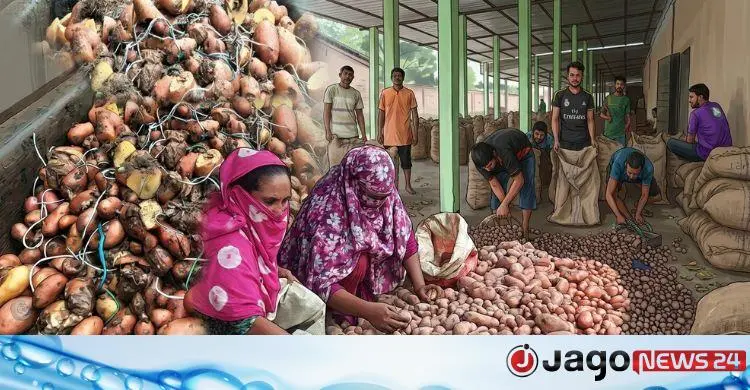
At harvest the potato crop came as a crop of hope. Rather than sell cheaply, farmers and traders put hundreds of thousands of tonnes of potatoes into cold storage in the hope of better prices. Four months on, those potatoes have become a burden. There is no demand in the market and prices are not rising; instead, after sitting so long, potatoes are starting to rot sack after sack.
Those affected say that selling now means a loss, while keeping the potatoes raises the risk of spoilage. Their capital is also tied up, so many are struggling to raise money for the coming Aman season.
This was the picture found during visits to cold stores in Bogura and Joypurhat and conversations with farmers, traders and others involved.
Losing money on every sack
In Joypurhat a 60 kg sack of Sada Diamond and other varieties now sells at the cold store gate for Tk 920 to 960, although the farmer's cost per sack, including production and storage rent, came to about Tk 1,400. That is a shortfall of Tk 440 to 480 a sack on average.
The situation in Bogura is not very different. At the Kafela Store in Eruliya, Stick and Katilal potatoes sell at Tk 14.50 to 15 a kg, Pakri at Tk 27 to 28 and Diamond at Tk 15.50. Middlemen (bepari) buy Stick and Katilal from farmers and traders at Tk 15, Pakri at Tk 28 to 29 and Diamond at Tk 16 a kg, leaving them a profit of only Tk 5 to 10 on a 60 kg sack. If a sack turns out to contain many rotten or poor potatoes, even that small margin disappears, and sometimes they lose money.
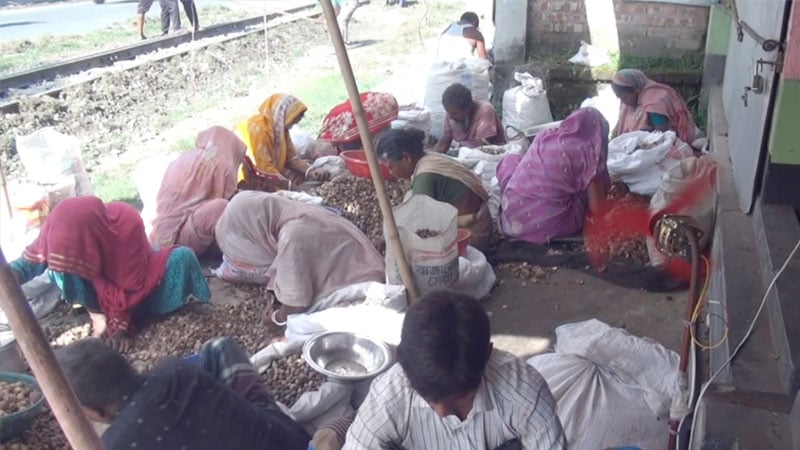
When potatoes were taken out of a cold store in Bogura, opening the sacks revealed a considerable quantity of rotten and damaged potatoes among the good ones. Some were blackened, others soft and rotten, and some that looked fine outside were rotten inside when cut. Workers have to sort out the good potatoes for sale, while a pile of spoiled ones grows to one side.
Traders fear the quality will worsen the longer the potatoes stay in storage. That increases farmers' losses and, with sorting and transport costs, traders' risks too.
Sales at half last year's pace
According to the Department of Agricultural Extension (DAE), Joypurhat produced 930,000 tonnes of potatoes on 39,330 hectares this year, about 5,000 hectares less than last year. A total of 215,982 tonnes was stored in the district's 22 cold stores.
Even after the first week of August, not even 20 per cent of those potatoes had been sold, compared with about 45 per cent released by the same time last year. In other words, the pace of sales from cold storage has fallen to less than half in a year.
Farmer Sabur Ali of Borai village in Kalai upazila stored 100 sacks. His total cost including rent was about Tk 1.35 lakh. After four months he sold them for only Tk 98,000, a loss of about Tk 37,000.
Zahidur Rahman of Chatkhur village in Panchbibi and Momin Molla of Aowra village in Kalai are in the same position. They kept their potatoes in storage rather than sell cheaply at harvest, and now, with prices not rising, they cannot sell.
Unsold potatoes not only add to farmers' losses but also lock up their capital. It is now the Aman rice season, and many farmers rely on money from stored potatoes to pay for seed, fertiliser, labour and land preparation. With that money not coming in, losses on the old crop are compounded by a cash shortage for the new one.
Bogura and Joypurhat together produced about 2.148 million tonnes of potatoes last season, and 505,268 tonnes were stored in the two districts' 56 cold stores. With demand low compared with this huge stock, potatoes are leaving cold storage slowly.
Traders and cold store managers
Traders at Punot haat in Kalai, Joypurhat, said they are losing money even when they send potatoes to markets in other districts, with losses of Tk 4,000 to 5,000 a truck and Tk 50 to 55 a sack. Many traders have scaled back buying and selling as a result.
Bogura potato trader Shamsul Pramanik said: "Beparis are buying Stick and Katilal from farmers and traders with stored potatoes at Tk 15 a kg, Pakri at Tk 28 to 29 and Diamond at Tk 16. The profit on a 60 kg sack is only Tk 5 to 10. If there are more bad potatoes when the sack is opened, sometimes there is a loss instead of a profit."
He said that once transport, labour and sorting costs are added, there is often no profit per sack. With demand low, traders do not want to risk buying at higher prices, so farmers cannot sell and traders are not buying enough.
More than 250,000 sacks of potatoes were stored at the Punot Cold Storage in Kalai, Joypurhat. According to the cold store's management, only 45,000 sacks had been released by the first week of August.
Its manager, Biplob Kumar, said farmers are not coming to sell because prices are poor. As a result a huge quantity of potatoes is lying there, and there is uncertainty over collecting rent. The longer potatoes stay in cold storage, the greater the risk to their quality, he said.
In Bogura, about 1.4 million tonnes of potatoes were produced on about 66,000 hectares last season, and about 200,000 tonnes were stored in the district's 33 cold stores. More than half the potatoes in greater Bogura's 49 cold stores remained unsold for a long time. With prices down, Bogura farmers have lost Tk 300 to 400 a sack, and many are not even interested in taking their potatoes out of storage.
A problem of planning, not just production
Farmers and traders say high production alone is not the cause of the crisis; a lack of joint planning for markets, storage, processing and exports is also to blame. The two districts produce more than 2 million tonnes of potatoes a year, but the domestic processing industry and export markets have not grown large enough for such a big crop.
So whenever production rises, supply pressure builds in the market, and when production falls in a season, consumer prices rise. The pressure of this contradiction falls sometimes on farmers, sometimes on consumers.
Farmers say simply building more cold stores will not solve the problem. Industries making chips, French fries, starch and other processed potato products must grow, and export markets must expand. If exports can be increased especially in years of high production, pressure on the local market will ease and farmers may get fair prices.
Those involved say approval alone is not enough to raise exports: quality control, grading, packaging, storage, transport and port facilities also need to improve.
In the current situation farmers are demanding that the market be revived quickly. They fear that the longer potatoes stay in storage, the more will spoil, and in the end they may have to sell at even lower prices.
The gap between prices in growing areas and for consumers is also not new. When farmers in producing areas cannot sell even at low prices, consumers elsewhere in the country often pay more. A lack of coordination along the value chain from producer to consumer is making the crisis more complicated.
Samsuddin, deputy director of the DAE's district office, said potato prices have fallen because production exceeded demand, and work is under way with the relevant authorities to revive the market and ensure reasonable prices.
Farmers and traders say that unless stored potatoes are marketed quickly and coordinated long-term steps are taken on processing, exports and market management, the same crisis will return every year, and it is mainly farmers who will pay the price.
Source: Jagonews24. First published in Bengali on The Agro News.

Comments
(0)