
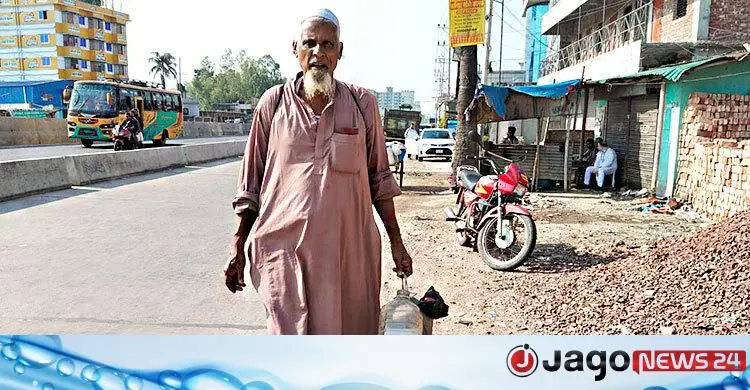
A filling station on the Sherpur road in Bogura. Afternoon has turned to evening and the heat is stifling. On one side of the pump motorcycles are lined up; on the other, trucks, pickups and auto-rickshaws. In the middle of the line stand a few farmers holding containers in both hands, some irritated, some anxious. Their hurry is not for the road but for their land: if the fields are not watered, the paddy will not survive, and irrigation pumps cannot run without diesel.
The diesel crisis has hit Bogura at the most critical time for paddy in the current IRRI-boro season. Filling stations across the district see long queues every day, run out of fuel, limit sales and face uncertainty. Farmers are taking the hardest blow, because much of boro cultivation in this northern district still depends on diesel-powered irrigation.
Shajahan Ali, a farmer from the Mirzapur area, said: "I came at 10 in the morning. It is now afternoon and I still haven't got fuel. The time to water the land is running out. If the machine stays off, the paddy will die. Who will compensate us then?" Abdul Kader of the Hossainpur area, standing in the same line, said: "I used to get fuel and leave in half an hour. Now even after standing for four or five hours there is no guarantee. Sometimes they say it's finished, come tomorrow. Can a farmer wait until tomorrow?"
Same picture at upazila pumps
The picture is the same at pumps in the upazilas, not just the towns. At a filling station in Dupchanchia upazila, diesel had run out before the afternoon and the dispenser machine was covered up. Several farmers waiting outside were going home disappointed. One of them said: "I've been sitting here since morning. Now they say there's no fuel, come tomorrow. Will the water in the field wait until tomorrow?"
According to sources, there are about 72 registered petrol pumps in Bogura district. With supply falling over the past few weeks, almost all of them are under extra pressure. Some are not selling more than a fixed quantity; others are suspending sales for a while.
Filling station owners say the main problem is irregular supply. On top of normal demand from transport, the extra demand for irrigation in the boro season has made the situation complicated.
Mizanur Rahman Ratan, president of the Bogura district unit of the Rajshahi Divisional Petroleum Owners' Association, said pressure had built up because supply was low for a few days. The situation is now gradually returning to normal, he said, but problems are arising in some places because demand is high.
But the reality in the fields is different. Farmers say that even when supply arrives, it is less than needed, so the queues are not getting shorter and the waiting does not end.
A daily shortfall of 50-60 tonnes
Several local fuel-sector sources, filling station owners and transport operators say that in the current boro season Bogura district needs an average of 280 to 300 tonnes of diesel a day. A large part goes to irrigation; the rest is used in transport, small industry, generators and other commercial work. But actual supply averages only 220 to 240 tonnes, leaving a daily shortfall of 50 to 60 tonnes, or about 15 to 20 per cent.
Those involved say that although the shortfall looks small in numbers, its effect in the field is much larger, because diesel demand in the boro season peaks at fixed times of day. Irrigation pumps run together from dawn to midday and from afternoon into the night. Without enough diesel at those times, many farmers cannot run their pumps, and some are forced to run them for a short time and then switch them off.
Filling station owners say reduced allocations have put them in difficulty too. Whatever fuel arrives each day runs out within a few hours, so many pumps have had to decide not to sell more than a set amount. In some places each customer is given a limited number of litres; in others farmers must wait in long queues.
Fuel traders say Bogura carries not only its own district's demand but also pressure from vehicles and farming in several surrounding areas. As the gateway to the north, its highway-side pumps always see high demand from transport. When thousands of irrigation pumps want diesel at the same time in the boro season, the shortfall quickly becomes visible.
Boro depends entirely on irrigation
The biggest blow of the shortfall falls on agriculture, because boro paddy is an entirely irrigation-dependent crop. If it does not get water on time, the soil cracks, plant growth is hampered and problems arise in panicle formation. In the words of agriculture officials, even a few days' disruption to irrigation at this stage can have a big effect on yield.
Farmers say fertiliser or seed can be arranged later, but once the time for irrigation has passed, the loss is hard to make up. The diesel shortfall is therefore no longer just a fuel crisis; it is directly tied to rice production, farmers' income and food security.
Agriculture officials say regular irrigation is essential for boro at this stage. If the land dries out, plant growth can stop, panicles can be small and grains can remain unfilled. In many cases the yield falls significantly.
Rafiqul Islam, a farmer in Dupchanchia, said: "This is the critical time for paddy. If the land doesn't get water for five to seven days it will dry out. If I don't get fuel, how will I irrigate?"
Azizar Rahman, a farmer in the Talora area, said: "We used to look up at the sky when it didn't rain. Now we have to look out for fuel as well."
According to the agriculture department, a hectare of boro needs an average of 400 to 450 litres of diesel over the whole season. Many shallow-machine pumps use up to about 300 litres in a season, so even a few days of shortage can have a major impact.
Boro has been planted on about 1.85 lakh to 1.90 lakh hectares in Bogura this season, most of it dependent on irrigation.
The agriculture department estimates that about 45,000 to 50,000 registered and unregistered irrigation pumps are active in the district, 70 to 75 per cent of them diesel-powered. That means about 32,000 to 35,000 pumps depend directly on diesel. In a system this large, even a small disruption in supply affects thousands of hectares at once.
Shamsuddin Firoz, deputy director of the district agricultural extension department, said a huge amount of fuel is needed every day this season, and irrigation suffers when supply is disrupted. The matter is being looked into in coordination with the administration, he said.
Licence rule adds a new hassle
To manage the situation, the local administration has taken some control measures. Some pumps have been instructed not to sell fuel without a driving licence, a helmet and the necessary papers.
The administration argues that this will reduce misuse and give genuine users priority. But farmers say it has created a new problem, because many village farmers who come to buy fuel on a motorcycle or with a jerrycan do not carry all the papers.
One farmer said: "I own the land and the machine is mine. But if they won't give me fuel because I have no licence, how will water reach the field?"
Energy and agriculture analysts say this crisis is not new. A very large number of the country's irrigation pumps still run on diesel, and because the shift to alternative energy is slow, the same pressure builds every season.
According to experts, the problem will be hard to solve in the long run without solar-powered irrigation, expansion of electric deep tube wells and a separate fuel allocation for the farming season.
In different parts of Bogura, farmers are now reckoning that before working out how much fertiliser the paddy needs or what the yield will be, they need water, and before water, they need diesel.
The paddy is standing in the fields, but the farmer is standing at the pump. That contrast is now Bogura's reality. If supply does not return to normal quickly, the irrigation crisis could become a major risk not just for farmers but for food production.
Source: Jagonews24. First published in Bengali on The Agro News.


Comments
(0)