
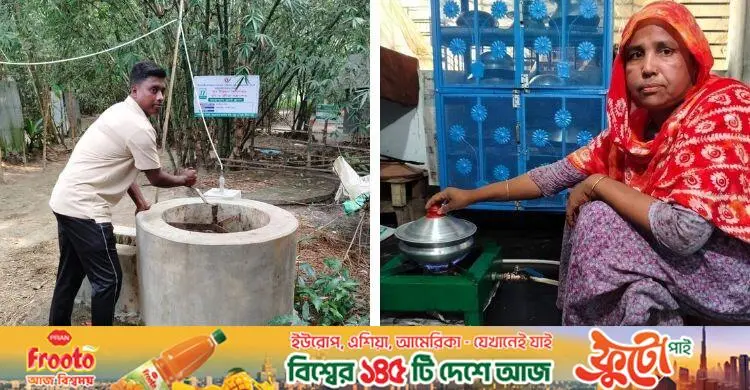
The cow dung that once had to be thrown away after the cowshed was cleaned each morning is now a family's cooking fuel. Once processed, the same dung also yields organic fertiliser for the fields, so one resource serves two purposes. It saves the trouble of buying or gathering wood and straw, cuts cooking costs, and opens a way to reduce dependence on chemical fertiliser.
The system is spreading across rural Bogura through biogas plants. Set up under a government programme, these plants produce gas from livestock dung and other organic waste. There are 393 plants now running in the district's 12 upazilas, producing about 61,960 cubic feet of gas a day. According to the district Department of Youth Development, the same process also yields about 47,653 kg of organic fertiliser and 15,300 kg of bio-chemicals every day.
Easier cooking, more uses for dung
For Shimu Begum, a housewife in Jamirbaria village of Gabtali upazila, the biggest benefit of biogas is that cooking has become easier. "Before, we had to collect wood and straw for cooking, and the smoke made working in the kitchen hard. Now we cook on a biogas stove, and it saves both time and fuel," she said.
Sathi Khatun, an entrepreneur in the same village, has had much the same experience, but for her the benefit goes beyond cooking fuel. "Before, cow dung had little use. Now gas is made from it, and the organic fertiliser from the plant can be used on the land. So one resource gives several benefits," she said.
Those involved see the change as a new opportunity for managing rural resources. For families that keep livestock, dung is no longer just waste but raw material for fuel and farm inputs.
According to the district Department of Youth Development, the 393 biogas plants in Bogura's 12 upazilas involve 2,640 trained beneficiaries, and Tk 5 crore 22 lakh 60 thousand has been disbursed in loans since the project began. Biogas is therefore tied not only to fuel but also to creating small entrepreneurs and self-employment.
Three biogas villages have also grown up in the district: Panchthupi and Gosaibari in Dhunat upazila and Jamirbaria in Gabtali upazila. In Jamirbaria, 36 families meet their cooking gas needs from their own livestock's dung.
How the plants work
Once dung and water are fed into the digester of a biogas plant, the organic matter decomposes in the absence of air and produces methane-rich gas, which is piped to the kitchen stove. The flow is controlled with a valve as needed. The residue left in the digester after the gas is produced is used as organic fertiliser.
By the Department of Youth Development's count, Bogura's plants yield about 47,653 kg of organic fertiliser a day, and those involved believe that wider use of it in farming could reduce reliance on chemical fertiliser.
Agriculture expert Bazlur Rashid said long-term overuse of chemical fertiliser had reduced the organic content of much farmland, and fertiliser from biogas plants can help restore soil fertility. It improves the soil's water-holding capacity, keeps micro-organisms active and creates scope to cut production costs, he said. In his view, dung left in the open increases bad smells, flies, mosquitoes and pollution, and using it in biogas plants reduces these problems considerably.
Officials said biogas need not be used only for cooking. With the right technology added, it can generate electricity through a generator to run lights, fans and other small appliances. In practice, however, most plants in Bogura are used mainly for cooking fuel, and because families use their own livestock's dung, they need to buy less fuel from the market.
Selim Uddin, assistant director of the Department of Youth Development in Bogura, said: "If biogas is seen only as a fuel project, its full benefit will not be understood. It is linked to waste management, renewable energy, farm production and self-employment."
Upkeep and challenges
Officials say that if properly run and regularly maintained, a biogas plant can remain in service for up to 35 years. This requires feeding a set amount of dung and water into the digester regularly; if the supply of dung falls, gas production falls too. The technology is therefore more effective for families that keep livestock.
But a lack of regular technical support after installation, a shortage of trained technicians and the initial investment remain challenges. For families without enough livestock, keeping a plant running can be difficult unless there is a separate arrangement to collect dung.
Those involved believe more families could be brought into the system if loans on easy terms, training for users and technical support at union or upazila level were ensured. Biogas plants also bring an environmental benefit: according to the district Department of Youth Development, the district's plants help cut carbon emissions by about 47,653 cubic feet a day.
Feeding dung into digesters instead of leaving it in the open also makes waste management easier, and burning less wood and straw creates scope to reduce smoke and air pollution locally.
Shariful Islam, associate professor of economics at Bogura's Azizul Haque College, said: "No single measure is enough to tackle the country's energy crisis. Along with exploring for domestic gas, we need an integrated use of renewable energy, energy saving and alternative technologies." In his view, Bogura's experience shows that local resources can deliver benefits for energy, farming and the environment at the same time, and a planned expansion of biogas could increase its impact on the rural economy.
Motahar Hossain, director general of the Department of Youth Development, said: "Through the IMPACT phase-3 project, we are working to expand renewable energy while creating opportunities for environmental protection, organic fertiliser production and self-employment. We plan to bring more people under this technology in future."
In Bogura's villages, the biogas story is about more than an alternative stove. A family's cow dung becomes cooking fuel, and the residue goes to the fields as fertiliser. The same resource cuts household fuel costs, reduces waste and returns organic matter to farming, and it is this range of uses that is gradually turning biogas into a promising local business and resource-management model.
Source: Jagonews24. First published in Bengali on The Agro News.

Comments
(0)