
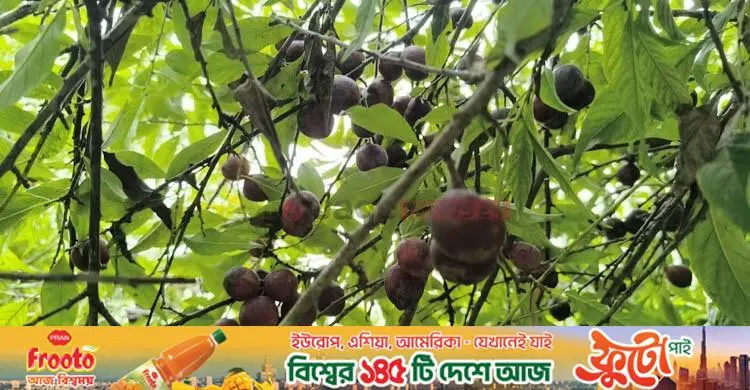
Habibur Rahman is a farm entrepreneur in Boalmari, Faridpur. Besides various crops and vegetables, he has planted an orchard of alubokhara, a foreign fruit, and it has paid off. After all expenses he has already earned several times what he spent.
Habibur Rahman, son of the late Moksed Molla of Loknath village in ward 9 of Boalmari municipality, has caused a stir in the area by growing alubokhara, a foreign spice fruit, beside his house. Seeing his orchard, many people are now interested, coming from far and near to see it and seek advice.
About the fruit
The local agriculture office says alubokhara is a foreign spice fruit, needed especially for cooking biryani. The trees usually flower in January and February, and the fruit ripens fully four to five months later, around June. Unripe fruit is dark green, turns bright brown as it matures and red to black when fully ripe, looking much like a black jamun. The fruit is soft and juicy. A tree five or six years old yields about 10-15 kg, and each fruit usually weighs 10-12 grams. The trees need little care, fertiliser or pesticide; looking after them like an ordinary vegetable crop is enough.
The orchard stands on farmland in a remote area, and from a distance many cannot tell what it is. This is the first time alubokhara has been grown in the area. Every tree is loaded with fruit, brown and black among the green leaves. Fruit is picked for sale every day; many buyers come to the house and many order online.
A family's change of fortune
Habibur Rahman's son, Md Zahir Rahman, said: "I look after the orchard with my father. When he first brought the saplings from the agriculture office and planted them, my mother and I wondered what he was planting. Fruit came about two years later, and as it increased we began to enjoy it. But early on, not understanding how to care for them, my father pulled up quite a few trees and grew vegetables. He kept seven. Now they are full of fruit and demand is huge. It sells for Tk 700-800 a kg. It has changed our fortunes."
His wife, Mosammat Jesmin Begum, told Jago News: "About five years ago an agriculture officer used to come to our house and hold meetings with the good farmers of the area. Then he gave us some alubokhara saplings. After planting, they bore a little fruit for a few years, but this year every tree has fruited heavily. In a month and a half we have sold or given away about 5-6 maunds and sold more than Tk 1.5 lakh worth. There will be a few more maunds on the trees. Altogether we will be able to sell several lakh taka worth, several times our costs."
Rafiq Islam of Loknath village told Jago News: "It is an expensive fruit. Habibur Rahman has succeeded with this orchard. Alubokhara fetches a good price, so I want to grow it. I want to take some grafts from here and plant an orchard."
Md Rezaul Molla said: "They taste great in biryani. Following Habibur, many are keen to plant orchards. In a word, Habibur Rahman has succeeded completely."
Abdur Rahim, a young man who came to see the orchard, said: "At 33 I saw an alubokhara tree and fruit for the first time in my life. It tastes good raw too. There is a lot of fruit. I picked some from the tree myself and ate it. I will start an orchard too."
Planting on a larger scale
Habibur Rahman said: "A few years ago I got 25 alubokhara trees from the agriculture office through training and planted them on farmland beside my house. A year after planting, not understanding, I cut down 18 of them, largely in anger. There are now seven trees. The orchard doesn't need much labour, fertiliser or care. It is possible to profit by planting on a large scale in this area's soil and climate, but the land must be high and the soil loamy so water does not collect at the base of the trees."
"The trees started bearing plenty of fruit two years after planting. I am selling at Tk 700-800 a kg. If the fruit can be stored and sold, it can fetch more than Tk 1,000 a kg in the local market. After all costs I have made several times my money. There are several more maunds on the trees. People come every day from far away to see it and buy. This year I have started preparing a commercial orchard on more land," he added.
Akash Saha, another successful entrepreneur who came to see the orchard, told Jago News: "There is hardly any alubokhara in this part of the district. Small as it is, this is the first orchard. I have eaten alubokhara in biryani but never seen the tree or the raw fruit. I came when I heard. I picked and ate some myself and bought a few kilos for home. I'll make pickle."
Boalmari sub-assistant agriculture officer Avijit Biswas said: "Alubokhara is a spice fruit used in polao, biryani, pickles and chutneys. It is popular around the world for its nutritional value and many uses, and it is also used in various fine dishes."
Boalmari upazila agriculture officer Alvir Rahman told Jago News: "Alubokhara is grown in Iraq, Iran and other parts of the Middle East and in some areas of India. It is now being grown in our country too, at the home of Boalmari farm entrepreneur Habibur Rahman. The agriculture department is standing by him and giving him all-round support."
Boalmari upazila nirbahi officer (UNO) SM Rakibul Hasan said: "This is good news. Farm entrepreneur Habibur Rahman has succeeded with a completely uncommon orchard. We have not heard of alubokhara being grown in this upazila or nearby. I thank Habibur Rahman. The upazila administration and the agriculture department will stand by him with full support."
Source: Jagonews24. First published in Bengali on The Agro News.
Comments
(0)