
By Benazir Ahmed Siddiqui
The sight of birds spreading their wings, flying in the open sky and chirping is always enchanting. The remarkable creativity with which birds build their nests seems like an expression of nature's wonderful architecture. Some nests are so brilliantly built that it is hard to believe. How can a tiny bird, like a skilled craftsman, make such a beautiful and flawless nest using only its beak and claws? That is why birds' nests are a source of endless wonder to many zoologists, naturalists and architects.
Interestingly, birds' nests are not only beautiful; some have even played a part in satisfying human appetites. In some countries, including China, Cambodia, Vietnam and Indonesia, soup made from nests built with the saliva of the salangane swift has become a highly valued delicacy.
The technique and type of nest-building depend on the geography of the particular area, its natural variety and the materials available. Some birds build with mud, some with twigs, some with grass, straw and hay, and some with their own saliva and feathers. The shapes of these nests vary too: some are long like a tube, some flat, some like a basket and some round.
A close look at a bird's nest shows how much labour, intelligence, patience and skill goes into building it. Birds put all their skill and ability into building nests so they can protect themselves from outside danger. To escape attacks by animals or snakes, many birds place the entrance at the bottom of the nest. They also use another method to stop outside attacks: they often make a second hole-like opening on the side of the nest, purely as a decoy. It is impossible to get into the nest through it. So let us look at the nests of some familiar birds.
Stitched leaves and borrowed holes
Nests made by stitching leaves: to make a nest that swings like a cradle, the tailorbird (tuntuni) stitches two or three leaves together into a small bowl, then builds the nest inside with soft grass and leaves. With its slender beak it stitches with thin creepers, cotton, plant fibre or thatch grass to make the nest sturdy.
Nests in hollows, crevices and pots: the magpie robin (doel), Bangladesh's national bird, is quite an expert at raiding other birds' nests. It occupies the nests of woodpeckers, parakeets, barbets and other birds, and also builds its own. It nests in holes at the tops of bamboo poles and in betel nut trees, as well as in crevices in buildings, tree hollows and inside discarded pots and pitchers. Its nest is bowl-shaped, or may be shaped like a teacup. Sparrows, mynas and drongos also build nests in haystacks, electricity poles, telephone poles, building crevices, tree hollows, ventilators and inside pots and pitchers.
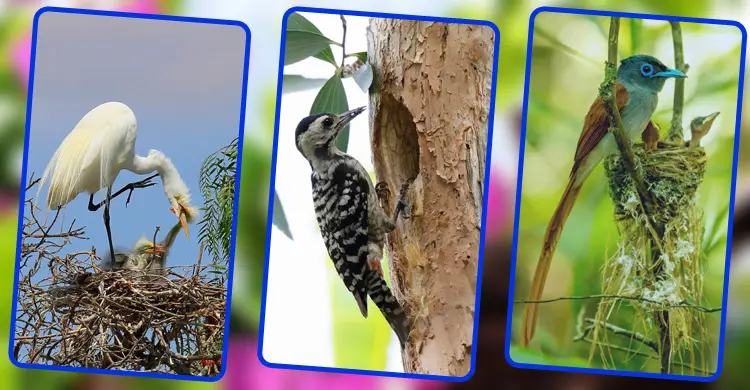
Nests in holes made in trees: the woodpecker usually pecks a hole in a tree trunk with its beak and builds its nest inside, lining it with grass and straw like a bed. Snakes and monitor lizards sometimes raid woodpecker nests for the eggs, so woodpeckers have to change nests often.
Weavers, raptors and water birds
Nests made of mud, grass and leaves: because the baya weaver (babui) weaves such artistic nests from mud, grass and leaves, it is also called the "weaver bird". Bayas nest in colonies in palmyra, coconut, date, betel nut and rain trees. Their nests are complex in structure and very beautiful in shape, looking much like an upturned pitcher. The baya works extremely hard to build its nest. It shapes the layers of grass and the mud mixture with its beak, and carefully smooths the round form by rubbing it with its belly. At first there are two downward-facing holes. Later it closes one side to make a place for the eggs and lengthens the other into an entrance and exit. Bayas usually build two types of nest. Interestingly, it is the male bird that builds these nests with its hard work and artistry. A nest takes 10 to 15 days to build. Such wonderful works of art, swaying in the breeze, bring joy to people's hearts.
Nests made of branches: eagles, kites, cormorants and egrets build nests with dry and green branches at the tops of large or medium-sized trees. Sometimes they bring straw and plastic wire in their beaks and claws and spread them in the nest to keep it strong and comfortable.
Floating nests on water: the white-breasted waterhen (dahuk), the purple swamphen (kalim) and some other water birds build nests on aquatic plants such as water hyacinth, water lilies, lotus, water spinach and helencha, using straw, dry leaves, bamboo roots and leaves, water hyacinth roots, jute fibre, moss and water grass. Sometimes these nests float away with the water hyacinth or water spinach on the current.
Nests in holes in the ground: kingfishers, snipes, bee-eaters and many water birds are adept at building nests in holes in the ground. Of these, the kingfisher likes to nest in earth banks, in holes dug by other birds in termite mounds, or in hollows in rotten tree stumps. Both male and female loosen the soil or rotten wood with their beaks to dig the hole, and kick the soil or wood dust out with their feet to build the nest.
The writer, Benazir Ahmed Siddiqui, is a pharmacist and social worker.
Source: Jagonews24. First published in Bengali on The Agro News.

Comments
(0)