
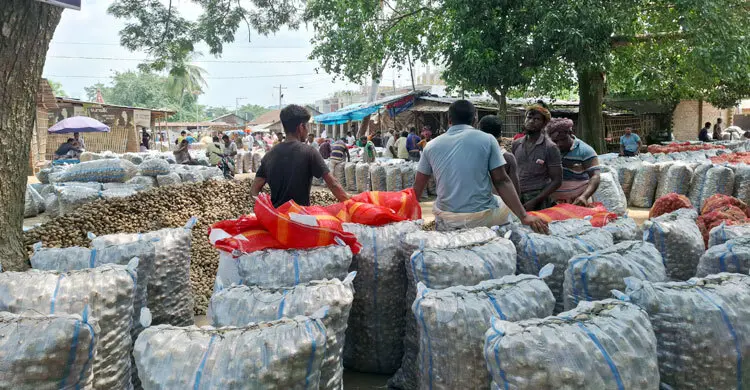
After rice, farmers in Birampur, Dinajpur, have found success with taro. Although the yield was low last year, the picture is different this time: farmers are pleased with the good harvest and smiling broadly at good prices.
According to the local agriculture department, various varieties of taro have been grown on 160 hectares in the upazila by about 850 farmers. The most widely grown is the bilashi variety. Each bigha yields 80-100 maunds, and production has reached about 4,500 maunds.
Taro has been grown most in the fields of Mukundapur, Keshabpur, Fakirpara, Harekrishnapur, Bhabanipur, Mahmudpur, Prastampur, Sarangapur, Chakbasantapur, Mirzapur and Habibpur villages.
Costs and prices
Farmers say one bigha has yielded 70-85 maunds depending on grade. Costs for a bigha come to Tk 36,000 in total: Tk 10,000 for seed, Tk 4,000 for water, Tk 6,000 for weeding, Tk 7,000 for earthing up, Tk 6,000 for fertiliser, Tk 2,000 for cow dung and Tk 1,000 for ploughing. On top of that, lifting the crop from the field costs another Tk 200 a maund and cleaning it Tk 100.
At Birampur's fresh produce market, local farmers were bringing in various vegetables straight from their fields by van. Taro was selling at Tk 1,350-1,450 a maund depending on grade. After meeting local demand, it is going by truck to various parts of the country.
Imran Ali, a farmer from Madhabpara village, said: "This year I grew taro on 3 bighas. Each bigha produced 75-80 maunds depending on grade. Last year the yield was low because of drought, but this year it is good. I sold a maund of taro at Tk 1,420, which gave me a good profit per bigha after costs."
Ahsan Kamal, a taro grower from Bhabanipur village, said: "I have been growing taro for 12 years. The yield goes up and down every year because of various disasters, but this time it has been very good. I got 180 maunds from 2 bighas and sold it at Tk 1,400 a maund, which gave a good profit after costs."
Work for labourers
Labourer Akbar Hossain said: "About 5 maunds of taro are lifted from the field every day, and I get Tk 1,000 in wages for it. With so much taro grown in the area, it has been good for us."
Another labourer, Aklima Khatun, said: "We clean the soil off the taro stems lifted from the fields and make them ready for sale. We get Tk 80 for every maund, and that is how we run our households. Last time there was less pressure, but this time there is a lot. The yield is much higher."
Upazila agriculture officer Kamal Krishna Roy said: "Taro is grown in several fields in the upazila. The soil here is a mix of sandy and loamy soil, which is very suitable for taro."
"Taro cultivation in Birampur is increasing day by day," he said. "Yields vary somewhat with the weather. After meeting local demand, this taro is supplied to various districts."
Source: Jagonews24. First published in Bengali on The Agro News.
Comments
(0)