
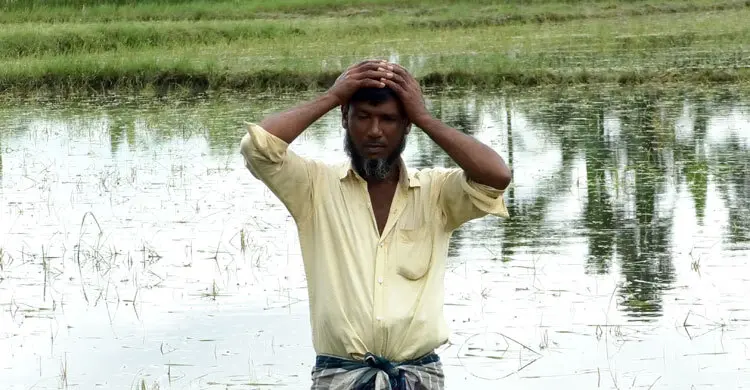
Transplanted Aman seedlings and seedbeds in Bhola have been submerged by abnormal tides and rainwater, leaving farmers facing losses.
Farmers say they borrowed at interest from banks, NGOs and local lenders to grow Aman this year. But over the past few days abnormally high tides and continuous rain washed away the seedlings planted in their fields and their seedbeds, and they are now worried about repaying their loans.
Visits to farmers' fields in Bhola Sadar and Daulatkhan upazilas found that abnormal tides in the Meghna and Tetulia rivers and several days of continuous rain had submerged transplanted seedlings and seedbeds. The Aman fields are now nothing but water. Some farmers were seen trying and failing to pull the seedlings out of the water, then standing in despair.
Farmers count the cost
Farmer Md Jamal of Tulatuli village in Bhola, and Md Mosleuddin and Md Billal Hossain of Daulatkhan, said they live by farming. This year each of them took loans from banks and NGOs and grew Aman on land leased from others. They prepared their own seedbeds and a month ago moved the seedlings to their fields, where they had started to grow. But the abnormal tides and rain of the past few days flooded the fields. Most of the seedlings were washed away and the rest rotted, causing losses of several lakh taka.
"We do not have the money to plant again, and Aman seedlings cannot be found either," the farmers said. "How will we pay our loan instalments now? If we get financial help from the government, we can get back on our feet."
Farmers Md Miraj, Md Selim and Abul Kashem said they had borrowed from NGOs and local lenders to make seedbeds. Just as the seedlings were ready to transplant, sudden tidal water and rain washed them away, costing each of them Tk 20,000–30,000. There is no longer time to make new seedbeds. Buying Aman seedlings from other districts and planting them would recoup some of the loss, they said, but if they cannot find seedlings elsewhere, the land will stay uncultivated.
Official figures
AFM Shahabuddin, additional deputy director at the Bhola Khamarbari (DAE) office, said about 19,525 hectares of land could remain uncultivated this season. To keep land from lying idle, farmers are being advised to bring Aman seedlings from other districts and to grow other rice varieties.
He said the district's Aman target this year was 1,75,936 hectares. Seedlings had been transplanted on 64,000 hectares, of which 30,450 hectares were damaged by tide and rainwater. Of 12,340 hectares of seedbeds prepared, 3,431 hectares were damaged.
Source: Jagonews24. First published in Bengali on The Agro News.

Comments
(0)