
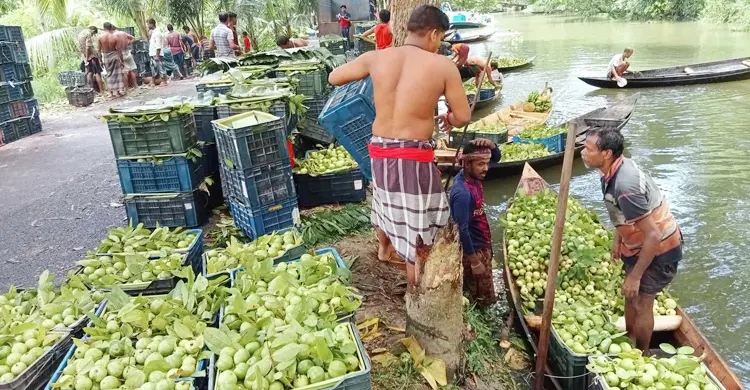
Thanks to the Padma Bridge, guavas picked in the morning now reach the capital and other parts of the country by road the same afternoon. The floating guava market is famous, but the biggest trading post (mokam) of the guava country is at Bhimruli. All along the roads leading there, sellers hand over boatloads of guavas to wholesale buyers from the roadside canals. They are selling guavas for Tk 300 to Tk 450 a maund depending on size and colour.
Although Bhimruli is famous as a floating market, fewer dinghies now come to its big mokam laden with guavas. Guavas are being bought and sold at more than 10 mokams beside the road about 10km from Jhalokati town. Farmers are getting better prices than in other years, but with a lower yield their joy has turned to gloom. Flowers dropped for lack of rain at the start of the season, so the crop has failed and guavas are less plentiful this year. Fifty-five villages in Jhalokati, Pirojpur and Banaripara are famous for guava. In the full monsoon of Asharh and Srabon, green fruit hangs from guava trees planted in the sorjan system along the banks of the region's rivers and canals.
Fifty-five villages of guava
Guavas are grown in 55 villages of Jhalokati, Banaripara and Swarupkathi upazilas. For thousands of people in the area, guava means economic comfort and a livelihood. In the monsoon months the rivers and canals of these areas are full of guavas. Flowering came late, and much of it then dropped for lack of rain. Asharh is normally the ripening season, but guavas matured at the start of Srabon, so the guava markets are only now busy. This information came from farmers in the Bhimruli, Shatadalkathi, Khajuria, Dumuria, Kapurakathi and Jagadishpur areas.
Guava is grown to some extent all over Barishal division, but commercial cultivation centres mainly on Banaripara in Barishal district, Jhalokati Sadar and Swarupkathi in Pirojpur district. Guava is grown on 937 hectares in 16 villages of Banaripara, 350 hectares in 13 villages of Jhalokati and 645 hectares in 26 villages of Swarupkathi. Of these, guava has been grown commercially for generations over large parts of the Jhalokati villages of Kirtipasha, Bhimruli, Shatadalkathi, Khajuria, Dumuria, Kapurakathi, Jagadishpur, Mirkathi, Shakha Gachhir, Himanandakathi, Adakathi, Rampur and Shimuleshwar.
The 26 villages of Swarupkathi include Sangitkathi, Khayerkathi, Bhadranando, Bachchukathi, Bhangura, Adabari, Rajapur, Brahmankathi, Dhalhar, Jindakathi, Atghar, Kuriana, Purba Jalabari, Idilkathi, Aramkathi, Madra, Ganapatikathi, Atakathi, Jamua, Joilshar, Sohagdal, Adamkathi, Ashwathkathi, Samit, Sehangal and Andarkul.
The guava orchards of Banaripara in Barishal are at Tetla, Syedkathi, Malikanda, Brahmanbari, Boalia, Jambudwip, Bisharkandi, Morichbunia, Murar Bari, Umarer Par, Laban Sara, Indir Hawla, Narerkathi, Razzakpur, Halta and Chuaripar. Several thousand working families in these villages have grown guava for generations.
Mokams and output
Several thousand seasonal traders and labourers are also involved in growing, trading and marketing guava. At this time of year seasonal guava mokams spring up in at least 20 places, and more than 10 of them are trading by road as well. They are Bhimruli, Atakathi, Dumuria, Ganapatikathi, Shatadalkathi, Rajapur, Madra, Adamkathi, Jindakathi, Barnapatikathi, Atghar, Kuriana, Andakul, Rayer Hat, Brahmankathi, Dhalhar and Baukathi. In season, 5,000 to 7,000 maunds of guava are traded at these mokams every day.
Local farmers said guava was grown in scattered plots more than about 200 years ago, but commercial cultivation began in 1940 and has been growing steadily. In 2022, commercial guava was grown on at least 1,932 hectares, producing about 20,000 tonnes. With the lower yield this year, farmers voiced frustration that there is doubt whether even 10,000 tonnes will be produced.
Farmers' worries
Farmer Pankaj Baral said: "In Magh and Falgun we had to clear the base of the guava trees and apply fertiliser, then cover the base with mud. That cost an average of more than Tk 300 per tree. Much of the flowering on the trees dropped because there was no rain. Forget profit, I am worried whether I will even recover my costs."
Farmer Debabrata Haldar Bitu said: "Guava is our only source of seasonal income. When the guava crop is good, we are comfortable. Crores of taka change hands every year at the floating market on the water. Some temporary shops set up to serve wholesalers, tourists and visitors food and refreshments, and the sellers profit from that business."
Farmer Bipul Chakraborti said: "Three men in our household work on every kind of task in the guava orchard, including its care. Our income in this season of the year keeps the household going all year."
Tourism businessman Nishith Haldar Shanu said: "Tourists from home and abroad come for the guava season. Before, they came only by water. Now, since the Padma Bridge, they can travel by road in a short time, so the number of tourists is rising. As the guava orchards have been harmed, we have created opportunities for scenic trips. Tourists and visitors buy some guavas to take home when they leave."
Former union parishad chairman Bhaben Haldar said: "This year the guava trees were cared for properly, but with no rain most of the flowers dropped. With the amount of fruit on the trees, we are getting good prices, but it is very little compared with the cost."
Md Monirul Islam, deputy director of the Department of Agricultural Extension (DAE) in Jhalokati, said: "Guava is grown commercially on 350 hectares in 13 villages of the district's Sadar upazila. In the guava season, guava means economic comfort and a livelihood for people in the area. The yield is lower this time, but farmers are getting good prices."
Reported by Md Atikur Rahman.
Source: Jagonews24. First published in Bengali on The Agro News.
Comments
(0)