
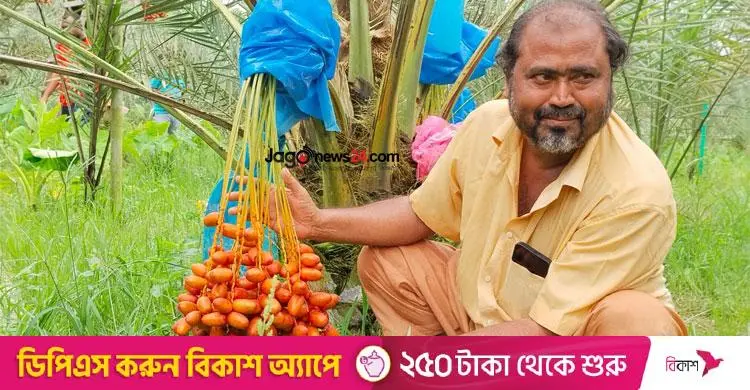
Growing dates, the fruit of the desert, has changed Abdul Motaleb's fortunes. His mud house has become a two-storey building, and he has bought several bighas of land worth more than Tk 1 crore. People who once mocked him now call him "crorepati date Motaleb", and his success is drawing many others to date farming.
Abdul Motaleb lives in Paragaon village of Habirbari union in Bhaluka upazila, Mymensingh. Over two decades he has built a date orchard in his home village, and inspired by his success, several date orchards large and small have sprung up in the upazila in recent years.
From laughing stock to success
The start was not easy. Motaleb once lived in a mud house with his wife and children. Hoping for a better life, he left his family for Saudi Arabia, where he learned the techniques of date farming. Hoping to succeed by selling dates and saplings at home, he brought date seeds back from Saudi Arabia and set up an orchard. Slowly the hope became reality.
At first his wish to plant a date orchard made him a figure of fun in the village. His confidence that Saudi dates could be grown in Bangladesh and that he would succeed by selling saplings earned him the name "mad Motaleb". But gradually the picture changed. Saplings from his orchard now go to all parts of the country and his tasty dates are sold. With income from the orchard he has built a two-storey house and bought land worth over Tk 1 crore. Seeing his success with a fruit grown in the scorching desert, many unemployed young people in the area now dream of becoming self-reliant by growing Saudi dates.
Motaleb went to Saudi Arabia in 1998 to lift his family out of hardship and worked on a date farm there for three years, from 1998 to 2001. During that time he planned to grow dates at home, and in late 2001 he brought back about 35 kg of seed of improved date varieties. He planted 275 seedlings on two bighas beside his house, but they bore no fruit. He planted again, with the same result. In the third round two trees fruited, and gradually he obtained seven mother trees. He then began producing saplings from cuttings. Disappointment gave way to success, and over nearly two and a half decades his gains have grown.
Today his seven-bigha orchard has more than 3,000 date palms of the Saudi Ajwa, Sukkari, Ambar, Lipjel and Mariam varieties, and it earns him more than Tk 50 lakh a year. He has also planted a new orchard of about 8,000 trees on another seven bighas, crossing local and foreign varieties for sap, with the aim of producing gur (molasses).
Inside the orchard
On a visit, dates of many varieties were hanging from the trees; on small trees the bunches touched the ground. For the taller trees, iron ladder-like frames have been fixed to the trunks, which an orchard worker uses to climb up and bring the dates down. Motaleb offers visitors free dates, and everyone is charmed by the taste of sweet dates grown on home soil.
Locals say that when people go abroad they come back with suitcases full of goods, but Motaleb came back with date seeds, and people laughed at him and called him mad, believing dates do not grow in every soil. Motaleb proved them wrong and changed his fortunes by selling date saplings. Educated unemployed young people are now being inspired to plant date orchards.
Inspired by Motaleb, Afaz Pathan of Paragaon village has built his own orchard. "I learned the technique from Motaleb and sowed seed on two bighas in late 2008. That year I got 6,000 saplings, of which 130 turned out to be mother trees. From cuttings of these I now have 3,500 mother trees, plus 500 other trees," he told Jago News. "My orchard now covers 10 bighas. I earn more than Tk 30 lakh a year selling dates and saplings."
Shafiullah Ansari said: "Motaleb had no schooling. He is essentially a farmer, and in Saudi Arabia too he got farm work. No one could have imagined that this farmer would cause a stir growing Saudi dates."
Md Sujon Mia, a worker at the orchard, said: "The dates grown here are relatively large and tasty, no different in taste and aroma from Saudi dates. Motaleb's fortunes changed mainly through selling saplings, not dates. I look after the orchard and load saplings onto vehicles when they are sold, among other work. My wages are enough to support my family properly."
Motaleb could not study himself, but his son Mizanur Rahman is in the first year of an honours course. "Alongside my studies I have worked in the orchard since 2023. I have learned to produce new saplings from cuttings, and I have developed a variety by crossing local and Saudi date palms that can yield a lot of sap for making gur," he said.
Motaleb in his own words
"The trees first bore dates in 2006, and I started selling saplings after that. I sell seed-grown saplings for Tk 1,000 to Tk 8,000, but there is no guarantee with them. Each sapling grown from a cutting sells for Tk 15,000 to Tk 2 lakh. When I sell these I give many buyers a written guarantee on stamp paper, because these saplings do not die. Saudi dates will grow in any soil anywhere in Bangladesh, but the trees must be female. Each tree gives 50 to 60 kg of dates a year. With government support, commercial Saudi date farming could be spread across the country," Motaleb told Jago News.
"Every year the flowers come in January-February and the fruit ripens in June, July and August. I earn more than Tk 50 lakh a year selling dates and saplings. A full-grown tree bears 250 kg of dates. Ajwa sells for Tk 3,000 a kg, Ambar for Tk 2,500, Sukkari for Tk 1,000, Lipjel for Tk 4,500 and Mariam for Tk 600. Date saplings are sold as well," he said.
Officials' view
Mizanur Rahman, additional agriculture officer of the upazila, who says he advises on Saudi date farming, said: "Many growers have trouble choosing between male and mother-tree saplings, so saplings must be selected carefully. Seed-grown saplings carry few or none of the true variety's traits, which is why cuttings sell more. Date saplings suffer very little disease. We regularly advise entrepreneurs like Motaleb, but we cannot give date orchards direct support through any project. If the government brought farmers under incentives through a project, they would benefit and the number of growers would rise."
Mymensingh divisional commissioner Mokhtar Ahmed told Jago News: "I went to see the orchard and ate its dates. They taste just like Saudi dates. Saudi dates are expensive in the market, so if enough orchards grow up in the country from Motaleb's saplings and plenty of dates are produced, the country will benefit. A plan to expand Saudi date farming and create entrepreneurs through incentives will be raised at a cabinet meeting."
Source: Jagonews24. First published in Bengali on The Agro News.
Comments
(0)