
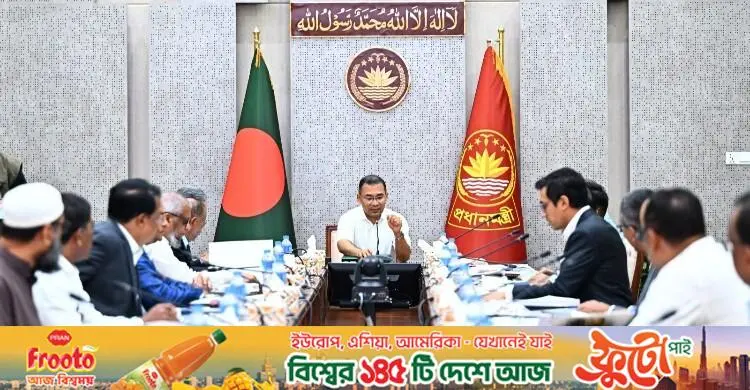
The governing board of the Bangladesh Economic Zones Authority (BEZA) has taken several important decisions on expanding the country's economic zones, increasing investment, creating jobs and protecting the environment.
Prime Minister Tarique Rahman chaired the board meeting at the Prime Minister's Office in the Cabinet Division at the Secretariat on Monday, 3 August. Deputy press secretary to the prime minister Sujauddoula Sujan Mahmud gave the information.
Ministers Amir Khasru Mahmud Chowdhury, Khandakar Abdul Muktadir, Abdul Awal Mintoo, Ariful Haque Chowdhury and Sheikh Rabiul Alam, and Bangladesh Investment Development Authority (BIDA) executive chairman Chowdhury Ashik Mahmud Bin Harun attended the meeting.
Trees in every EPZ
Under the decision, trees will be planted in every export processing zone (EPZ) in the country as part of the government's programme to plant 25 crore trees. A total of 1.25 lakh trees are to be planted across the EPZs. The initiative aims to protect the environmental balance alongside industrialisation, increase greenery and develop the economic zones as environment-friendly areas.
The meeting also reviewed progress in implementing the decisions of the ninth meeting of the BEZA governing board, and discussed setting up new economic zones, reviewing the evaluation of private economic zones and making the best use of unused state-owned industrial assets.
Jute mill land and private zones
The board also examined the potential for using the land and existing infrastructure of Karim Jute Mills and Latif Bawany Jute Mills in Narayanganj for economic activity. Emphasis was placed on attracting local and foreign investment, creating jobs and energising the local economy by setting up modern industries in these areas.
Following the set guidelines for applications and licences for private economic zones and framing a new policy were also discussed.
The prime minister stressed developing the economic zones as green, modern and investment-friendly industrial areas by combining industrialisation with environmental protection.
Source: Jagonews24. First published in Bengali on The Agro News.
Comments
(0)