
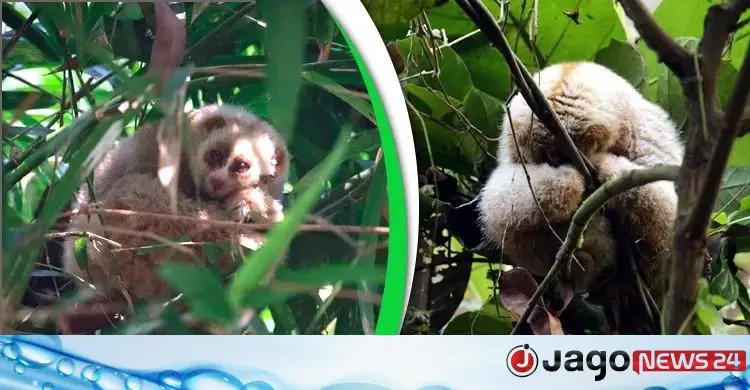
The slow loris is a small primate. Although it moves slowly, it plays an important role in pollinating flowers and spreading seeds, and it eats more harmful insects than fruit, which makes it a friend of the ecosystem. That is how Hasan Al Razi, a PhD fellow at the University of Western Australia who works on slow loris conservation and research in the Chittagong Hill Tracts and Sylhet, describes the value of this vanishing animal. "Besides nectar and tree insects, slow lorises eat the thick, jelly-like gum of trees such as jiga and bahera," he said. "If they cannot find it, they face a food crisis. So we should revive natural forests, so that endangered animals like these can find food."
The International Union for Conservation of Nature (IUCN) Red List places the slow loris in the "endangered" category, meaning the species could become extinct in the wild. Several have recently been rescued in Khagrachhari. On 13 April the Forest Department rescued a slow loris at Ganjpara in Sadar upazila. "It was found hanging from an electric wire in Ganjpara," Khagrachhari's divisional forest officer said. "Locals informed the Forest Department, and staff of the Khagrachhari Sadar range brought it to the range office. After two days of care it recovered and was released in the Alutila reserved forest."
A few days later, on 20 April, another slow loris was rescued at Bhaibonchhara; it was saved by the quick rescue and also released in Alutila reserved forest. At least eight slow lorises have been rescued and released in Khagrachhari in the past two years. The Forest Department is active in protecting endangered animals like these and moves quickly when it hears that wildlife has strayed into settlements or is in danger.
Teak plantations drive them into villages
The forest officer said several awareness meetings on wildlife protection have been held in Ramgarh and other upazilas of the district. "The main reason slow lorises come into settlements is plantations of foreign trees such as teak," he said. "In evergreen forest, wildlife finds the right food and habitat. But with so many teak plantations, slow lorises cannot find tree gum, their main food, so they come into villages. That is why we ask local people to grow mixed forest instead of monoculture, which creates the right conditions for forests and wildlife."
He described the animal: "The slow loris's head and body are 33 cm long and it weighs about 1.2 kg. Its body is covered in short, soft fur, light brown to grey. It has a round head, owl-like eyes ringed with brown, a short tail almost hidden in its fur, and a long brown stripe from the top of its head down its back." The Bengal slow loris is found mainly in Bangladesh, India, Bhutan, Cambodia, China, Myanmar, Thailand and Vietnam. In Bangladesh it lives in hilly evergreen forest. It is nocturnal, does not move about by day and prefers the high branches of trees.
Its diet includes young leaves, buds, tree gum, small insects, arthropods, small birds and the eggs of various animals. In Khagrachhari, the environmental organisation Pitachhara has been working on forest and wildlife conservation, including slow loris conservation since 2017. It runs research on the slow loris at Pitachhara and is trying to create a suitable habitat. Seven or eight slow lorises can be seen in more than 13 acres of protected forest there. Besides insects, the slow loris feeds on the gum of seven or eight tree species, but few such trees remain in the forest, and where there was forest there may now be settlements.
That is why the animals have left the forest for villages, where they are often electrocuted while crossing power lines. People are being made aware so that they do not kill slow lorises. The slow loris moves slowly but can grip anything very tightly. It lives in trees, usually alone, and generally gives birth to a single young after about seven months of pregnancy.
Researchers call for forest restoration
Researchers say conserving the slow loris requires reviving natural forests. Its distribution in the hill districts varies somewhat, as the forests there are scattered and fragmented, split up by human activity, and slow lorises are sometimes seen in the small patches. Noting that monoculture forests of a single tree species are not good for the slow loris or any other animal, the researchers said: "If we do not know which trees in the forest they are feeding on, we cannot conserve them. If those trees are not in the forest, they will face a food crisis."
"To conserve an animal, we need to know its ecology, its relationship with its environment," they said. "The slow loris's habits may change from one forest to another, and its behaviour may vary. We need to learn about its habits and behaviour."
Source: Jagonews24. First published in Bengali on The Agro News.


Comments
(0)