
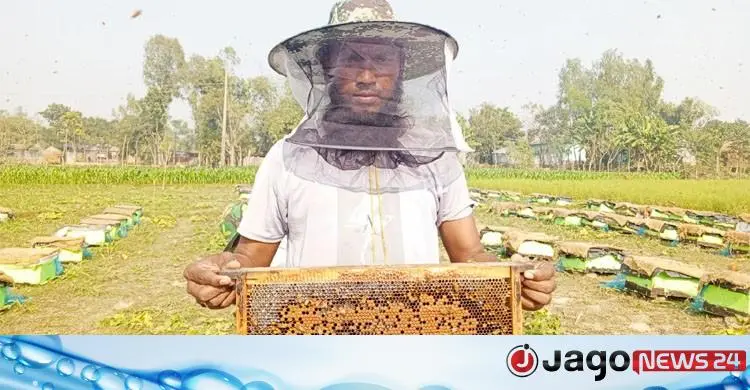
Memories of the hard times of the Covid pandemic are still fresh. For many it was simply a time of helplessness and uncertainty, and thousands were left adrift after losing their jobs. Yet some found a new path and a new dream even then. One of them is Mohammad Shah Alam, who chose beekeeping after losing his job and is now a successful entrepreneur.
Mohammad Shah Alam is the son of Ramjan Ali of Madhupur village in Barhatta upazila, Netrokona. He has a wife, two sons and two daughters. He told Jago News that before Covid he worked at a firm in Narayanganj on a monthly salary of Tk 30,000. It was a regular job and a reasonably comfortable life, until Covid turned everything upside down in 2020 and he lost his job.
From YouTube to BSCIC training
At first Shah Alam was mentally shattered. Household costs and his children's future plunged him into uncertainty. But he did not give up, believing hard work would open a way. Around then he watched YouTube videos of honey production with bee boxes and became keen to try it.
He then took training on bees and honey production at BSCIC in Gazipur, gradually learning about the life of bees, honey collection and bee box management. After the training he realised honey could be the mainstay of his new life. He took a loan of Tk 1 lakh, bought 25 bee boxes and started. The start was not easy: caring for bees, the effect of the weather and the availability of flowers were all new to him. But with patience and hard work his experience and confidence grew over time.
150 boxes in the mustard fields
This year Shah Alam has come to Islampur upazila in Jamalpur to collect mustard flower honey, with rows of bee boxes beside vast mustard fields. He now has 150 bee boxes, and each yields 1.5 to 2 kg of honey.
Besides mustard honey, he collects litchi flower honey, black cumin (kalojira) honey and pure Sundarbans honey using bee boxes. He is busy with this work six to eight months a year, travelling with his boxes to different districts according to the flowering season. He sells mainly to the wholesale market. His venture also employs four workers.
"I have come to Jamalpur for mustard flower honey," Mohammad Shah Alam said. "A lot of mustard is grown here. At first I collected little honey, but for the past two years it has been good. I collect honey from the boxes every 10 days. This season I have set a target of selling Tk 3 to 5 lakh worth of mustard honey."
"Mustard and litchi flower honey are available in the largest quantities," he said. "I sell them wholesale at Tk 12,000 a maund. Black cumin honey and pure Sundarbans honey come in smaller quantities, but their prices are relatively higher."
Asked about sales, he said: "Because it is good-quality pure honey, I do not have to worry about selling it. Regular buyers place orders in advance. Various companies collect honey straight from the field, and many people also buy it retail."
Reinvesting the income
"I do not save a big part of my income from honey," Mohammad Shah Alam said. "Besides running the household, I turn it into capital. Every year I buy new bee boxes from my income. A bee box costs Tk 5,000 to 7,000. I started with just 25 boxes; today I have 150, which is now my big capital."
"In the rainy season, or when there are no flowers, the bees have to be fed sugar, which costs around Tk 3 to 5 lakh," he said. "Even after transport, food, lodging and other costs, there is a sizeable profit every year."
Beekeeping has changed his family's finances, and he now looks to the future with confidence rather than fear. "Losing my job was very painful then," he said. "But now I feel it gave me the chance to stand on my own feet. If I had not taken the risk, I would not be where I am today."
Shah Alam's story is not just one man's success, the report says, but an inspiration for thousands of unemployed young people and jobless workers, showing that with proper training, hard work and patience an honourable life can be built through farm-based enterprise.
Source: Jagonews24. First published in Bengali on The Agro News.

Comments
(0)