
By Benazir Ahmed Siddiqui
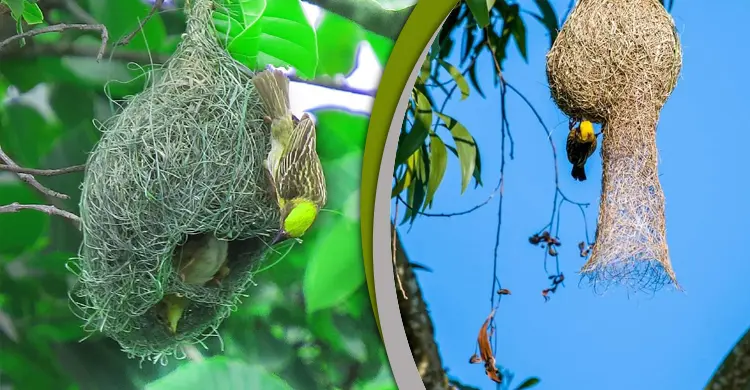
Go Cong is a neat, green town that has grown up along the broad Mekong river in Vietnam's Tien Giang province. Walking through the middle of the town, near the railway station, you are suddenly stopped by the chirping of birds. A short distance away, in various palms and thorny trees, weaver birds (called rong roc in Vietnam) are peeping out of their nests and flying about. The sweet chorus of so many weaver birds sends the delighted mind flying back to childhood and Rajanikanta Sen's poem "Swadhinatar Sukh" (The Joy of Freedom).
With the rhythm of the poem in my head, I boarded the train in a carefree mood, bound for Can Hoch, a village framed by picture-like rivers, trees and hills and by layers of green paddy fields. Leaving the station, I came onto the road and noticed a small crowd. Pushing forward, I saw a middle-aged man wearing a conical leaf hat (the traditional hat called non la in Vietnam) putting on a show of tricks with birds. Sometimes the birds flew in a flock and turned somersaults, sometimes they brought pieces of bread in their beaks and put them in their owner's mouth, and sometimes they put on a funny act of falling over unconscious. Most of the performing birds were rong roc, or weaver birds. Watching the trained weavers, I grew nostalgic and in my imagination dived among the weaver birds of evergreen Bangladesh.
Trees that sheltered the weaver
Once, Bangladesh's towns and especially its villages had plenty of palmyra, coconut, date, betel nut and babla trees. Passing a palmyra tree in the month of Bhadra, the sweet smell of ripe palmyra fruit would refresh the soul, and with luck you would find a reddish-black ripe fruit under the tree. In the summer heat, when the ground cracked all around, the coconut trees near the house were what quenched our thirst. Drinking date juice while shivering on a winter morning was a delight too. The betel nut trees behind the house added to the afternoon paan-chewing gatherings of village housewives. And on sunny days farmers rested between work under babla trees beside the ridges of wide fields. Scenes like these made rural Bengal ever greener and closer to the soil.
The weaver birds built their nests in these tall palmyra, coconut and betel nut trees and in thorny date and babla trees. A main reason for choosing tall and thorny trees was to protect themselves and their nests from predators. There are said to be 117 weaver species in the world, of which three are seen in Bangladesh:
- Baya weaver (deshi babui): outside the breeding season, both male and female have a copper-coloured back with black streaks and plain copper underparts. The bill is thick and conical and the tail square. In the breeding season the male's back turns dark brown, and the upper part of its yellow breast is pale.
- Streaked weaver (dagi babui): the breast is copper-coloured with clear streaks.
- Black-breasted weaver (Bangla babui): in the breeding season the male's crown is bright golden-yellow and its throat white, separated from the copper-white underparts by a black band. At other times the crown of both male and female is brown like the back feathers, the black breast band is less distinct, there is a prominent eyebrow stripe and a spot behind the ear. (Banglapedia)
Because the weaver weaves such artistic nests, it is also called the "weaver bird". Its nests are complex in structure and very beautiful in shape, looking much like an upturned pitcher. The weaver works extremely hard to build its nest. It shapes the layers of grass and the mud mixture with its beak, and carefully smooths the round form by rubbing it with its belly. At first there are two downward-facing holes. Later it closes one side to make a place for the eggs and lengthens the other into an entrance and exit. Weavers usually build two types of nest. Interestingly, it is the male that builds them with its hard work and artistry. A nest takes 10 to 15 days to build. Such wonderful works of art, swaying in the breeze, bring joy to people's hearts.
A bird in decline
Building a weaver's nest requires reeds, date palm leaves and hogla (elephant grass) thickets. But in Bangladesh reed and hogla thickets have shrunk, and palmyra, coconut, betel nut, date and babla trees have also declined greatly. As a result there are now very few weaver birds, and their very existence is under threat. In Bangladesh the black-breasted and streaked weavers are on the way to extinction, though the baya weaver still weaves its nests in flocks in trees in many villages.
With the passage of time, lack of awareness, environmental disaster and other causes, weaver birds and their nests are disappearing. A legend of the Indian subcontinent says the male weaver brings twinkling fireflies to its nest in the evening to light up the home and attract its mate. It sticks them in the mud on the nest wall, releases them in the morning and flies off in the joy of freedom. With the flow of time, the weaver bird has lost that free and happy life and barely survives, twinkling like a firefly's light, in the corners of Bangladesh's villages.
Lost in these thoughts, I suddenly saw that the old Vietnamese man's bird show was ending. With a heavy heart I said goodbye to him and took a taxi to a homestay in Can Hoch village, where, it is said, fireflies come in the evening in the joy of perfect freedom and light up the weaver birds' nests themselves.
The writer, Benazir Ahmed Siddiqui, is a pharmacist and social worker.
Source: Jagonews24. First published in Bengali on The Agro News.
Comments
(0)