
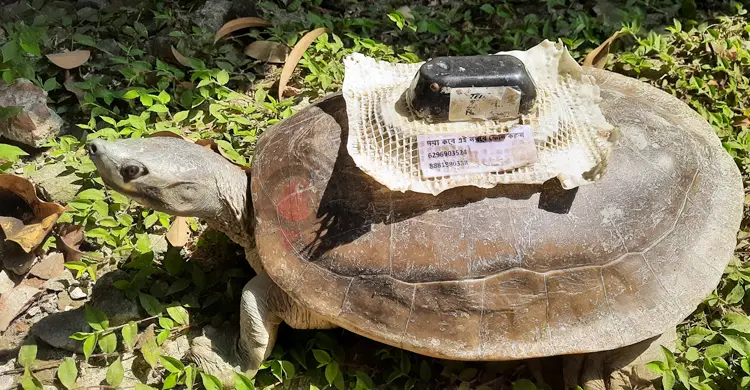
Another critically endangered Batagur baska turtle, fitted with a satellite transmitter and released for research in India, has been recovered in Bangladesh.
According to the report, fishermen netted the turtle while fishing in the Payra river in Patuakhali on Sunday (6 March) morning. In the afternoon it was brought to the Karamjal Wildlife Breeding Centre in the Chandpai range of the East Sundarbans division in Bagerhat.
Earlier, on 26 February, a Batagur baska turtle fitted with an Indian satellite transmitter was caught in a local fisherman's net in the Kazirhat area of Dighalia upazila, Khulna.
How the turtles arrived
Howlader Azad Kabir, officer-in-charge of the Karamjal Wildlife Breeding Centre, gave a different account of the timing: "The turtle was caught in fishermen's nets in the Payra river at Patharghata on Saturday (5 March) evening. On getting the news, Patuakhali Forest Department guards recovered it from the fishermen this morning, and in the afternoon the satellite-tagged turtle was brought to the Karamjal Wildlife Breeding Centre."
He said: "To learn about the movement and behaviour, range, diet and breeding of the critically endangered Batagur baska, India's tiger project and wildlife conservation department released 10 male turtles fitted with satellite transmitters at Kultali in the Sajnekhali area of West Bengal on 15 February. The Indian authorities told us two of these tagged turtles had entered our country by water."
"Eleven days later, on 26 February, one of them was first caught in fishermen's nets at Gazirhat in Dighalia upazila of Khulna, having travelled by sea and river. At that time signals showed the other tagged turtle was moving in the Baleshwar river next to the Sundarbans in Sarankhola upazila of Bagerhat."
A critically endangered species
A Rob, station manager of the Batagur baska project at the Karamjal centre in the Chandpai range, said the species once existed in Bangladesh, India and Myanmar and is now classed as critically endangered and near extinction.
"Only one or two survive in our coastal areas. Collecting those, research has been carried out at the Karamjal Wildlife Breeding Centre in the Sundarbans since 2014," he said.
He said the satellite transmitter on the turtle's back works for one year. "Data is collected in the first year, after which it falls off by itself. Like us, India has begun research with satellite transmitters to save the critically endangered Batagur baska."
Source: Jagonews24. First published in Bengali on The Agro News.
Comments
(0)