
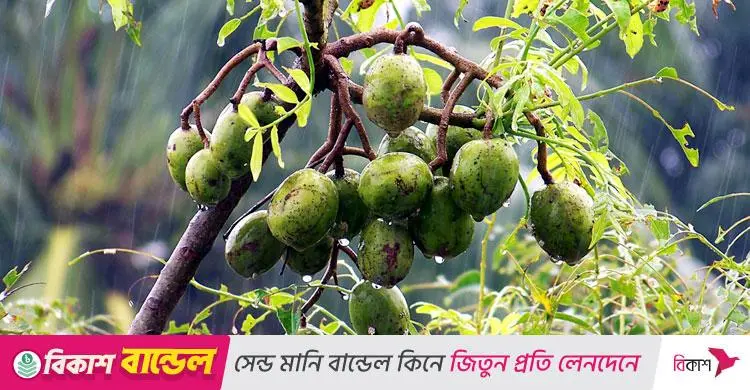
Amra, the hog plum, is a seasonal fruit of Bangladesh, and it is grown most in Barishal. The southern division meets 80 per cent of the demand for this tasty fruit, which is why it is known across the country as Barishal's amra.
With its recent recognition as a geographical indication (GI) product, everyone expects the profile of and demand for Barishal's amra to grow further in national and international markets.
Barishal's amra is not just a tasty fruit: it is closely tied to the region's heritage, culture and farm-based economy. Its distinctive taste, nutritional value and many uses have made it popular across the country. Many people from Barishal send amra to relatives in other parts of the country, and people in other regions also recognise Barishal's amra as different in taste and quality.
Production by district
According to the Department of Agricultural Extension (DAE) at Khamarbari, Barishal, amra is grown on 1,855 hectares in the division, producing 24,684 tonnes, or 13.307 tonnes per hectare. By output, Pirojpur produces the most, 8,677 tonnes, followed by Jhalakathi with 4,578 tonnes, Patuakhali with 3,900 tonnes, Barishal with 3,384 tonnes, Bhola with 2,890 tonnes and Barguna with 1,255 tonnes.
By area, however, Jhalakathi grows the most, on 602 hectares, followed by Pirojpur on 463 hectares, Patuakhali on 315 hectares, Barishal on 282 hectares, Bhola on 131 hectares and Barguna on 62 hectares. Within Barishal district, the most amra is produced in Banaripara, Mehendiganj, Muladi and Bakerganj.
Growers say the amra season begins as the guava season ends, usually from the Bengali month of Bhadra, and lasts two months. Now that the Padma Bridge is open, Barishal's amra reaches the capital in just three hours. It also reaches Sylhet, Chattogram, Jashore, Rajshahi and other big cities by road through wholesalers and middlemen.
Growers and officials
Shariful Islam, an amra grower in Banaripara upazila of Barishal, said he has about 3,000 amra trees on several acres of land. Last season he sold 4,000 maunds of amra from them for more than Tk 60 lakh. If the weather is favourable, he expects a good yield this year too.
Mosammat Mariam, deputy director of the DAE in Barishal, said the soil and water of the southern region are especially suited to amra. The tastiest amra is grown in Jhalakathi, Pirojpur and Patuakhali in the Barishal region, and growers here meet about 80 per cent of the country's demand. Amra has now become known as a cash crop for growers, she said.
She said GI recognition will increase the profile of and demand for Barishal's amra in national and international markets, and will further enrich agriculture in the south.
On 30 April, Industries Adviser Adilur Rahman Khan and Cultural Affairs Adviser Mostofa Sarwar Farooki handed the amra GI registration certificate to Barishal Deputy Commissioner Mohammad Delowar Hossain.
Source: Jagonews24. First published in Bengali on The Agro News.

Comments
(0)