
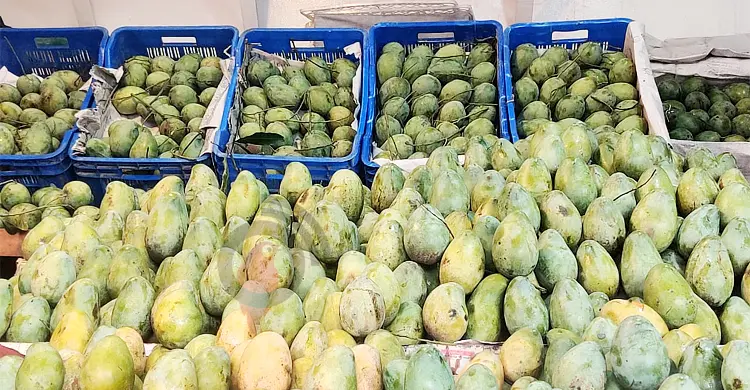
The honey month (Jyoishtho) ended a month and a half ago, and almost all the fruits available around it are gone. Only mangoes and jackfruit are left, and jackfruit is at the very end and scarce in the market. Mangoes are a somewhat different story: even at the very end of the season, supply is still good, thanks to Amrapali and BARI varieties.
Buyers say several varieties of mango are still available. Supply in August is somewhat higher this year than other years, and although prices are a little high, the mangoes on sale taste and smell good.
Sellers say that even two years ago, some Amrapali and Fazli mangoes could be had at this time (August). There were BARI mangoes too, but supply was very low. This year there is less Fazli and more Amrapali and BARI. At the end of the season, mangoes are available at Tk 90 to Tk 150 a kg depending on variety and quality, which sellers say is comparatively low.
Growers and traders in the areas the sellers source from want to send more mangoes. They expect good supplies of Amrapali for another 10 days and of BARI varieties for a month.
Markets still busy
Visits on 1 and 2 August to Karwan Bazar in the capital, Badamtoli in Old Dhaka and the market beside the Shah Ali shrine at Mirpur-1 found mangoes still arriving from Rajshahi, Chapainawabganj and Naogaon. Although the season is ending, mango trading is still good.
Retail markets across the capital also have plenty of mangoes. At fruit shops in Gulistan, Rampura kitchen market, Madhya Badda, North Badda, Notun Bazar, Mohakhali Amchattar and Mirpur, Amrapali is the most common. Traders say 90 percent of this Amrapali comes from Sapahar in Naogaon. After Amrapali, the most common are BARI-3, BARI-4, BARI-11 and BARI-12 or Gourmati, though sellers sell all of them as "BARI mango".
In retail markets Amrapali and BARI mangoes sell for Tk 120 to Tk 150 depending on quality. Fazli is also Tk 150 a kg, and Banana mango sells at Tk 200 a kg. Ashwina is available at Tk 80 a kg. Some Katimon mangoes will come next, and sellers say they will not be available for under Tk 300 a kg.
Rajab Ali, a fruit trader in the Shah Ali shrine area, told Jago News: "There is no Fazli now. Before, lots of Fazli came from Rajshahi and Chapainawabganj, and the season ended with Fazli and Ashwina. Now BARI mangoes are everywhere. BARI will be available for about another month, but prices will rise further."
There are several fruit shops in front of Bhatara police station in the Notun Bazar area. On 2 August, Siddiqur Rahman was bargaining over mangoes at one of them. He told Jago News: "I take one or two kilos of mangoes home every day on my way back. The children eat them. I mostly buy Amrapali, but for the past two days I have taken BARI-4. It's very good, with a small stone and juicy. Prices are going up, but compared with other years they still seem lower this time."
Traders' margins
Karwan Bazar wholesaler Saidur Rahman Patwari said: "There are still plenty of mangoes. We have people in Chapainawabganj and Sapahar (Naogaon). Mangoes will be available for about another month."
"We are buying BARI mangoes from orchards at Tk 4,200 to Tk 4,500 a maund," he said. "With labour and transport, that comes to more than Tk 5,000. We sell wholesale at Tk 5,200 to Tk 5,400 a maund. Retailers are probably selling at Tk 140 to Tk 150 a kg. Amrapali is at the very end, and its price is rising daily at the orchards themselves."
Raju Ahmed, a fruit trader in North Badda, told Jago News: "The season is over. I have been in business for 10 years. Other years I didn't sell mangoes after July, but this year there are mangoes and people are buying. Given how prices of everything in the market have risen, mango prices are not very high this year compared with other years."
"I am still getting mangoes at Badamtoli market," he said, "but prices are going up by Tk 10 a kg every day. In a week or so ordinary buyers may no longer be able to afford mangoes, and then we won't sell them either."
A longer mango season
Fruit researchers say the development of several new varieties is lengthening the mango season in the country, so that supply even out of season is becoming largely "normal". BARI-4 and BARI-12 in particular are available even in Srabon and Bhadro. In Rajshahi and Chapainawabganj BARI-12 is known as "Gourmati". Cultivation of the Katimon variety, which fruits three times a year, is also increasing.
Dr Abdul Alim served for a long time as chief scientific officer of the Rajshahi Fruit Research Station and has recently retired. The fruit researcher studied mangoes of the Rajshahi region for many years. He told Jago News: "The mango season has grown longer and is still growing. This is not a one-day matter, but BARI varieties have played the biggest role in lengthening it. I hear the Fruit Research Station is now also active on the Katimon variety. If that works, mangoes will be available even in February-March."
Shafiqul Islam, chief scientific officer of the Rajshahi Fruit Research Station, told Jago News: "Research is under way so that mangoes are available for a few more months, that is, until December-January or February. More research is needed on the Katimon variety. Then we will see mangoes in the market even in February."
Source: Jagonews24. First published in Bengali on The Agro News.
Comments
(0)