
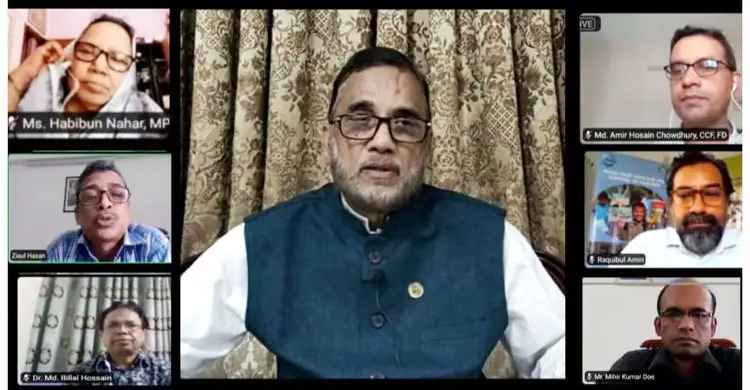
Environment, Forest and Climate Change Minister Md Shahab Uddin has said that 99 per cent of the country's vultures have disappeared for various reasons. There are now 260 vultures in the country, so the government is working to increase their number.
He said the government banned diclofenac, a drug harmful to vultures, across the country in 2010 to protect them, and is also considering a nationwide ban on ketotifen in animal treatment.
He was speaking as chief guest, joining from his official residence, at an online seminar organised by the Forest Department on Saturday, 5 September, to mark International Vulture Awareness Day.
The environment minister said the contribution of vultures, nature's cleaners, to protecting the environment is undeniable, yet this useful bird is disappearing from nature day by day. Steps have been taken to raise public awareness to save the endangered vulture, and the government is implementing various vulture conservation programmes. For these to succeed, all of us must play our part from wherever we are.
Safe zones, feeding stations and a rescue centre
At the start of his speech, the minister mentioned the initiatives of the Father of the Nation, Bangabandhu Sheikh Mujibur Rahman, to conserve wildlife and biodiversity. He said the Bangladesh National Vulture Conservation Committee was formed in 2013, and in 2014 two regions of the country were declared safe zones for vultures. In 2016 a ten-year Bangladesh Vulture Conservation Action Plan (2016-2025) was drawn up, which serves as a long-term framework for saving the country's vultures. All vulture conservation work is now carried out with priority given to this plan.
He said that in 2015 two feeding stations were set up, at Remakalenga Wildlife Sanctuary in Habiganj and in the Sundarbans, to meet vultures' extra food needs during the breeding season. In 2016 a vulture rescue and care centre was set up at Singra in Dinajpur to rescue and rehabilitate sick and injured vultures.
The minister also said vulture conservation teams have been formed with local people for long-term monitoring of vulture habitats and management of the safe zones. With their help, awareness programmes are being held in the field. Thanks to the government's many measures, the breeding success of vultures at Remakalenga in Habiganj rose from 44 per cent in 2014 to 57 per cent in 2020, which he called very encouraging.
The webinar was chaired by Chief Conservator of Forests Md Amir Hosain Chowdhury. Speakers included special guest Deputy Minister for Environment, Forest and Climate Change Habibun Nahar, Secretary Ziaul Hasan, Additional Secretary (Administration) Dr Md Billal Hossain, Prokriti O Jibon Foundation chairman Mukit Majumder Babu, Conservator of Forests for the wildlife and nature conservation circle Mihir Kumar Doe, Chris Bowden, Global Threatened Species Officer and programme manager at the Royal Society for the Protection of Birds, and international bird researcher Dr Enam Ul Haque.
The programme was moderated by Rakibul Amin, country representative of the International Union for Conservation of Nature (IUCN).
Source: Jagonews24. First published in Bengali on The Agro News.
Comments
(0)