
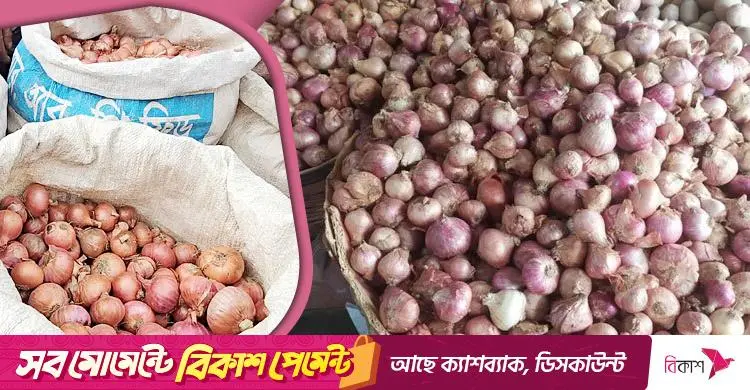
Bangladesh ranks third in the world in onion production. Surprisingly, it is also near the top of the list of importers, because local production still does not meet the country's full demand. Year after year the bulb's sharp prices have been in the spotlight: sometimes demand rises, sometimes prices climb out of reach. Dependence on India had made the country's onion market risky.
Annual onion demand now stands at about 36 lakh tonnes, which by that measure is less than production. Yet the country imports an average of 7 to 10 lakh tonnes of onions every year. The reason is that 25 to 30 per cent of the crop is lost for lack of proper storage, and that creates an artificial shortage.
A decade of growth
Department of Agricultural Extension (DAE) figures for the past 10 years show that the area under onions has grown about one and a half times and production has more than doubled. In 2015-16, 2.16 lakh hectares produced 21.30 lakh tonnes. In 2019-20, 2.37 lakh hectares yielded 25.60 lakh tonnes. Times have changed: Bangladesh is no longer looking only to India, and the main goal is self-sufficiency. In 2024-25 production reached a record 44,48,700 tonnes.
Onions are grown in two main ways in the country: murikata (from bulbs) and hali, or seed onion. Pabna, Faridpur, Rajbari and Rajshahi lead production. Last fiscal year Pabna alone grew onions on 52,000 hectares, followed by Faridpur on 43,000 hectares and Rajbari on more than 36,000 hectares.
Onion prices are low at the start of the season, but a shortage appears after the monsoon. The summer variety BARI Piyaj-5 offers hope of filling that gap. Developed by the Spices Research Centre in Bogura, it can be grown three times a year, giving more output at lower cost and in less time. Shajahan Ali Badsha, a farmer in Ishwardi, Pabna, grew the variety last year and harvested nearly 200 maunds of onions per bigha, which caused a stir among local farmers.
Md Abul Kalam Azad, acting director general of the Bangladesh Institute of Nuclear Agriculture (BINA), said: "Through the joint efforts of research institutes, Bangladesh has set a target of stopping onion imports completely within the next two to three years. We are working to develop climate-resilient, high-yielding varieties that will help achieve self-sufficiency."
Onions on the chars
Dr Abdullah Al Mahmud, regional head of the On-Farm Research Division of the Bangladesh Agricultural Research Institute (BARI) in Gaibandha, said onion farming has spread to the wide chars that have risen in the Jamuna, Brahmaputra and Teesta in the north. Sandbar cropping has brought new energy to onion growing there, and various BARI-developed varieties are the most widely grown on the chars.
People involved say all of this production is surplus, because char land is not counted as part of the main cultivable land.
Air-flow storage and seed
Dr Md Jamal Uddin, additional director of the DAE's field service wing, said: "The government has taken various steps to make up this shortfall. Air-flow storage units are being set up across the country, making it possible to store thousands of tonnes of onions at low cost. In the first phase, 4,000 air-flow machines have been installed in onion-growing areas."
Under this method, a bamboo platform 10 feet long and 10 feet wide with brick walls is built on the floor of a semi-pucca room, and an air-flow machine costing Tk 20,000-22,000 is placed in the middle. About 300 maunds of onions can be stored this way. Onions stored like this will not rot, and they will lose no more than 10 to 12 per cent of their weight.
He added that onion seed has to be imported every year, and farmers have had to pay Tk 3,000 to Tk 3,500 for it. To cut costs, steps have now been taken to produce and store seed at farm level.
Imports down, but prices a worry
The DAE said imports have been discouraged at government level so that farmers can recover their production costs and make some profit. As a result, only 3 lakh tonnes of onions have been imported from India so far this year. The effect is visible in the market: at Shyambazar, the capital's wholesale market, every warehouse was stocking locally grown onions. Traders said that with a good harvest this year they expect domestic onions to meet the need, and that local onions are always in demand because of their better quality.
The onion market that was once controlled by decisions made abroad is returning to farmers' hands. But this year it cost Tk 40 to Tk 42 a kg just to produce onions, and three months into the season farmers are still having to sell them wholesale for about Tk 40 to Tk 45. If they could sell at Tk 60, they would make a good profit.
The reality is that if farmers do not get a good price, onion cultivation will fall again, dependence on the neighbouring country will rise once more, and self-sufficiency in onions could be pushed further away.
Source: Jagonews24. First published in Bengali on The Agro News.


Comments
(0)