
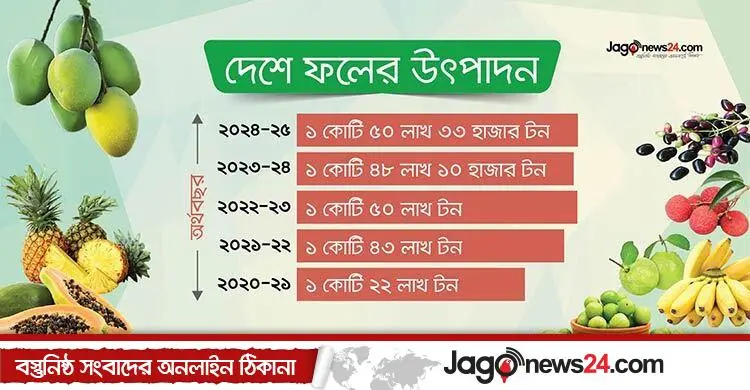
Bangladesh now produces 1.5 crore tonnes of fruit a year, up from one crore tonnes a dozen years ago. Growing commercial production has brought sustained, steady growth. Over this period the output of several fruits, including mango, jamun, litchi, banana and pineapple, has risen, while jackfruit and coconut have fallen.
Department of Agricultural Extension (DAE) data show that 1,50,33,000 tonnes of fruit were produced in the last fiscal year (2024-25), on 7,65,559 hectares.
The data show that exactly a dozen years earlier, in 2013-14, fruit production was 99,72,000 tonnes, grown on 6,78,145 hectares.
Production then rose to 1.06 crore tonnes in 2014-15, 1.10 crore the following year and then 1.20 crore tonnes. In the next two years (2017-18 and 2018-19) it was around 1.21 crore. In the following years production was 1.23 crore tonnes, 1.22 crore, 1.43 crore and 1.50 crore tonnes respectively.
The report gives production in the last fiscal year (2023-24) as 1,48,10,000 tonnes of fruit, on 7,57,496 hectares.
Winners and losers among the main fruits
The DAE holds separate figures for the country's ten main fruits, but the 2024-25 data have not yet been updated; the latest separate figures run to 2023-24. They show that among the ten main fruits, production of mango, jamun, litchi, banana, jujube (boroi), papaya, guava and pineapple has risen.
Over the dozen years from 2012-13 to 2023-24, mango production rose from 15,04,000 tonnes to 25,08,000 tonnes. Mango was grown on 1,56,000 hectares before; it is now grown on 2,05,000 hectares.
Over the same period jamun rose from 37,000 tonnes to 45,000 tonnes, litchi from 1,19,000 to 2,30,000 tonnes, banana from 15,01,000 to 24,38,000 tonnes, papaya from 4,52,000 to 7,26,000 tonnes, guava from 3,14,000 to 6,13,000 tonnes, jujube from 1,60,000 to 1,76,000 tonnes and pineapple from 2,39,000 to 5,80,000 tonnes.
Among the main fruits, jackfruit and coconut production fell over the dozen years. Jackfruit output was 32,12,000 tonnes in 2012-13 but fell to 18,30,000 tonnes by 2023-24, and the area under jackfruit shrank from 82,691 hectares to 58,700 hectares. Coconut production fell from 5,91,000 tonnes to 5,05,000 tonnes over the dozen years.
Those involved say that although Bangladesh produces plenty of jackfruit thanks to favourable terrain, it lags far behind in producing and exporting jackfruit and jackfruit products. Because its diverse uses have not grown, jackfruit does not fetch a good price, and so there is no commercial production.
DAE horticulturist Md Moinul Haque told Jago News: "Although production of other fruits has risen, people are reluctant to eat jackfruit. That is why it has not been grown commercially like mango and litchi, and that is why its production is falling."
Foreign fruits take root
Besides the main local fruits, production of foreign fruits such as dragon fruit, strawberry and malta is rising every day, and these have now become commercial fruits in Bangladesh.
DAE data show dragon fruit production rose by about 400 per cent in three years. In 2021-22, dragon fruit was grown on 1,115 hectares, producing 13,872 tonnes. In 2022-23, production from 2,588 hectares reached 51,287 tonnes, and in 2023-24 it rose to 68,813 tonnes.
Horticulturist Moinul Haque said: "Dragon fruit cultivation began in Bangladesh with varieties brought from Thailand, the United States and Vietnam. It is now grown commercially in significant quantities. This type of fruit is medium-sized and sweet, and yields well."
Commercial cultivation of strawberry, an attractive fruit of cold countries, began in Bangladesh in 2007. Despite many difficulties, it has established itself as a high-value crop.
Local malta is now grown in almost every district, with orchards and output rising year by year. Malta production was 17,000 tonnes in 2018-19 and exceeded 84,000 tonnes in 2024-25. Over the same period malta orchards grew from 2,433 hectares to almost 8,000 hectares. Malta is now grown most in the hill districts: Bandarban leads the country, followed by Khagrachhari, with Rajshahi third.
Besides dragon fruit, malta and strawberry, high-value foreign fruits such as rambutan, avocado, persimmon, kathlichu and sammam (muskmelon) are now grown in the country.
Horticulture wing officials say farmers are keen on foreign fruits to meet growing demand, cut dependence on imports and because they are profitable.
According to the DAE, total production of various foreign fruits rose from 1,46,922 tonnes in 2022-23 to 1,68,577 tonnes in 2023-24, an increase of more than 21,000 tonnes in a year. Over the same period the area under foreign fruits grew from 15,431 hectares to 16,568 hectares.
Imports and the next project
Alongside domestic production, 38 types of fruit are now imported to meet demand. According to the National Board of Revenue (NBR), Tk 4,500 crore was spent on importing foreign fruit in 2023-24, the latest year. No precise figures were found on how much was spent on each fruit; fruit-by-fruit import data from the DAE were available only up to 2022-23.
Those data show that in 2022-23 Bangladesh imported 1,70,000 tonnes of apples, 1,94,000 tonnes of oranges, 95,130 tonnes of grapes, 75 tonnes of mango, 6,093 tonnes of pomegranate, 60,538 tonnes of malta, 21,585 tonnes of kinnow and 490 tonnes of dragon fruit.
Sirajul Islam, president of the Bangladesh Fresh Fruits Importers Association, told Jago News: "The cost of importing fruit has risen, so dependence on foreign fruit is falling and imports are falling too. Imports are now much lower than in 2022-23."
The DAE's Nutrition Improvement through Year-round Fruit Production project played a big role in increasing fruit production in the country. That project ended this year.
Abdul Halim, the project's last director, said plans are under way for another new project on the same model. "Efforts are being made to take up a new project to increase fruit production again," he said. "Through the government's earlier efforts, dependence on imported fruit fell sharply as local fruit production grew."
He said: "People now eat more local fruit. Many young people are finding work in growing local and foreign fruit. Commercial activity in fruit is expanding, and private entrepreneurs are increasingly interested in processing. The government is working to provide more policy support to raise production in this sector and encourage entrepreneurs."
Source: Jagonews24. First published in Bengali on The Agro News.

Comments
(0)