
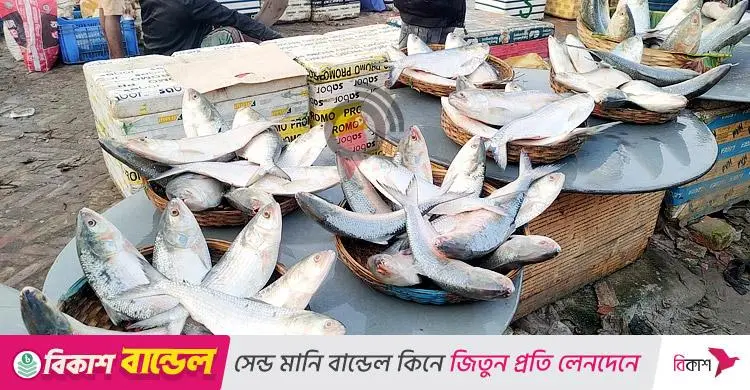
Bangladesh's fish production crossed 50 lakh tonnes in the 2023-24 fiscal year, when 50 lakh 18 thousand tonnes of fish were produced. It was a new "milestone" in the country's total fish output.
The government has not yet compiled precise production figures for 2024-25, but the Department of Fisheries believes output has risen further over the previous year.
Last year (2024) also brought good news on the global stage for Bengalis, famously people of "fish and rice": Bangladesh moved up from third to second in the world in freshwater fish capture. The information appeared in the Food and Agriculture Organization's (FAO) "The State of World Fisheries and Aquaculture 2024" report.
Where the fish comes from
Overall, Bangladesh is going through a good period for fish production. Data show that in 2023-24 Bangladesh harvested fish from 47 lakh hectares of water bodies. Of the total, farmed fish accounted for 29 lakh 78 thousand tonnes and capture from open water bodies 14 lakh 11 thousand tonnes; the rest came from the sea.
Half of the fish caught from open water bodies is hilsa. That year Bangladesh produced 5 lakh 29 thousand tonnes of hilsa alone.
The country's open water bodies hold 261 species of fish, but 56 per cent of Bangladesh's fish comes from ponds. Pond farming has increased production nearly six-fold over the past three decades. Besides ponds, planned farming in beels and rivers is also helping raise output.
Dr Md Motaleb Hossain, director (inland fisheries) of the Department of Fisheries, told Jago News: "For almost a decade a revolution in fish farming has been under way in the country, with everyone's sincere effort. Fish production has increased thanks to conserving various native fish varieties and making them suitable for pond culture, observing fishing bans, and the government's fisheries-friendly policies."
Against this backdrop, National Fisheries Week 2025 is being observed from 23 to 29 July this year, with the theme "Let us build sanctuaries, and fill the country with native fish."
Growth over the decades
Data show that fish production in Bangladesh has risen by more than a third over the past 12 years; total output in 2011-12 was 30 lakh 62 thousand tonnes. Over the past four decades total fish production has risen more than six-fold: in 1983-84, 7 lakh 54 thousand tonnes were produced.
With the significant rise in production, per capita daily fish intake has risen to 67.80 grams against a requirement of 60 grams. The fisheries sub-sector contributes 2.53 per cent of total GDP and 22.26 per cent of agricultural GDP.
Professor Abdul Wahab of Bangladesh Agricultural University told Jago News: "Small and medium-sized fish species in the country's haors and beels should now be protected during their breeding season. Then it will be possible to raise production of nutritious small fish further."
About two crore people, over 12 per cent of the population and including 14 lakh women, earn their living directly or indirectly from various activities in the fisheries sector.
Exports and modernisation
Bangladesh also earns significant foreign currency by exporting shrimp and other fish products. Fish accounts for 0.99 per cent of national export earnings. In 2023-24, about 77 thousand tonnes of fish and fish products were exported, earning Tk 450 crore.
Bangladesh ranks first in the world in hilsa production, and fourth in the world and third in Asia in tilapia production.
An initiative has been taken to modernise government fish farms to raise national fish production by another 30 per cent. Production will be increased using modern technology at the existing 113 government fish hatcheries and farms in 56 districts. A project of about Tk 372 crore from the government's revenue budget is being implemented for this. The project began in 2024 and will run until 2028.
Source: Jagonews24. First published in Bengali on The Agro News.

Comments
(0)