
An outbreak of Russell's viper (chandrabora) has caused snake panic across the country, and the government's Directorate General of Health Services (DGHS) has taken note. To ensure proper treatment of snakebite patients, the government has decided to buy twice as much antivenom this year as last year.
Antivenom injection is the main treatment for snakebite, but supply at the grassroots falls short of demand. Only the government buys it and supplies it to district and upazila hospitals; there is no record of any pharmaceutical company selling it privately.
Besides buying more antivenom, the DGHS is also putting importance on quickly collecting accurate figures from district and upazila hospitals, after years of laxity in gathering data on snakebite patients.
Health officials claim that, although there have been no accurate figures, the number of snakebite victims has not risen significantly. The number of Russell's vipers, however, is steadily increasing.
Health officials and snake experts say that killing snakes was once seen as the answer when they became a nuisance, but it is now considered an offence. Snakes also play an important role in keeping the environment in balance. Killing them is therefore not the solution; what is needed is to follow the necessary precautions against bites and to build wide public awareness.
Cases and deaths this year
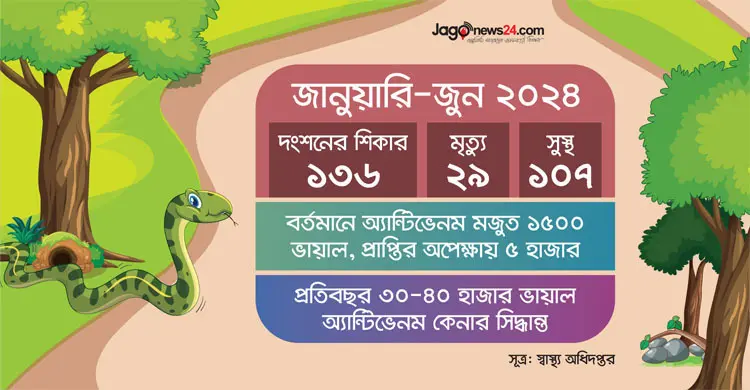
Dr Zahidul Islam, deputy programme manager (e-Health) of the DGHS and in charge of the Health Emergency Operation Centre and Control Room, said: "This year a total of 136 people across the country have been bitten by snakes. Of them, 29 have died. Government hospitals could confirm 17 of the deaths; the other 12 were learned of from the media. Of those bitten, 107 recovered after hospital treatment."
He said they have no information on whether those who died were bitten by Russell's vipers or other snakes.
In the 2023-24 fiscal year the DGHS was to collect and distribute a total of 25,000 doses of antivenom in phases across the country for patients bitten by all kinds of snakes, including Russell's viper. Of these, 15,000 vials were to come from the state-owned Essential Drugs Company Limited (EDCL) and 10,000 from the World Health Organization.
30,000-40,000 vials next year
Dr Nosayer Chowdhury, deputy programme manager of the DGHS Non-Communicable Disease Control (NCDC) programme, told Jago News: "In the last fiscal year (July 2023 to June 2024), 20,000 vials of injection were collected. Of them, 18,500 vials were supplied to district and upazila hospitals across the country. The current stock is only 1,500 vials. Another 5,000 vials will be added soon."
He said that from the next fiscal year (July 2024 to June 2025), 30,000-40,000 vials of antivenom injection will be bought through the DGHS alone. Any additional antivenom received through the WHO would be a bonus.
He also claimed that the number of snakebite patients has not risen significantly. Asked how he could be sure, he said: "Data on various diseases is collected through the Health Emergency and Crisis Management Centre under the DGHS Management Information System (MIS) branch. We have not received information from them that snakebite patients have increased. And we learn from newspapers that the number of Russell's vipers has risen. The rise in numbers is a matter for the livestock department."
Asked whether Russell's viper is deadly venomous, Dr Nosayer Chowdhury said: "Russell's viper is comparatively less venomous than other venomous snakes, because the amount of neurotoxin is much higher in other venomous snakes and relatively lower in Russell's viper. But whereas signs and symptoms show quickly after other snakebites, here they appear much later. By then the patient's physical condition has deteriorated."
He added that while other snakes move away quickly when they sense people, this snake does not; it stays in place and keeps making a noise.
Spread to 27 districts
According to the Venom Research Centre at Chittagong Medical College Hospital, in 2013 a snakebite patient from Nachole in Chapainawabganj came to Rajshahi Medical College. The snake had bitten him when he tried to catch it, thinking it was a baby python. Experts later identified it as a Russell's viper (chandrabora).
By May 2024 the snake had spread to 27 districts, most of all in the districts along the Padma river and its branches.
A 2018 research paper says Russell's viper was once found in 11 districts of Bangladesh (Nilphamari, Dinajpur, Rangpur, Bogura, Chapainawabganj, Rajshahi, Jashore, Satkhira, Khulna, Bagerhat and Chattogram), but from 2013 to 2016 its presence was confirmed in only nine districts, including six new ones (Dinajpur, Chapainawabganj, Rajshahi, Naogaon, Natore, Pabna, Rajbari, Chuadanga and Patuakhali).
According to a 2023 paper by Venom Research Centre researchers, based only on confirmed records such as collected snakes and bite victims, Russell's viper was documented in six districts of Rajshahi division other than Bogura and Sirajganj; in Rajbari, Faridpur, Madaripur, Shariatpur, Manikganj, Dhaka and Munshiganj in Dhaka division; in Kushtia and Chuadanga in Khulna division; in Chandpur, Noakhali and Lakshmipur in Chattogram division; and in the five districts of Barishal division other than Pirojpur.
By May 2024 the snake had been found in four more districts (Jashore, Satkhira, Jhenaidah and Meherpur). Russell's viper has spread 11 years after it was first identified.
Experts believe the spread is due to the destruction of snake habitat under the impact of climate change, infrastructure development, the spread of river water with floodwater and water hyacinth, and a fall in the numbers of predators such as monitor lizards, mongooses, owls, kites and hawks.
Several snake experts, speaking on condition of anonymity, said the snake could become even more widespread. Asked why, they said it breeds prolifically, producing 30-40 young at a time. While few young of other snakes survive, most of these do, so their numbers keep rising. In future the snake could spread everywhere in the country except the hill regions.
What to do if you see a snake
- Do not panic needlessly; let the snake go away.
- Snakes do not bite people willingly and will move away if given the chance. They bite only in self-defence or when provoked.
- Do not kill snakes needlessly: they benefit people by keeping insects and small animals in check and help keep the environment in balance.
Source: Jagonews24. First published in Bengali on The Agro News.


Comments
(0)