
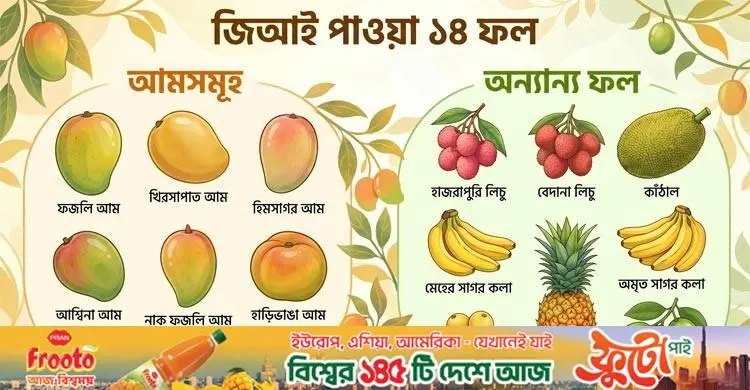
So far 64 Bangladeshi products have received geographical indication (GI) certification. Among fruits, mangoes dominate the list, alongside several well-known regional fruits and bananas. In all, 14 fruits now hold GI status.
Those involved say this legal recognition helps guarantee the quality of the fruits and creates opportunities for origin-based branding, while also helping farmers get fair prices in the market.
A geographical indication is a legal recognition that gives a product shaped by a particular region's environment, soil, climate and production tradition an identity distinct from all similar products. Even if a certain fruit variety is grown elsewhere, the taste, aroma, size and keeping quality of the fruit from the GI-listed region are distinct and its own.
The fruits on the list
The country's GI list includes Fazli mango from Rajshahi-Chapainawabganj, Khirsapat mango from Chapainawabganj, Himsagar mango from Meherpur, Ashwina mango from Chapainawabganj, Nak Fazli mango from Naogaon and Haribhanga mango from Rangpur.
Hazrapuri lychee from Magura, Bedana lychee from Dinajpur and Gazipur's jackfruit have also received GI status.
In addition, Meher Sagar banana from Meherpur, Amrita Sagar banana and latkan from Narsingdi, Madhupur pineapple from Tangail and amra (hog plum) from Barishal are now Bangladeshi GI products.
A 'GI mango belt'
GI recognition has begun to have a major positive effect on the country's fruit economy. With traditional mango varieties including Fazli, Khirsapat, Himsagar, Langra, Ashwina and Haribhanga receiving GI recognition, a strong "GI mango belt" is taking shape in the country's mango-growing areas.
This is not only raising the brand value of mangoes in the domestic market but also creating an effective plan for marketing high-quality, premium-priced mangoes at different points through the season.
Likewise, GI recognition for promising fruits such as lychee, latkan and jackfruit is opening new horizons for specialised markets, processing industries and agro-tourism centred on local heritage and origin.
Source: Jagonews24. First published in Bengali on The Agro News.
Comments
(0)